With the advancement of science and technology and the development of automation technology, mobile robots have been widely used in many industries such as manufacturing, logistics, medical care, and agriculture. In order to ensure that these robots can work smoothly and stably, cable assemblies play a vital role in their design and operation. Mobile robots usually operate in complex working environments and require frequent movement, turning, and contact with surrounding objects, which requires cable assemblies to have high flexibility, durability, and anti-interference capabilities. This article will explore the application of robot cable assemblies in mobile robots.
1. The key role of robot cable assemblies
In mobile robots, cable assemblies are mainly responsible for transmitting power, control signals, data communications, and sensor signals. Mobile robots usually have multiple moving parts (such as wheels, arms, sensors, etc.), which need to transmit energy and control signals through cables, so the reliability and durability of cables are crucial to the performance of robots.
2. Key features of mobile robot cable assemblies
Mobile robot cable assemblies need to be flexible, wear-resistant, and stretch-resistant to adapt to frequent movement and turning. The outer layer of the cable usually has anti-interference ability, which can effectively avoid the influence of electromagnetic interference on signal transmission. In addition, the cable must also have waterproof, oil-proof, dust-proof and other protective functions, especially when working outdoors or in harsh environments, to cope with different working conditions and temperature changes, to ensure the efficient operation and long-term stability of the robot.
3. Application examples of mobile robot cable assemblies
The application of mobile robots in different fields has different requirements for cable assemblies. The following are some typical application examples:
- Logistics robots: In logistics warehouses, automated transport robots need to perform complex movements and navigation in limited spaces. Cable assemblies need to withstand frequent bending and stretching during this process while maintaining good power transmission and signal stability. The wear resistance, stretch resistance and anti-interference of the cable are essential to ensure the efficient operation of the robot.
- Medical robots: Medical robots usually require highly precise operations during surgery and treatment, so their cable assemblies must not only support precise control signal transmission, but also have the ability to resist interference and electromagnetic interference while maintaining flexibility. Special medical cables also need to have waterproof and antibacterial properties.
- Agricultural robots: In agricultural automation, robots need to work outdoors and may face challenges such as moisture, mud, and corrosive substances. Cable assemblies must have strong waterproof, anti-corrosion and high temperature resistance characteristics, while maintaining flexibility to adapt to a variety of complex working environments.
- Service robots: Service robots (such as automatic cleaning robots, welcoming robots, etc.) need to move flexibly in dynamic environments. Cable assemblies must support various actions and be able to withstand long-term use. In order to ensure the stability of the robot, the cable must also have characteristics such as anti-stretching and wear resistance.
- Industrial robots: Industrial robots are often used in high-load and high-precision production line operations. Cable assemblies need to support large amounts of data transmission and power supply while having the durability and anti-interference capabilities required for high-frequency movement.

You may also like
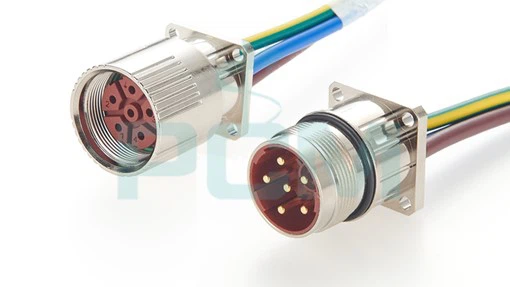
M23 Receptacle, Flange Mount

M23 Thread Power Supply Extension Cable

RJ45 to M12 cables for Servo Motors

M40 Power Cable 6SL3162-2MA00-0AC0

M16 Sensor Connector

M23 Servo Power Cable Right Angle