


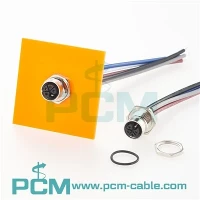


Servo Motor Encoder Cable
Introduction of Servo Motor Encoder Cable
Servo motor encoder cable - special cable for servo system, a new environmentally friendly series product, the cable has a series of unique characteristics such as high flexibility, wear resistance, folding resistance, oil resistance, bending resistance, tensile resistance, torsion resistance, anti-interference, and aging resistance. It is used as a special servo cable for connecting and controlling the servo system. It is perfectly combined with the operation of the servo motor, greatly improving the working efficiency of the servo motor (control motor, actuator motor).
Benefits of Servo Motor Encoder Cable

Resistant to bending and drag chains
Using highly flexible special mixed elastic PVC material, resistant to tension and bending

Resistant to oil and corrosion
After 30 days of immersion test, the cable can still be used normally

Low eccentricity
The thickness of the sheath is uniform, preventing current breakdown and effectively protecting the wire core to ensure electrical safety

Resistant to high and low temperatures
The cable can be used normally at low temperatures of 30 degrees and high temperatures of 105 degrees

Double Shielding and Anti-interference
High-density shielding net + aluminum foil, with better anti-interference performance

Wide Range of Applications
Used for various mobile installations such as automation equipment, robots, tank chains, etc.

Flame-retardant PVC Jacket
It goes out instantly when it leaves the light, a small amount of white smoke, which is both environmentally friendly and safe

Clear Printing on the Cable Jacket
The wire body is printed with specifications, voltage and other information
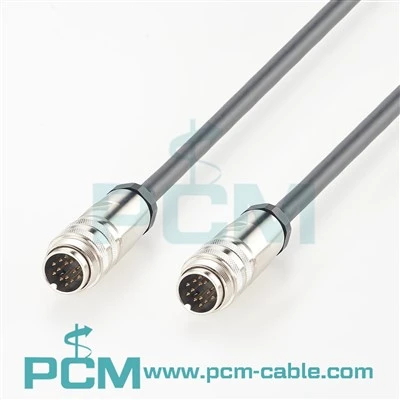

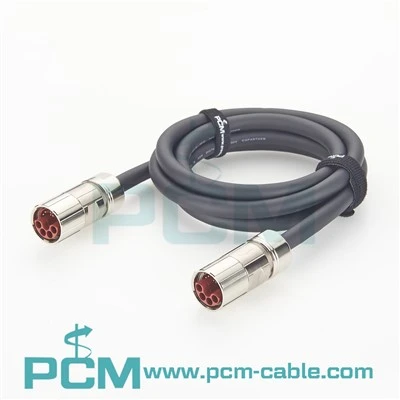


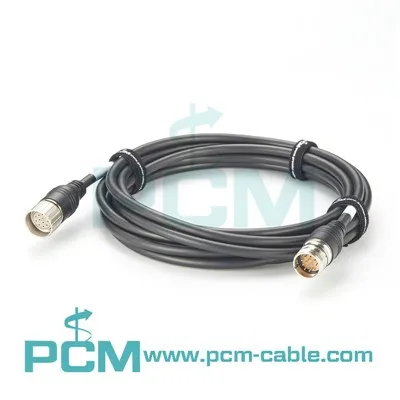
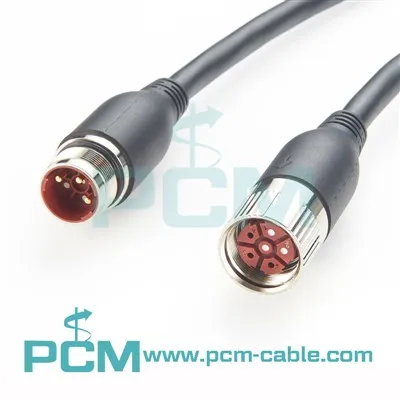

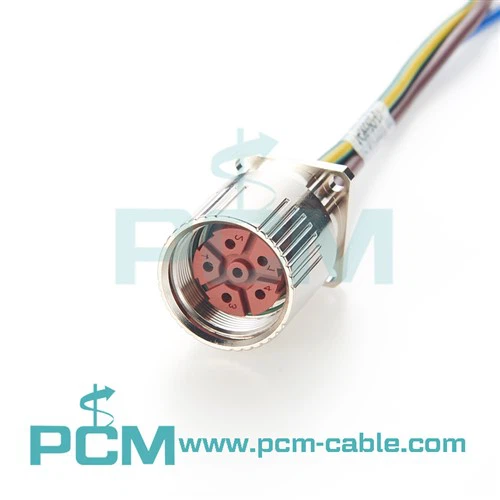

Types of Servo Motor Encoder Cable
Classification by Function
- Servo Power Cable
Mainly used to transmit power and provide the required power supply for servo motors or other equipment.
Applicable to servo motors of various brands, such as SIEMENS, FANUC, Mitsubishi, etc.
- Servo Signal Cable
Used to transmit various control signals, such as start, stop, adjustment, etc.
Applicable to controllers, sensors and actuators of various brands, such as OMRON, Allen-Bradley, Schneider Electric, etc.
- Servo Encoder Cable
Used to connect encoders and transmit signals of position or motion information.
Applicable to encoders of various brands, such as Heidenhain, SICK, Baumer, etc.
- Servo Brake Cable
Mainly used to transmit brake signals and control the brake function of servo motors or other equipment.
Applicable to some servo systems that require brake functions, such as FANUC, Yaskawa, etc.

Classification by connector type
- M23 connector cable
- Applicable to many industrial equipment, such as servo motors, encoders and sensors.
- M23 cables are very common in German brands, such as FANUC and SIEMENS.
- M23 cables usually have reliable protection performance and can be used in harsh industrial environments.
- Pin numbers: 4 Pin, 6 Pin, 8 Pin, 12 Pin, 17 Pin, 19 Pin
- M12 connector cable
- Applicable to small robots, sensors and actuators.
- M12 cables are widely used in some brands, such as OMRON and BALLUFF.
- M12 cables usually have compact design and lower cost, suitable for space-constrained applications.
- D-sub connector cables
- Applicable to some specific encoders and sensors, as well as some old-fashioned equipment.
- D-sub connectors may be more common in some brands, such as Panasonic.
- D-sub connectors usually have a large number of pins and are suitable for occasions where multiple signals need to be transmitted.
- Other Connector Types
In addition to M23, M12, and D-sub connectors, there are other types of connectors, such as RJ45 connectors. These connectors may be used in specific brands or special applications, depending on the design of the equipment and the manufacturer's preference.

Applications of Servo motor encoder cable

Fixed installation
Used in places where the cable does not move, such as fixed in a cabinet.
Choose ordinary standard flexible type, wear-resistant type, waterproof type, strong interference type, and other cable products.

Long-term drag chain operation
Used for long-term U-shaped drag chain operation, which has high requirements for the bending resistance of the wire.
Choose high-flexibility, ultra-high-speed drag chain cables: wear-resistant, bending-resistant, etc.

Robot torsional motion resistance
Applied in robot wiring. Attention should be paid to the wire's forward bending parameters, back-and-forth twisting number, etc.
Choose extra-flexible, ultra-flexible and wear-resistant products.

Industrial Automation
Applied to mechanized automatic devices, such as automated industrial manufacturing, various industrial automation, electromechanical equipment, machine tools, logistics equipment, etc.

Robotic automation
Provide cable solutions for unmanned robot restaurants and cafes.
Requires resistance to oil smoke, high temperature, low temperature, bending and wear.

Servo motor drive system
Suitable for installation under continuous reciprocating motion and frequent bending in industrial environments.
Suitable for various electrical installations in dry or humid indoor or outdoor environments.
Application of M23 Cable in Interbus

Interbus is a Fieldbus communication protocol used in the field of industrial automation. It allows real-time data transmission and control between various industrial devices, thereby realizing automated control and monitoring.
The application of the M23 cable in the Interbus system is usually as a connection cable to connect various Interbus devices, such as IO modules, sensors, actuators, etc. These devices communicate with PLC or other controllers through the Interbus network to achieve data exchange and transmission of control instructions.
The specific applications of M23 cable in the Interbus system include:
1. Connecting IO module: Connecting the IO module to the Interbus bus to transmit external input/output signals to PLC or other controllers, or to send control signals from the controller to external devices.
2. Connecting sensors: Connecting various sensors (such as temperature sensors, pressure sensors, etc.) to the Interbus network through the M23 cable for real-time monitoring of various parameters in the production process.
3. Connecting actuators: Connecting actuators (such as motors, cylinders, etc.) to the Interbus network through M23 cables to receive control instructions and perform corresponding actions.
4. Connecting additional devices: Connecting other types of devices (such as encoders, counters, etc.) to the Interbus network through M23 cables to expand the functions and monitoring capabilities of the system.
About Factory

Premier Cable: Your Go-To Source for Precision Servo Motor Encoder Cables
As a manufacturer focusing on the research and development of industrial control connection system wiring harnesses and robotics wiring harnesses, Premier Cable is committed to providing customers with high-quality and reliable products. Our product range covers a variety of encoder cables, servo motor cables, brake cables, absolute encoder cables, etc. to meet the needs of different industries.
Our products are compatible with many well-known brands, including Siemens, Schneider Electric, Matsushita, Mitsubishi, Fuji, Delta, FANUC, Omron, etc. This ensures that our products can work perfectly with customers' existing equipment and systems, whether in the field of industrial automation or robotics.
Frequently Asked Questions
How long can a servo motor encoder cable be?
+
-
Typically, the length of a servo motor encoder cable can be between 1 meter (about 3 feet) and 10 meters (about 33 feet). Cable lengths in this range can usually meet the needs of most industrial automation and mechanical applications. However, for some special applications, longer or shorter cable lengths can also be customized to meet specific requirements.
What is the minimum bending radius of the servo motor cable?
+
-
For servo motor cables, the minimum bending radius usually depends on the application scenario, such as mobile applications or fixed installations. Generally speaking, in mobile applications, in order to ensure the durability and reliability of the cable, the minimum bending radius will be slightly larger. In the case of fixed installations, the cable is usually in a static state, so the minimum bending radius can be relatively smaller.
For mobile applications: 7.5 x the outer diameter of the cable
For fixed installations: 5 x the outer diameter of the cable
The difference between servo motor cables and ordinary cables
+
-
Purpose:
Servo motor cables are specially designed to connect servo motors and related equipment for transmitting control signals, feedback signals, and power supply, etc., to achieve precise motion control and position feedback.
Ordinary cables are used for various general electrical connections, such as power transmission, data transmission, signal transmission, etc., and are often used in home, commercial and industrial applications.
Electrical performance:
Servo motor cables usually have higher electrical performance requirements, such as higher anti-interference ability, lower signal delay, higher current carrying capacity, etc., to meet the needs of precision control systems.
Ordinary cables usually have more general electrical performance and are suitable for general electrical connection needs, but may not be suitable for precision control systems.
Structural design:
Servo motor cables usually have more complex structural designs to adapt to complex control requirements and working environments, and may contain more wires, shielding layers, insulation materials, etc.
The structure of ordinary cables is relatively simple, generally including wires, insulation materials and outer protective layers to meet basic electrical connection needs.
Durability:
Servo motor cables usually have higher durability and anti-interference ability to adapt to harsh conditions such as high loads, high temperatures, vibrations, etc. in industrial environments.
Ordinary cables can be durable in general applications, but may not have the high performance and durability required for servo motor cables.
How many wires does a servo motor have?
+
-
Three-phase servo motors: Servo motors used in most industrial applications are three-phase motors, which usually have 3 main power supply wires, phase A, phase B, and phase C. In addition, additional wires may be included for grounding or other signal transmission.
Single-phase servo motors: Some smaller servo motors may be single-phase motors, which usually have 2 power supply wires (positive and negative) and possible additional wires for signal transmission or grounding.
Multi-pole servo motors: In some high-performance servo motors or special applications, there may be more wires to support more complex control and feedback systems, such as encoder feedback signals, temperature sensors, etc.
What is a servo motor cable?
+
-
Servo motor cable is a special cable used to connect servo motors and controllers. It has a special design and structure to meet high requirements for signal transmission, anti-interference and durability. It usually includes wires for power, data and feedback signal transmission, as well as possible shielding layers and insulation materials. Common interface types include M12 cable, M23 cable, etc.
Should servo motor encoder cable be shielded?
+
-
The servo motor encoder cable should be shielded because the servo system is usually used in an industrial environment and may be greatly affected by electromagnetic interference.
How does an encoder cable for a servo drive work?
+
-
The encoder cable of the servo drive is used to transmit position and speed feedback signals by connecting the encoder and the drive. Its working principle generally includes the following steps:
Encoder operation: The encoder is installed on the servo motor and converts this information into digital signals by sensing the position and speed of the motor rotor.
Signal transmission: The encoder transmits digital signals of position and speed to the servo drive through the encoder cable. The wires in the encoder cable transmit these signals from the encoder to the drive.
Drive decoding: The drive receives the signals transmitted by the encoder and controls the rotation of the motor based on these signals. The drive adjusts the rotation of the motor based on the received position and speed feedback signals to achieve precise position control and speed control.
Feedback control: The drive uses the position and speed information obtained from the encoder, compares it with the set value, and adjusts the output of the motor to ensure that the actual movement is consistent with the expected movement. This closed-loop control enables the servo system to achieve high-precision and stable motion control.
How does a servo brake work?
+
-
Servo brakes are usually electromagnetic brakes that achieve braking or release functions by controlling electromagnetic force. Its working principle is as follows:
Electromagnetic force control: The servo brake contains an electromagnetic coil inside, which generates electromagnetic force when powered. This electromagnetic force causes the brake disc inside the brake to contact the brake body fixed on the servo motor shaft, thereby achieving the braking function.
Brake release: When the brake needs to be released, the control system disconnects the power supply of the electromagnetic coil, so that the electromagnetic force disappears, and the contact between the brake disc and the brake body is also released, thereby releasing the brake.
Stability and reliability: Servo brakes are usually designed with a spring preloaded structure. Even in the event of power failure or failure, the brake will remain in the braking state, ensuring the stability and reliability of the mechanical device.
How to connect the servo motor cable?
+
-
Generally speaking, the wiring steps of the servo motor are as follows:
Confirm the power and ground cable: First, confirm the power cable and ground cable. The power cable is usually red, and the ground cable is usually brown or black. Connect the power cable to the corresponding power port and the ground cable to the ground port.
Connect the control signal: The control signal cable is generally orange, yellow, white or blue. According to the interface identification of the controller or driver, connect the control signal cable to the corresponding port.
Fix the connection: Make sure all connections are firm and reliable to avoid looseness or poor contact.
How to distinguish servo motor cables?
+
-
1. Number of encoder cables
First, the definition of the encoder cable can be distinguished by the number of servo motor encoder cables. Generally speaking, there are three or four encoder cables. If there are three encoder cables, they correspond to phase A, phase B, and phase Z, respectively, and are used to detect the phase and direction of motor rotation; if there are four encoder cables, in addition to phase A, phase B, and phase Z, there is also a power line.
2. Color of encoder cable
Secondly, the definition of the encoder cable can be distinguished by the color of the encoder cable. The colors of servo motor encoder cables of different manufacturers and models may vary slightly, but generally speaking, the color of the A phase cable is green or black, the color of the B phase cable is red or white, the color of the Z phase cable is blue or yellow, and the power line is generally red or brown. If you are not sure about the definition of the encoder cable, you can check the relevant specifications.
3. Interface of encoder cable
Finally, the definition of the encoder cable can be distinguished by the interface of the servo motor encoder cable. Generally speaking, there are two types of interfaces for encoder cables, namely terminals and plugs. If it is a terminal interface, you need to use a screwdriver to connect the cable to the terminal of the controller or drive; if it is a plug interface, you need to insert the cable into the plug of the controller or drive.
What are servo motors used for?
+
-
Servo motors are often used in applications that require precise control of position, speed, and torque, such as industrial machinery, robotics, CNC machining, etc. Servo motors can accurately adjust the position and speed of the output shaft according to the input signal, and are often used in scenarios that require high-precision motion control.
What are encoders used for?
+
-
Encoders are used to measure the position, speed and direction of motor or mechanical movement to provide accurate feedback information. In servo systems, encoders are usually used to monitor the position of the motor rotor and send feedback signals to the control system to achieve closed-loop control and ensure the accuracy and stability of the system. Encoders are also widely used in automation equipment, robots, CNC systems and other fields.
What do the colors of servo cables mean?
+
-
Ground (GND):
Usually brown or black is used to represent the ground wire, connected to the negative terminal of the battery.
Servo power (Vservo):
Usually red is used to represent the servo power, connected to the positive terminal of the battery.
Servo control signal line:
It can be orange, yellow, white, or blue, used to transmit control signals such as position and speed control.
What gauge wire do servos use?
+
-
The wire gauge commonly used for servo motors depends on the power, current, and application requirements of the motor. Generally speaking, smaller power servo motors may use thinner wires, while higher power servo motors require thicker wires to carry higher currents. Common wire gauges include wire diameters ranging from 22AWG to 16AWG.