Due to the complexity of the robot system and the variability of the working environment, cable assemblies often face various faults and problems. If these problems are not solved in time, they may affect the performance of the robot and even cause equipment failure.
The following are common faults and problems of robot cable assemblies during use, and provide corresponding avoidance methods.
1. Cable wear and breakage
Problem: Cable wear and breakage is one of the most common problems of robot cable assemblies. During the movement of the robot, the cable will be frequently bent, stretched or impacted by external forces, especially in the joints or high-frequency movement areas. Over time, problems such as cable sheath wear, wire breakage, and insulation damage are prone to occur.
How to avoid:
- Choose highly flexible cables: Use specially designed flexible cables and bending-resistant cables in joints or places where frequent movement is required.
- Cable protection: Use protective devices such as cable sheaths, conduits or cable chains to reduce friction and collision between cables and other objects.
- Regular inspection and maintenance: Regularly inspect cables, especially cables in the moving parts of the robot, and promptly detect signs of wear and replace them.
2. Signal interference and electromagnetic compatibility issues
Problem: Robot cables are often used for high-speed data transmission and signal control. In this case, electromagnetic interference (EMI) may cause signal loss, data errors or control failure. Especially when the signal cable is exposed to a strong electromagnetic field, the interference will be more serious.
How to avoid:
- Use shielded cables: Select cables with a shielding layer, which can effectively block external electromagnetic interference and ensure stable signal transmission.
- Reasonable wiring: Avoid parallel wiring of signal cables with power cables or other high-voltage cables to reduce the possibility of electromagnetic interference.
- Install EMI filters: Use electromagnetic interference filters in the robot system to further improve electromagnetic compatibility.
3. Loose or corroded cable connectors
Problem: The cable connector part may become loose, oxidized or corroded due to long-term use. Connector problems can cause unstable cable connections, resulting in power transmission interruptions or signal loss.
How to avoid:
- Check the connector regularly: Check the connector part of the cable regularly to ensure that it is tight and corrosion-free. If looseness or corrosion is found, clean and reconnect it in time.
- Use anti-corrosion connectors: Choose anti-corrosion materials or gold-plated connectors, especially when used in humid or corrosive environments.
- Ensure correct installation: Ensure that the connector and connector are correctly matched during installation to avoid over-tightening or over-loosening the connector.
4. Cable damage caused by high temperature
Problem: When the robot works in a high-temperature environment, the cable may age, break insulation and other problems due to high temperature. High temperature not only affects the physical properties of the cable, but may also cause the electrical characteristics of the cable to deteriorate, eventually leading to failure.
How to avoid:
- Choose high temperature resistant cables: In high temperature working environment, choose specially designed high temperature resistant cables to ensure that the cables can withstand the influence of high temperature environment.
- Improve ventilation and heat dissipation: Ensure that the robot equipment has a good heat dissipation system to avoid long-term overheating.
- Check the cable sheath regularly: High temperature environment can easily cause the cable sheath to age. Check the cable regularly and replace it in time if signs of aging are found.
5. Inappropriate cable length
Problem: Cables that are too long or too short can cause problems. Cables that are too long are prone to cause unnecessary curling or swinging, increasing the risk of wear; while cables that are too short may limit the robot's range of motion, causing the cable to stretch or break.
How to avoid:
- Customize the cable length according to needs: Choose the cable length reasonably according to the actual needs of the robot. Cables that are too long can be sorted and bundled to avoid excessive swinging, and cables that are too short should ensure that there is enough margin to support free movement.
- Avoid cable stretching: Ensure that the cable length is moderate to avoid stretching due to cables that are too short, which affects the flexibility of movement.

You may also like
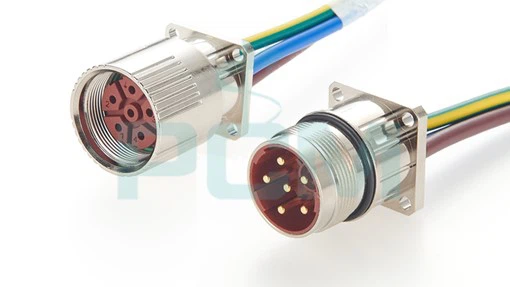
M23 Receptacle, Flange Mount

M23 Thread Power Supply Extension Cable

RJ45 to M12 cables for Servo Motors

M40 Power Cable 6SL3162-2MA00-0AC0

M16 Sensor Connector

M23 Servo Power Cable Right Angle