




NMEA2000 Cables & Connectors
why choose us
Reliable manufacturer of NMEA 2000 connectors and cables for fast data transmission

why choose our products
We specialize in manufacturing NMEA 2000 connectors and cables, offering competitive prices and assured quality. Our products feature high waterproof performance, proven through rigorous testing including prolonged submersion. Utilizing trusted brand plugs ensures reliability. Additionally, we conduct salt spray testing to guarantee durability in challenging environments. Whether for marine connections or specialized applications, count on us for dependable solutions.
What is NMEA 2000?
What is NMEA 2000?
NMEA 2000 is a digital communication protocol specifically designed for data communication between ships and ship equipment. It is a standardized network protocol that allows efficient and reliable data exchange and communication between various ship systems (such as engines, navigation equipment, radar, autopilot, etc.).
NMEA 2000 VS NMEA 0183
NMEA 0183 is an older ship data communication protocol, mainly used to transmit simple data such as basic position, speed and direction. It uses serial communication, suitable for simple navigation equipment and short-distance communication needs.
NMEA 2000 is a modern digital communication protocol based on the Controller Area Network (CAN) bus architecture. It supports multi-point connection and high-speed data transmission, and can simultaneously process complex ship system data such as engine parameters, power management and navigation information. NMEA 2000 is suitable for complex ship system integration and advanced functional requirements.
NMEA 2000 & CAN
CAN is a general industrial control network protocol, while NMEA 2000 is a high-level data communication protocol based on the CAN bus designed specifically for ships.
NMEA 2000 adds specific ship data and network management functions based on the CAN protocol, such as ship system integration, multiple sensor data exchange, and network topology optimization. NMEA 2000 supports high-speed, multi-point data transmission, and is suitable for complex ship system integration and advanced application requirements.
NMEA 2000 & DeviceNet
The NMEA 2000 network uses DeviceNet standard hardware, including cables and connectors, to create its communication infrastructure. DeviceNet has been widely proven in multiple industries such as automotive and agriculture, which enables it to operate stably in marine environments with good durability and reliability.




Types of NMEA 2000 Connectors and Cables

NMEA 2000 Network with Standard Terminators
- Linear backbone network construction
- Female termination resistor and male termination resistor are installed at both ends of the backbone network.
NMEA 2000 Network with an In-line Terminator
- Used when there is a long extension cable between the final device and the backbone network, and the traditional T-connector/branch cable/terminator combination is not suitable.
- Replaces the last T-connector on the backbone network, providing more flexible installation options.
- The final device can be connected to the series terminal resistor via a drop cable, or directly to the female connector of the series terminal resistor.
NMEA 2000 (Tee) T-connector
NMEA 2000 T-connectors are used to connect trunk lines and branch lines, allowing multiple devices to be added to the network. They have different number of port options, ranging from single port to six ports, suitable for simple to complex network layout requirements. These connectors can effectively support data communication and integration between ships and ship equipment, ensuring the stability of network operation and the reliability of data transmission.


NMEA 2000 Backbone Cable
NMEA 2000 backbone cable is used to extend the NMEA2000 backbone line. The maximum length of a single backbone line is 100 meters.
NMEA 2000 Drop Cable
NMEA 2000 drop cables are used to connect devices to a branch of the main NMEA 2000 network, usually connected to a T-connector. This cable allows various sensors, displays, and other devices to be connected to the network, supporting data transmission and communication between devices. The length and connection method of the drop cable should be determined according to the specific device installation location and network layout to ensure network stability and data transmission reliability.


NMEA 2000 Power Cable
The NMEA 2000 power cable is used to provide power to devices in the NMEA 2000 network. This cable connects to an appropriate power source (such as a battery or power distributor) to provide the required power to various sensors, displays, and other devices in the network. The installation and connection of the power cable should comply with the NMEA 2000 standard to ensure stable operation of the network and normal operation of the devices.
NMEA 2000 engine interface cable
NMEA 2000 engine interface cable is used to connect the ship engine to the NMEA 2000 network, transmitting key engine data such as speed, oil pressure, etc., and supports many well-known brands such as Yamaha, Honda, Lowrance, etc.
Through these interface cables, the engine data can be connected to other devices (such as GPS navigation systems, ship instruments, etc.) through the NMEA 2000 network, so as to achieve real-time monitoring and management of the engine status.
There are two styles: 4-pin and 6-pin. 4-pin is used as Yamaha engine interface cable. 6-pin is used as Honda engine interface.


Field Attachable Connectors
Field attachable connectors allow users to perform customized installations on-site to meet different wiring requirements and device connection methods, providing flexibility and convenience. There are two designs, 180° and 90°. They are designed with rugged housing materials to withstand harsh marine environments and ensure long-term reliable operation. In particular, the 90° connector is suitable for installation in small spaces, such as the back of a display. These connectors meet IP67 waterproof standards and can effectively prevent the intrusion of water and dust, ensuring the reliability and durability of the equipment under various environmental conditions.
NMEA 2000 Gender Charger
NMEA 2000 gender chargers are designed to solve the problem of connecting the same type of male and female connectors in marine electronic systems. Products include NMEA 2000 micro gender chargers and NMEA 2000 mini gender chargers, providing adapters and cable options to ensure compatibility and connection reliability.


NMEA 2000 Power Isolator
The NMEA 2000 power isolator is a product used to isolate and protect the power supply in the NMEA 2000 network. Its main function is to ensure a stable power supply and prevent electrical interference or faults from affecting network performance.
NMEA 2000 Bulkhead Feed-thru Connector
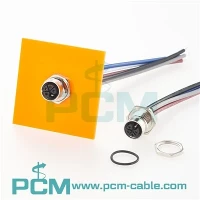
The NMEA 2000 Bulkhead Feed-thru Connector is used to pass NMEA 2000 network cables through bulkheads or walls, ensuring seamless integration between different instruments and systems. It is compatible with other manufacturers' NMEA 2000 T-connectors, cables and sensors, supporting plug-and-play. There are two models available: NMEA 2000 Mini Bulkhead Feed Through Connector and NMEA 2000 Micro Bulkhead Feed Through Connector, the connector type is male to female, suitable for various installation needs of marine and marine applications.


Self-contained Boat Network
NMEA 2000 Self-Contained Boat Network is a compact NMEA 2000 network solution designed to simplify the installation process, especially for small vessels and marine applications. It provides two options: 4-way NMEA 2000 Self-Contained Boat Network and 8-way NMEA 2000 Self-Contained Boat Network. Each unit integrates the functions of 4 or 8 T-connectors into one housing, eliminating the need for additional T-connectors and connecting wires, saving installation time and space. Built-in terminal resistors further simplify installation steps and reduce costs. Suitable for marine environments, it can stably connect multiple NMEA 2000 devices and provide a simple and reliable network connection solution.
NMEA 2000 Instrument Drop
NMEA 2000 Instrument Drop is a solution that simplifies multi-device connectivity by connecting multiple devices via a single cable, significantly reducing the complexity and cost of NMEA 2000 cabling. The product provides NMEA 2000 Instrument 4-Way Drop, NMEA 2000 Instrument 6-Way Drop and NMEA 2000 Instrument 8-Way Drop options to adapt to different device connection needs and save installation time, space and cost.


M12-to-DB9 5-Pin Adapter Cable [NMEA 2000, CANopen]
M12-to-DB9 5-Pin Adapter Cable [NMEA 2000, CANopen] is a cable for connecting and recording data, suitable for obtaining data from the NMEA 2000 network of ships or vessels and the CANopen network of industrial machinery. It allows these data to be transferred to recording devices or other data processing equipment for analysis, monitoring or recording. This M12 to DB9 connection cable is often used to connect sensors, controllers or other equipment on ships, or in industrial environments for data acquisition and analysis of mechanical equipment. Through the M2 to DB9 interface, it is able to establish a stable data connection between different types of equipment, ensuring reliable transmission and recording of data.
NMEA 2000 Starter Kit
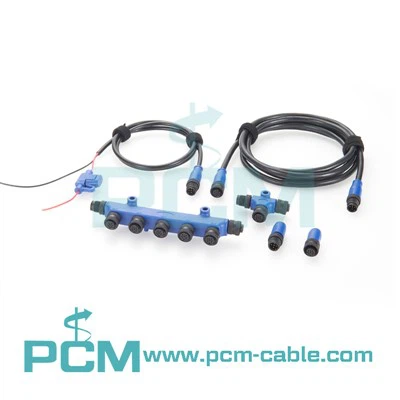
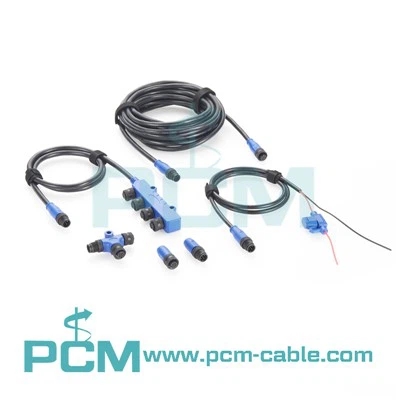
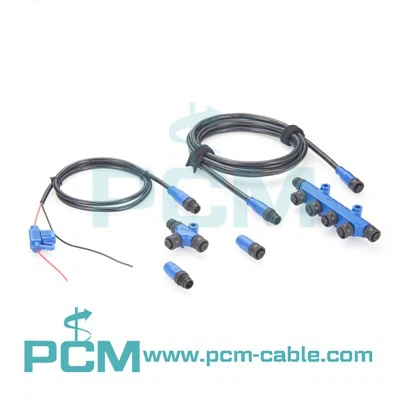
The NMEA 2000 Starter Kit is a complete starter kit that includes the necessary components to build and expand a NMEA 2000 network. The kit includes the following components: 1 male terminal resistor, 1 female terminal resistor, 2 T-connector, 1 backbone cable, 1 drop cable, and 1 power cable. These components allow users to quickly build a basic NMEA 2000 network and facilitate subsequent device additions and network expansion.

NMEA 2000 Cable System Types
Micro cable system
- Mainly used in small networks, the current of each network branch is usually less than 3 amps
Mid cable system
- Supports slightly higher current capacity than micro cables, usually less than 4 amps per network branch.
Mini cable system
- For large networks, the current per network branch is greater than 4 amps but less than 8 amps.

NMEA Cable Limitations
| Cable Type | Max Length | Max Amp | Power Pair | Data Pair |
| Per drop cable |
6m |
|||
| Sum of all drop cables | 78m | |||
|
Micro/Lite backbone (Terminator to terminator) |
100m | 3 | 22 AWG | 24 AWG |
|
Mid backbone (Terminator to terminator) |
250m | 4 | 18 AWG | 20 AWG |
|
Mini/Heavy backnone (Terminator to terminator) |
250m | 8 | 15 AWG | 18 AWG |
| The network must be properly terminated; a terminator is installed at each end of the backbone line | ||||
| The NMEA 2000 supply voltage must be between 9V and 16V | ||||
| Maximum of 50 physical devices on the network | ||||
| The voltage drop from one end of the network to the other must be less than 1.5V | ||||