1, Basic classification of automotive cables
Automotive cables can be roughly divided into the following categories based on their usage, structure, and materials:
Power cord: mainly used to provide electrical energy to various components of the car, such as engine starting, battery charging, lighting systems, etc. Power cords typically have high current carrying capacity and require good insulation performance to ensure safety.
Signal line: used to transmit signals between various sensors, controllers, and actuators, such as the engine control unit (ECU) receiving signals from oxygen sensors, throttle position sensors, etc., to adjust fuel injection quantity and ignition time. The signal line has high requirements for signal integrity and anti-interference ability.
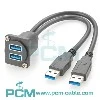
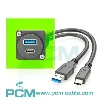
Data cable: With the development of intelligent automobiles, more and more electronic devices require data communication, such as in car entertainment systems, navigation systems, car networking modules, etc. Data cables typically follow specific communication protocols, such as CAN bus, LIN bus, FlexRay, etc., to achieve high-speed and reliable data transmission.
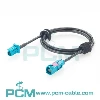
Coaxial cable: mainly used for connecting car antennas with receiving devices such as radios and televisions, transmitting high-frequency signals such as radio broadcasts and satellite signals. Coaxial cables have excellent anti-interference ability and signal transmission quality.
Optical fiber cable: With the improvement of data transmission rate and bandwidth requirements of automobiles, optical fiber cable has begun to be used in automobiles, especially in the Advanced Driving Assistance System (ADAS) and auto drive system, to transmit high-definition video signals and high-speed data.
2, Functions and characteristics of automotive cables
Different types of automotive cables serve different functions and also have their own unique characteristics:
Power cord: It needs to withstand large current and voltage fluctuations, so it usually uses thicker conductors and insulation materials that are resistant to high temperatures and wear.
Signal line: It is required to have low impedance and high anti-interference ability to ensure accurate signal transmission. In addition, signal lines also need to have good flexibility and corrosion resistance to adapt to the complex environment inside the car.
Data cable: It needs to support high-speed data transmission while having good electromagnetic compatibility and noise resistance. Data cables are typically designed with shielding to reduce external interference.
Coaxial cable: With excellent shielding performance, it can effectively prevent external electromagnetic interference and ensure stable transmission of high-frequency signals.
Fiber optic cable: It has extremely high data transmission rate and bandwidth, and is not affected by electromagnetic interference. The long transmission distance and low signal attenuation of fiber optic cables are important development directions for future data transmission inside automobiles.
3, Practical Application of Automotive Cables
The application of automotive cables covers almost every corner of the car, from power systems to body control, from entertainment systems to safety systems, all of which rely on the support of cables. Here are some typical application scenarios:
Power system: The power cord connects key components such as the battery, generator, and electric motor to ensure the normal starting and operation of the car.
Vehicle control: Signal and data lines connect various sensors, controllers, and actuators to achieve intelligent control of various vehicle systems, such as window lifting, door lock control, seat adjustment, etc.
Entertainment system: Coaxial cables and data cables connect car audio, display screens, navigation systems, etc., providing rich entertainment and navigation functions.
Safety system: With the development of ADAS and autonomous driving technology, fiber optic cables are beginning to be used for data transmission of sensors such as cameras, radar, and LiDAR to improve the performance and reliability of safety systems.
4, The development trend of automotive cables
With the continuous advancement of automotive technology and the increasing demands of consumers for automotive performance, safety, and comfort, automotive cables are also constantly developing:
Lightweight: Adopting lighter materials and more compact designs to reduce the overall weight of the car, improve fuel economy and environmental performance.
High performance: Improve the current carrying capacity, data transmission rate, and anti-interference ability of cables to meet the needs of automobiles for high performance and high reliability.
Intelligence: By integrating sensors and intelligent control units, cables have the ability to self monitor and self repair, improving the safety and reliability of automobiles.
Environmental Protection: Using environmentally friendly materials and recyclable designs to reduce the pollution of car cables to the environment.

Dec 30, 2024
Leave a message
What type of cable does the car use?
Send Inquiry