1, Interface color
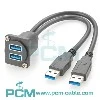
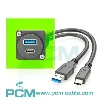
Color is an intuitive and commonly used method to distinguish between USB 2.0 and 3.0 ports. Generally speaking, the color of USB 2.0 ports is mostly black or white, but this is not absolute as different manufacturers may use different color schemes. In contrast, USB 3.0 ports are usually predominantly blue, which is a relatively more common and easily recognizable feature. It should be noted that although color can be used as a preliminary basis for judgment, not all USB 3.0 ports are necessarily blue, so other methods need to be combined for comprehensive judgment.
2, Interface identification
In addition to color, the identification on the interface is also an important criterion for distinguishing between USB 2.0 and 3.0. USB 2.0 ports usually only have the USB logo and no additional speed or version identification. The USB 3.0 port will have the words "SS" (SuperSpeed) or "3.0" printed next to or inside the interface to indicate that it supports higher transfer speeds. These markings are usually clear and visible, and are an effective means of distinguishing between the two interfaces.
3, Number of contacts
From a physical structure perspective, there are also differences in the number of contacts between USB 2.0 and 3.0 ports. The USB 2.0 port only has 4 metal contacts for data transmission and power supply. The USB 3.0 port adds an additional number of contacts, usually 9 (including 5 pairs of contacts for data transmission), to achieve higher transmission speeds and more stable power supply. This difference in physical structure makes USB 3.0 ports more complex in appearance, but it also provides stronger performance and functionality.
4, Transmission speed
Of course, the most direct way to distinguish between USB 2.0 and 3.0 ports is to test their transmission speed. The maximum transfer speed of USB 2.0 is 480Mbps (60MB/s), while the maximum transfer speed of USB 3.0 can reach 5Gbps (625MB/s), which is nearly ten times that of USB 2.0. It is easy to distinguish the speed difference between the two interfaces through actual testing or the use of professional speed measurement software. However, this method requires certain technical and device support, which may not be very convenient for ordinary users.
5, Other methods
In addition to the above methods, USB 2.0 and 3.0 ports can also be distinguished by viewing device managers or system information. In the Windows operating system, you can view the attribute information of the USB controller through the Device Manager to understand the detailed specifications and versions of each port. In addition, some professional hardware detection software can also provide similar functions to help users quickly identify the type and version of USB ports.