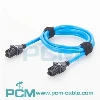
AISG (Antenna Interface Standards Group) cable is a specialized cable widely used in the communication industry, mainly used to connect mobile communication devices and antennas. AISG cables not only carry the important task of transmitting control signals and data signals, but also achieve remote control and monitoring of antennas, greatly improving the performance and reliability of communication networks.
Definition and Standards of AISG Cables
The AISG standard was proposed by the European Telecommunications Standards Institute (ETSI) to define antenna interfaces for wireless radio frequency communication. The core of this standard is to provide a unified interface that enables mobile devices to connect with base stations and achieve wireless RF communication. As a specific implementation of this standard, AISG cables ensure effective communication between base stations and mobile devices through standardized connection methods and interfaces.
AISG cables typically consist of two or more wires, with one wire used to transmit power signals and the other wire or wires used to transmit data signals. These wires are usually wrapped with insulation material on the outside to ensure the stability and reliability of signal transmission. In addition, AISG cables also adopt special shielding design to resist electromagnetic interference and further ensure the quality of signal transmission.
Application of AISG cables in the communication industry
Antenna pointing control
AISG cables play a crucial role in mobile communication base stations and antenna systems. Through AISG cables, mobile operators can remotely control the direction of antennas, thereby optimizing network coverage. This ability is crucial for dealing with complex and ever-changing communication environments, especially in densely populated urban and remote areas. By adjusting antenna pointing, stable signal transmission can be ensured and communication quality can be improved.
Antenna tilt angle adjustment
AISG cables are also used to adjust the electrical tilt angle of antennas to optimize signal transmission and coverage. The adjustment of the electric tilt angle can affect the direction and intensity of signal propagation. Through precise adjustment, it can ensure that the signal achieves the best coverage effect in the target area. This function is particularly important in the construction and optimization of mobile communication networks.
Antenna fault detection
AISG cables can transmit the working status and fault information of antennas, helping operators to detect and solve problems in a timely manner. By monitoring the status of antennas in real-time, operators can take preventive measures before faults occur, or quickly locate and repair problems after they occur, ensuring the stability and reliability of communication networks.
Antenna parameter monitoring
In addition to fault detection, AISG cables can also be used for real-time monitoring of antenna parameters such as power, gain, etc. These parameters are crucial for evaluating and optimizing the performance of communication networks. By regularly monitoring and analyzing these parameters, operators can understand the operational status of the network and make adjustments and optimizations as needed to ensure that the network is always in optimal condition.
Advantages of AISG cables
High anti-interference ability
AISG cables adopt special shielding design, which can effectively resist electromagnetic interference and ensure the quality of signal transmission. This feature enables AISG cables to perform well in complex and ever-changing communication environments, maintaining stable signal transmission even under strong interference conditions.
reliability
AISG cables use high-quality materials and manufacturing processes, with a long service life and reliability. This feature makes AISG cables an indispensable part of mobile communication networks, providing strong support for the stable operation of the network.
Waterproof performance
AISG cables typically have waterproof designs that can maintain stable signal transmission under harsh environmental conditions. This feature makes it possible for AISG cables to be used outdoors and in harsh environments, further expanding their application range.
Standardization
AISG cables comply with AISG standards and are compatible with various AISG compatible devices, providing an interoperable solution. This feature has enabled AISG cables to be widely used in communication networks, providing operators with more choices and flexibility.