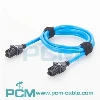
Basic Overview of AISG Cable
AISG cable is a specialized cable mainly used to connect mobile communication devices and antennas. The AISG standard is developed and promoted by the Antenna Interface Standards Group, which is dedicated to developing control and monitoring interface standards between base stations and various tower top equipment. These devices include antennas with remote electrical tilt (RET) functionality, tower top amplifiers, and various sensors used to monitor the operation of tower top equipment. AISG cables typically consist of two or more wires, one for transmitting power signals and the other for transmitting data signals. The exterior of these wires is usually wrapped in insulation material to ensure the stability and reliability of signal transmission.
AISG cables have various significant characteristics, including high anti-interference, reliability, and waterproofing. Its special shielding design can effectively resist electromagnetic interference and ensure the quality of signal transmission. Using high-quality materials and manufacturing processes, AISG cables have a long service life and reliability. Meanwhile, its waterproof design enables the cable to maintain stable signal transmission under harsh environmental conditions. In addition, AISG cables comply with AISG standards and are compatible with various AISG compatible devices, providing an interoperable solution.
Application of AISG Cable in 4G Communication System
In 4G communication systems, the application of AISG cables is mainly reflected in the following aspects:
Antenna pointing control: Through AISG cables, mobile operators can remotely control the antenna pointing, achieving optimization and adjustment of network coverage. This is of great significance for improving communication quality and expanding network coverage.
Antenna tilt angle adjustment: AISG cables can be used to adjust the tilt angle of the antenna to optimize signal transmission and coverage. This helps to reduce signal interference and enhance signal strength, thereby improving the overall performance of the communication system.
Antenna fault detection: AISG cables can transmit the working status and fault information of antennas, helping operators to detect and solve problems in a timely manner. This reduces the risk of communication interruption caused by antenna failure and improves the stability and reliability of the communication system.
Antenna parameter monitoring: Through AISG cables, operators can monitor antenna parameters in real-time, such as power, gain, etc. This helps ensure that network performance is at its optimal level, promptly identifying and adjusting potential issues.
In 4G communication base stations, AISG cables serve as key components connecting antennas and base stations, and their stability and reliability are crucial for ensuring communication quality. By precisely controlling the direction and tilt angle of the antenna, AISG cables help optimize network coverage and improve the overall efficiency of communication systems.
Application of AISG Cable in 5G Communication System
With the introduction and widespread application of 5G communication technology, the role of AISG cables in 5G communication systems is becoming increasingly prominent. Compared with 4G, 5G communication systems have higher requirements for data transmission speed, network capacity, and latency performance. The application of AISG cables in 5G communication systems is mainly reflected in the following aspects:
High frequency coverage optimization: 5G communication systems adopt higher frequency bands, such as millimeter wave bands, to achieve higher data transmission speeds. However, the linear propagation and attenuation characteristics of high-frequency signals significantly weaken their coverage ability. By remotely controlling antenna pointing and tilt angle through AISG cables, operators can optimize the coverage range of 5G signals, reduce signal blind spots, and improve the continuity and stability of network coverage.
Micro base station deployment: In order to alleviate the cost pressure of high-frequency coverage, 5G communication systems have extensively adopted micro base stations. Micro base stations have a small size and flexible deployment, making it easier to integrate into the surrounding environment. As a key component connecting micro base stations and antennas, the stability and reliability of AISG cables are crucial for ensuring the overall performance of 5G communication systems. Through AISG cables, operators can achieve remote control and monitoring of micro base station antennas, ensuring the continuity and stability of network coverage.
Large scale MIMO antenna array control: 5G communication systems adopt Multiple Input Multiple Output (MIMO) antenna array technology to improve data transmission speed and network capacity. AISG cables achieve precise control of large-scale MIMO antenna arrays by transmitting control and data signals. This helps optimize the signal transmission path, reduce signal interference, and improve the overall performance of the communication system.
Equipment compatibility and interoperability: AISG cables comply with AISG standards and are compatible with various AISG compatible devices. This enables operators to flexibly choose different brands and models of devices when deploying 5G communication systems, achieving interoperability between devices. This helps to reduce equipment procurement costs and improve the scalability and flexibility of communication systems.
In the practical application of 5G communication systems, the high anti-interference, reliability, and waterproof characteristics of AISG cables have been fully demonstrated. For example, in harsh outdoor environmental conditions, AISG cables can maintain stable signal transmission, ensuring the normal operation of communication systems. Meanwhile, its compliance with AISG standards enables operators to easily achieve remote control and monitoring of different brands and models of equipment.
Selection and installation of AISG cables
When selecting and installing AISG cables, multiple factors need to be considered to ensure their performance and reliability. These factors include adaptability, length and connection method, environmental adaptability, and installation specifications.
Adaptability: Ensure that the selected AISG cable is compatible with the interface of communication equipment and antennas to achieve stable signal transmission and control functions.
Length and connection method: Choose the appropriate cable length and connection method according to actual needs. Long cables may increase the risk of signal attenuation and interference, while short cables may limit the deployment flexibility of equipment. At the same time, it is necessary to choose a suitable connection method to ensure reliable connection between the cable, equipment, and antenna.
Environmental adaptability: Considering the temperature, humidity, salt spray and other conditions of the environment where the cable is located, select cables with corresponding protection levels to ensure their long-term stable operation. For example, in harsh outdoor environmental conditions, AISG cables with waterproof, corrosion-resistant and other characteristics should be selected.
Installation specifications: Follow relevant installation specifications and requirements for cable laying and connection. Ensure that the cables are laid neatly and securely, avoiding interference and damage from external factors. At the same time, regular maintenance and inspection of cables are required to promptly identify and resolve issues.