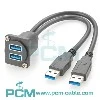
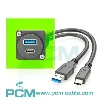
The best way to expand a USB port depends on your specific needs. USB hubs are the most common and cost-effective choice, while PCI/PCIe expansion cards are suitable for users who require higher performance. USB branching is suitable for connecting basic USB devices, while upgrading to USB 3.0/USB 3.1 can improve overall performance. Finally, when choosing a USB hub, please consider whether an active hub is needed to meet current requirements. Regardless of your needs, choosing the appropriate extension method can help you more conveniently connect and manage USB devices.
1. Using a USB hub:
A USB hub is one of the most common and simplest ways to expand a USB port. They typically have multiple USB ports, allowing you to connect multiple USB devices to a computer or device. Here are some key advantages of using a USB hub:
Convenience: The USB hub is easy to use, just plug it into one USB port on the computer, and you can connect multiple USB devices.
Affordable: USB hubs are relatively inexpensive, making them an economical choice for expanding USB ports.
Mobility: Many USB hubs are designed to be compact and easy to carry, and can be used in offices, homes, or during travel.
2. Using a PCI/PCIe expansion card:
If your computer has available PCI or PCIe slots, using an expansion card is another effective way to expand USB ports. These cartoons often provide additional USB ports and perform well. Here are some advantages of using a PCI/PCIe expansion card:
High performance: PCI/PCIe expansion cards typically provide higher data transfer speeds and are suitable for USB devices that require big data transfer.
Multiple port types: Some expansion cards not only provide USB-A ports, but also USB-C ports to accommodate different types of USB devices.
Stability: Due to the fact that the expansion card is directly inserted into the motherboard, it has high stability and is suitable for long-term use.
3. Use USB branching device:
A USB splitter is a device that divides a USB port into multiple ports. They are typically used to connect devices such as USB printers, keyboards, and mice. Here are some advantages of using a USB splitter:
Power saving: USB branching devices usually do not require external power supply, so they are power saving and easy to use.
Simple installation: Simply plug the USB branching device into the computer's USB port, and then plug the USB device that needs to be connected into the branching device's port.
Suitable for basic needs: If you only need to connect some basic USB devices, a USB splitter may be an economical choice.
4. Using USB 3.0/USB 3.1:
If your device supports USB 3.0 or USB 3.1, upgrading to these high-speed USB standards is also a way to expand USB ports. USB 3.0 and USB 3.1 provide faster data transfer speeds while being compatible with USB 2.0 devices. This can improve the performance of USB devices, especially for devices that require big data transmission.
5. Consider the type of USB hub:
When choosing a USB hub, you also need to consider its type. There are two main types of USB hubs: active hubs and passive hubs.
Active Hub: Active hubs typically have their own power adapter, which can provide more current and are suitable for connecting high-power USB devices, such as external hard drives or USB hubs with their own power supply. This ensures the normal operation of USB devices and avoids instability.
Passive hub: A passive hub relies on the current provided by the computer. They are suitable for connecting low-power USB devices such as keyboards, mice, etc. However, it should be noted that connecting high-power devices may result in insufficient current supply and prevent the device from working properly.

Sep 09, 2023
Leave a message
What is the best way to expand a USB port?
Send Inquiry