1, Definition and Classification
Panel mounted connectors, as the name suggests, refer to connectors that can be directly installed on equipment panels or partitions. They are firmly fixed to the panel through flanges or fasteners (such as screws) to ensure the stability and reliability of the connection. This type of connector typically comes in various interface forms and specifications to meet different electrical and signal transmission needs.
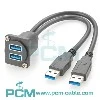
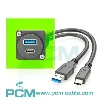
According to the different interface forms, panel mounted connectors can be divided into various types, such as BNC connectors, SMA connectors, USB connectors, RJ45 connectors, etc. Each type of connector has its specific application scenarios and performance characteristics. For example, BNC connectors are commonly used for connecting coaxial cables and are suitable for transmitting RF signals; SMA connectors have excellent electrical performance and mechanical stability, and are suitable for microwave and RF communication fields; USB connectors are widely used for connecting computers and peripheral devices.
2, Structural characteristics
The structure of panel mounted connectors typically includes the connector body, contacts, insulation, and housing. The connector body is the core part of the connector, responsible for the transmission of electrical and signal signals. Contacts are key components in connectors that enable electrical connections, typically made of conductive materials with good conductivity and wear resistance. Insulators are used to isolate contacts and prevent electrical short circuits and signal interference. The shell serves to protect the connector body and contacts, while providing a fixed installation interface.
Another significant feature of panel mounted connectors is their installation method. They are usually designed with flanges or mounting holes to be fixed to the panel using fasteners such as screws. This installation method is not only simple and convenient, but also provides a firm fixing effect, ensuring that the connector will not loosen or fall off during long-term use.
3, Application Fields
Panel mounted connectors have a wide range of applications in multiple fields. In the field of mechanical engineering, they are used for electrical connections and signal transmission of various mechanical equipment, such as automated production lines, CNC machine tools, etc. In the field of instrumentation, panel mounted connectors are used to connect various sensors, measuring instruments, and controllers to achieve data acquisition, processing, and transmission. In addition, panel mounted connectors also play an important role in fields such as communication, aerospace, and medical electronics.
4, Performance characteristics and advantages
Panel mounted connectors have various performance characteristics and advantages. Firstly, they have excellent electrical performance and can meet different electrical and signal transmission needs. Secondly, they have good mechanical stability and durability, capable of withstanding large mechanical stresses and vibrations, ensuring the stability and reliability of the connection. In addition, panel mounted connectors also have the advantages of easy installation and simple maintenance, which can greatly improve the efficiency of equipment installation and debugging.
In practical applications, the performance characteristics and advantages of panel mounted connectors have been fully demonstrated. For example, in communication base stations, panel mounted connectors are used to connect antennas and RF modules, ensuring stable signal transmission and reception. In medical equipment, panel mounted connectors are used to connect various sensors and controllers, enabling real-time monitoring and processing of data. These applications fully demonstrate the important role of panel mounted connectors in electrical connections and signal transmission.

Oct 30, 2024
Leave a message
What is a panel mount connector?
Send Inquiry