Robot systems play a vital role in modern industrial automation, and cable assemblies are one of the key components to ensure the efficient operation of robots. Robot cable assemblies are not only responsible for power transmission, but also for the transmission of data, signals, and control signals. When selecting and designing robot cable assemblies, it is important to understand their common types and their applicable scenarios. This article will give you a detailed introduction to several common types of robot cable assemblies.
1. Power Cables
Power cables are mainly responsible for transmitting electrical energy to various motors and drives in the robot system. According to the needs of the robot, power cables can carry different current and voltage levels. They are usually relatively sturdy structures with high temperature resistance and anti-interference characteristics.
Application scenarios:
- Robot motors
- Electrical drive systems
- Transmission systems
2. Data Cables
Data cables are used to transmit data between robot control systems and sensors. These cables usually need to carry high-speed data communications to ensure the real-time and accuracy of the system. Data cables are often used for programming interfaces of robot systems, sensor data collection, and communication between robots and control systems.
Application scenarios:
- Data transmission between sensors and control systems
- Communication between robots and external devices
- Data connection of visual systems and positioning systems
3. Signal Cables
Signal cables are mainly used to transmit various control signals in robots. These signals include position control, speed regulation, state feedback, etc. The design of signal cables requires strong suppression of electromagnetic interference to ensure the integrity and stability of the signal.
Application scenarios:
- Signal transmission between robot sensors and actuators
- Transmission of motor control signals
- State monitoring and safety feedback signals
4. Pneumatic Cables
For some robotic systems, especially robots with integrated pneumatic systems, pneumatic cables are used to transmit air or gas signals. These cables are often combined with power transmission and signal transmission to become part of a multifunctional robotic system.
Application scenarios:
- Robot pneumatic actuators
- Pneumatic drive parts of robotic arms
- Pneumatic equipment on automated assembly lines
When choosing robot cable assemblies, please make decisions based on the actual application needs, working environment and special requirements of the robot system. If you need a customized cable solution, you can contact Premier Cable. We provide professional customization services to help you choose the most suitable cable assembly to ensure the long-term stable operation of the robot system.

<
You may also like
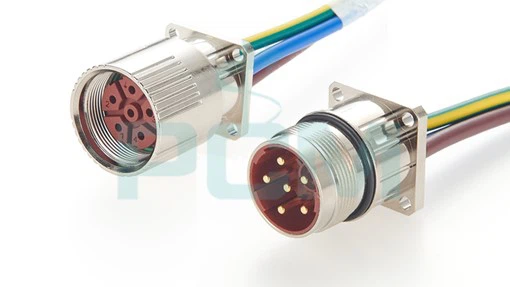
M23 Receptacle, Flange Mount

M23 Thread Power Supply Extension Cable

RJ45 to M12 cables for Servo Motors

M40 Power Cable 6SL3162-2MA00-0AC0

M16 Sensor Connector

M23 Servo Power Cable Right Angle