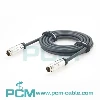
MIDI (Musical Instrument Digital Interface) cables are widely used in modern music production and performance. As a digital communication protocol, it connects various music devices, enabling musicians and producers to create a rich and diverse range of music works. This article will explore the advantages and disadvantages of MIDI cables, as well as their importance in the music industry.
1、 Advantages:
1. Strong compatibility: MIDI cable is a standardized communication protocol that almost all music devices support MIDI connections. Whether it's a keyboard instrument, synthesizer, drum player, or computer software, as long as they have a MIDI interface, they can connect and communicate with each other. This high level of compatibility provides musicians with a wide range of choices and flexibility.
2. Reliable data transmission: MIDI cables transmit music data through serial transmission, so there will be no loss or damage during the transmission process. Compared to the transmission of analog signals, the transmission of digital signals is more reliable, ensuring the accuracy and stability of music data. This allows musicians to play and record with confidence using MIDI cables without worrying about signal quality issues.
3. Multichannel transmission: MIDI cables support multi-channel transmission, and each channel can independently transmit information such as notes, volume, and timbre. This allows multiple music devices to be independently controlled and played simultaneously, bringing more possibilities for music production. Through reasonable channel allocation and setting, musicians can create complex and diverse music works.
4. Flexibility and scalability: MIDI cables have high flexibility, allowing music devices to be connected and combined in various ways. Through simple cable connections, musicians can combine multiple devices into a whole, achieving richer music creation and performance effects. In addition, MIDI cables also support cascading connections through MIDI Thru ports to expand the system's capabilities.
5. Standardized interface: MIDI cables use standardized interfaces, allowing different brands and types of music devices to communicate with each other. No matter keyboard instrument, electronic drum or synthesizer, as long as they support MIDI function, they can be connected and controlled through MIDI cable. This standardized interface greatly simplifies compatibility issues between music devices.
6. Low latency: The transmission speed of MIDI cables is very fast, with almost no latency. This is very important for music applications that require real-time performance and feedback, such as live performance, music creation, and music teaching. The low latency performance of MIDI cables ensures that musicians can accurately feel their playing movements and adjust and control music expression in a timely manner.
7. Durability: MIDI cables are usually made of sturdy materials and connectors, which have good durability. Compared to wireless transmission or other interfaces, MIDI cables are more reliable and less susceptible to electromagnetic interference or signal loss. This allows musicians to use MIDI cables for extended periods of time without worrying about connection quality issues.