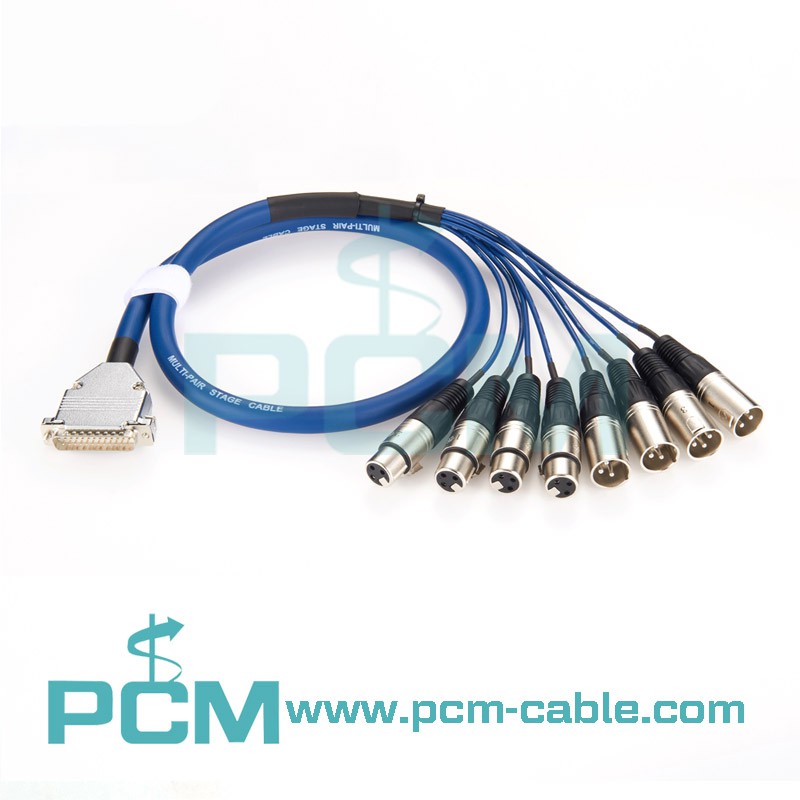
Welcome to contact us for TT Patch Cables: https://www.pcm-cable.com/audio-cables/tt-patch-cables/Typically, patch panels have 24 channels per unit. They handle the input and output of each channel, forming 48 "points" or connections.
Most modern patch panels use trs connectors on the front. Although, some patch panels use 1/4" TRS or XLR connectors. The rear usually uses DB-25 connectors to save space, but some use 1/4" TRS or XLR.
DB-25 (or D-sub) cables are multi-pin connectors that carry 8 analog audio signals simultaneously. One end of the D-sub cable has a DB-25 connector. The other has an 8-channel "pigtail" style XLR or 1/4" TRS connector.
This is a great solution to save on wiring and costs. For example, console channel outputs 1-8 use one 8-channel audio cable to connect to the patch panel instead of 8 separate TRS cables.
Signal Flow
Studio Microphone Line: The output of the microphone in the studio
Channel Mic Input: Mic Level Console Input
Thru/group outputs: Line-level console outputs for channels and groups
Multitrack Sends/Inputs: Line-level tape machine or digital audio effects input
Digital audio converters connect to DAWs using USB, Thunderbolt, etc. Inputs are assigned digitally to DAW inputs.
Multitrack Return/Send: Line tape machine or DAC output
Channel Line/Monitor Input: Line-level console input for monitoring
This will take the sound from the studio through the console, into the DAW, and out of the speakers. What about the rest? Every patch panel is different. Plan the signal flow according to the actual equipment situation.
Insert send
Insert return
Auxiliary send
Auxiliary return
SPU*output
SPU*input
cue sending
Auxiliary input
muls (Multiple repeating signals. One input and multiple outputs.)
Welcome to contact us for Studio Cables: https://www.pcm-cable.com/audio-cables/snake-cables/