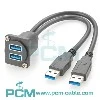
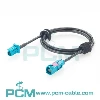
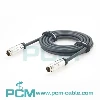
1, Basic structure of terminal connectors:
Terminal connectors typically consist of a casing, conductive components, and fixing components. The shell is the external protective structure of the connector, which can prevent the influence of external environments such as dust and moisture on the interior of the connector. Conductive components are the core part of connectors, responsible for conducting current. Common conductive components include sockets, pins, threads, and other forms. Fixed parts are used to fix conductive parts, ensuring a secure and reliable connection.
2, Working principle of terminal connectors:
Design and material selection of conductive components: The conductive components of terminal connectors are usually made of high-quality conductive materials, such as copper, aluminum, etc., to ensure good conductivity and thermal conductivity. The design of conductive components also considers the tightness and stability of the connection to prevent poor contact or poor conductivity during operation.
The selection of connection method: In the working principle of terminal connectors, the selection of connection method is crucial. Common connection methods include plug-in connections, threaded connections, and crimping connections. Different connection methods are suitable for different scenarios. For example, plug-in connections are suitable for situations that require frequent replacement, while threaded connections are more suitable for situations that require secure connections.
Insulation design: In order to prevent safety hazards such as short circuits in electrical equipment during operation, terminal connectors usually also use insulation design. Insulation materials can be plastic, rubber, etc., to ensure that current only flows through conductive components and avoid unnecessary electrical contact with the external environment.
Protective performance: Terminal connectors may face various environmental challenges during operation, such as humidity, high temperature, corrosion, etc. Therefore, good protective performance is an important guarantee for the reliable operation of connectors. By adopting waterproof, dust-proof, corrosion-resistant and other designs, connectors can work stably in harsh environments.
3, Application areas of terminal connectors:
Power system: In the power system, terminal connectors are widely used for electrical connections of equipment such as generators, transformers, and switchgear. Its reliable connection performance ensures the normal operation of the power system.
Electronic devices: In the field of electronic device manufacturing, terminal connectors are widely used for connecting circuit boards. Its compact size and reliable connectivity make it an indispensable component in electronic devices.
Automation control system: Automation control system requires a large number of connections between sensors, actuators and other equipment, and terminal connectors play a crucial role in these connections. Its stable connection performance helps ensure the stable operation of the automation system.
In the field of transportation: In vehicles such as cars, trains, and airplanes, terminal connectors are used to connect various electrical equipment, such as headlights, sensors, controllers, etc., to ensure the normal and reliable operation of vehicles.

Dec 23, 2023
Leave a message
How does the terminal connector work?
Send Inquiry