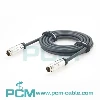
M23 Receptacles are often used with Junction Boxes to form an efficient and safe multi-core signal and power connection solution, which is widely used in industrial automation, servo systems, robots, and machine tools.
Here is a brief description of how they work together:
Analysis of matching methods
1. Panel mounted on the junction box housing
- M23 receptacle is usually installed as a female socket on the housing or panel of the junction box.
- There are two installation methods: front mount and rear mount, depending on the structural design.


2. External connection uses M23 cable
- External devices are connected to the M23 receptacle on the junction box through cables with M23 plugs, realizing quick plug-in wiring without repeated unpacking.
3. Internal leads are connected to the branching module
- The inside of the socket is connected to the I/O module, power terminal or PCB board inside the junction box by welding, crimping or screw terminals.
- Different socket pins can correspond to different numbers of sensors/actuators/power circuits.

4. Support IP67 protection level
- The socket is equipped with a sealing ring and a threaded locking structure, which can maintain waterproof and dustproof performance after connecting the cable, and is very suitable for harsh industrial environments.
Advantages
- Modular design for easy maintenance and replacement
- Simplified wiring to improve production efficiency
- Excellent compatibility with standard brands (e.g., Turck Eurofast®, Molex)
- Supports high-density connections of up to 28 pins
For high-quality M23 Receptacles that seamlessly integrate with Junction Boxes, Premier Cable offers:
- Full specifications & installation accessories
- Custom options: pin count, cable length, mounting dimensions
- Sample requests & detailed catalog
Contact us today for tailored solutions!
You May Also Like

M23 Connectors and Cable Assemblies

M23 Receptacles

M23 T Connectors

Overmolded M23 Extension Cable

M23 To DB15 Servo Encoder Cable

M23 Cable Assemblies