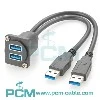
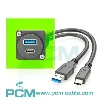
USB extenders are not universal products, they come in various types and are suitable for different needs and application scenarios. Choosing the correct USB extender depends on multiple factors such as transmission distance, device type, signal quality, budget, and environmental conditions. Therefore, before purchasing a USB extender, it is important to have a detailed understanding of your needs and carefully compare different models of USB extenders to ensure that you choose the most suitable product. Only in this way can stable and reliable USB connections be achieved to meet the needs of different scenarios.
Part 1: Types of USB Extenders
USB extenders are not a universal product, but can be divided into different types, each with its specific purpose and performance. The following are common types of USB extenders:
USB 2.0 Extender: USB 2.0 is an earlier USB standard with a maximum transfer speed of 480 Mbps. USB 2.0 extenders are typically used to connect low-speed and full-speed USB devices, such as keyboards, mice, cameras, etc. They usually have a short transmission distance, typically between 5 and 10 meters.
USB 3.0 Extender: USB 3.0 is a faster USB standard with a maximum transfer speed of 5 Gbps. The USB 3.0 extender is suitable for connecting devices that require higher bandwidth, such as external hard drives and high-resolution cameras. They typically support longer transmission distances, up to 15 meters or more.
Passive USB extender: Passive USB extenders do not include electronic amplifiers or signal enhancers. They are suitable for shorter transmission distances, usually not exceeding 5 meters, but are cheaper and suitable for connecting low bandwidth devices.
Active USB extender: The active USB extender is equipped with an electronic amplifier, which can extend the USB signal transmission distance while maintaining high signal quality. They are suitable for devices that require long-distance connections, such as cameras or audio devices in conference rooms.
Wireless USB Extender: Wireless USB extenders transmit USB signals through Wi Fi or other wireless technologies, allowing for a wider range of connections, but may be affected by signal interference.
Part 2: Working Principle of USB Extender
The working principle of a USB extender involves signal transmission and signal quality maintenance. The following is the general working principle of a USB extender:
Signal capture: The USB extender first captures signals from USB devices. This includes signals such as data, power, and ground.
Signal amplification: In an active USB extender, the signal is amplified to maintain signal quality during long-distance transmission. This ensures the reliability and stability of the data.
Signal transmission: The USB extender transmits the amplified signal to a remote device, such as a computer, through a cable. This can be via USB connection or wireless connection, depending on the type of USB extender.
Signal decoding: After the remote device receives the signal, the USB extender decodes the signal and restores it to the original data.
Data transmission: Once the signal is restored, the USB device can function normally for data transmission and interaction.
Part 3: How to choose a USB extender that suits your needs
Choosing a USB extender that suits your needs is crucial. Here are some considerations:
Transmission distance: First, determine the required transmission distance. If only a short distance connection is required, a passive USB extender may be sufficient, but if a long distance connection is required, an active USB extender or a wireless USB extender may be more suitable.
Device type: Consider the type of USB device that needs to be connected. If it is a high bandwidth device, such as a high-resolution camera or external hard drive, a USB 3.0 extender may be more suitable.
Signal quality: For applications that require reliable data transmission, such as audio and video transmission, signal quality is crucial. Active USB extenders typically provide better signal quality.
Budget: The price of USB extenders varies depending on model and performance. Choose the appropriate extender based on the budget.
Environmental conditions: Consider the environmental conditions under which the USB extender will be placed. If there is a possibility of interference or electromagnetic interference, a wireless USB extender may be more suitable.

Sep 06, 2023
Leave a message
Exploring USB extenders: Are they all the same?
Send Inquiry