Advantages of Spliceable Encoder Cable
1 Flexibility
One of the main advantages of spliceable encoder cables is their flexibility. By adopting a spliceable design, users can flexibly choose cable lengths based on specific needs without worrying too much about signal quality issues. This provides engineers with greater freedom, making it easier for encoders to integrate into various complex systems.
2 Cost savings
In traditional solutions, as the cable length is usually fixed, additional equipment (such as signal amplifiers) may need to be used to compensate for insufficient length. The emergence of spliceable encoder cables allows users to customize cable lengths according to their needs, thereby avoiding unnecessary cost expenditures.
3 Easy to maintain
The design of the spliceable encoder cable also simplifies the maintenance process. In traditional solutions, replacing or repairing cables may require the intervention of professional technicians, while the design of spliceable cables makes maintenance and replacement easier for users, reducing downtime and production costs.
4 Technical Implementation
The implementation of spliceable encoder cables involves a series of technologies, including:
5 Joint design
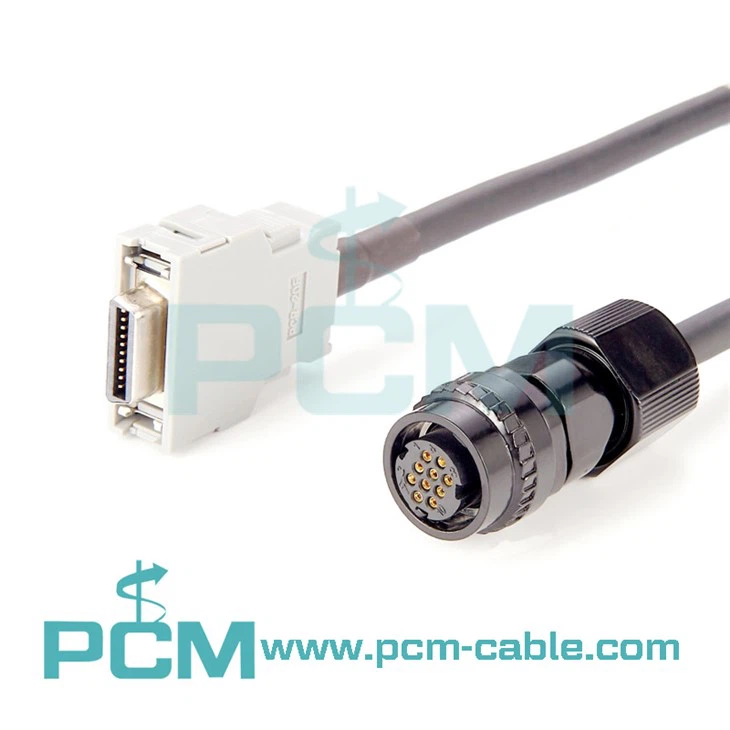
The key to cable splicing lies in joint design. Engineers need to design connectors that can maintain signal quality while also facilitating connections. High quality joint design can reduce the possibility of signal attenuation and interference, ensuring accurate data transmission.
6 Signal amplification technology
In some cases where longer cables are required, signal amplification technology may be required to maintain signal quality. This requires integrating professional signal amplifiers at the splice to ensure that the signal is not affected by attenuation.
7 Waterproof and anti-interference technology
Considering the variability of the industrial environment, spliceable encoder cables need to have certain waterproof and anti-interference performance to adapt to various harsh working conditions. This may involve technological innovation in areas such as waterproof sealing design and strengthening of shielding layers.
Application Cases
1 Mechanical manufacturing
In the field of mechanical manufacturing, robots and automation equipment typically need to perform tasks in complex environments. The flexibility of spliceable encoder cables makes integration and installation easier in these environments.
2 Automobile manufacturing
On automotive production lines, various transmission and control systems typically require the use of encoders. The cost savings and ease of maintenance of spliceable encoder cables have made them popular in automotive manufacturing.
3 Medical equipment
Medical devices typically require extremely high precision, and as a part of measuring equipment, the flexibility and maintainability of the encoder's cables are crucial to ensuring the normal operation of the equipment.
Nov 22, 2023
Leave a message
Can I splice encoder cables?
Send Inquiry