HSD 4+4 Pin Z Code Dual-Channel Data Cable: Features, Applications and Selection Guide
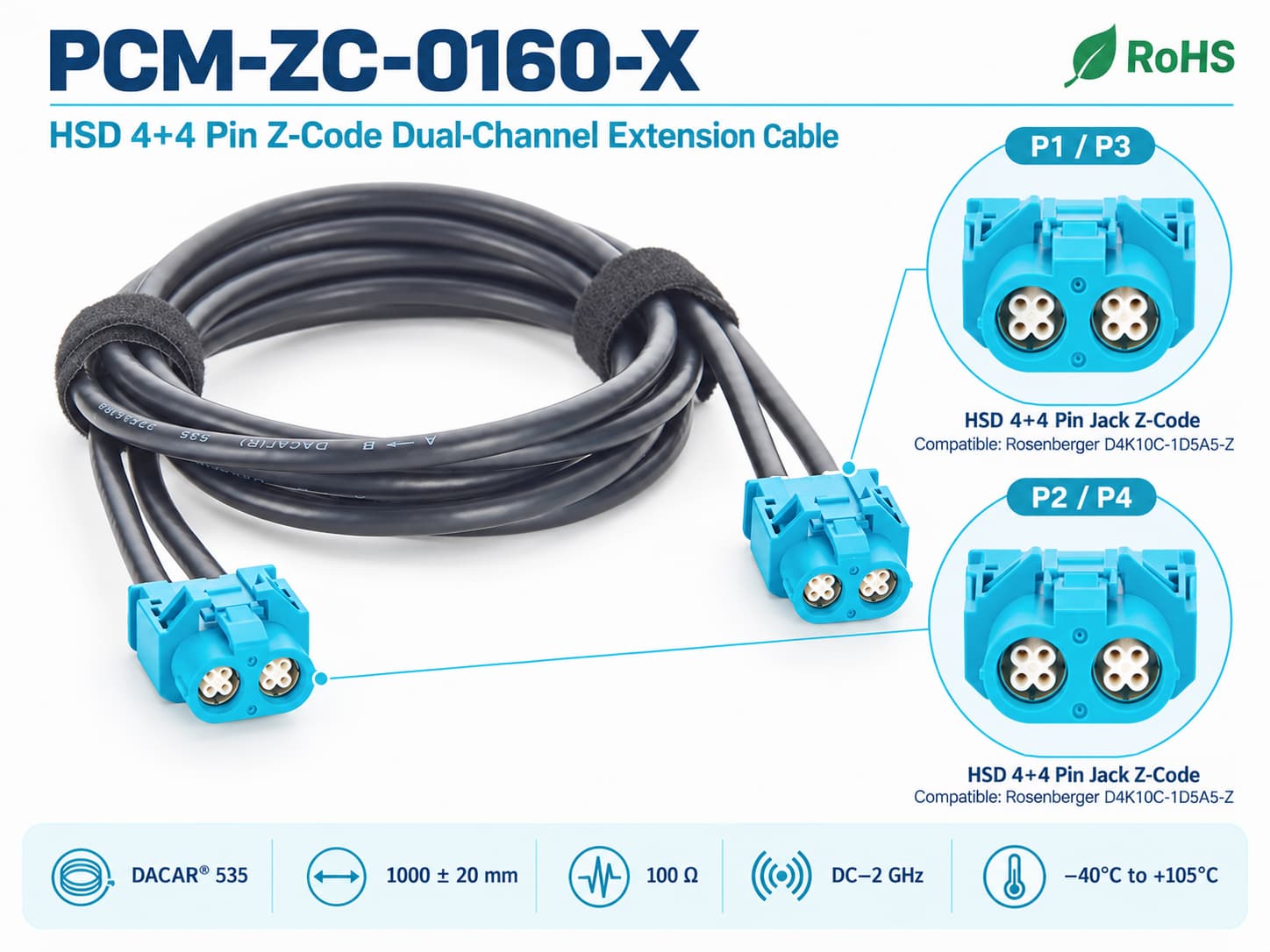
PCM-ZC-0160 is an HSD 4+4 Pin Z Code dual-channel automotive high-speed data cable featuring dual HSD jack interfaces on both ends compatible with Rosenberger D4K10C-1D5A5-Z and Dacar 535 100Ω high-speed cable for two concentrated differential data links. Supporting DC–2GHz and -40°C to +105°C operation, it combines shielding, mechanical coding, secure locking and high cable retention for ADAS cameras, digital cockpits, automotive displays, infotainment, LVDS and high-speed automotive electronic interconnections.
What Does This Article Cover?
As automotive electronic architectures evolve from traditional distributed ECUs toward domain controllers, zonal architectures and central computing, cameras, displays, infotainment head units and data-processing modules must exchange increasingly large volumes of high-speed data. Cable assemblies are therefore no longer simple mechanical interconnects; they have become important components affecting signal integrity, EMC, system reliability and vehicle wiring efficiency.
This article focuses on the Premier Cable PCM-ZC-0160 HSD 4+4 Pin Z Code dual-channel high-speed data cable and systematically analyzes HSD interface fundamentals, dual-channel architecture, 100Ω differential transmission, Dacar 535 cable, Z Code mechanical coding, application challenges, product selection, compatibility risks and customization capabilities, helping engineers, buyers and system integrators understand and select automotive high-speed data cable assemblies more accurately.
Quick Product Introduction
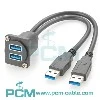
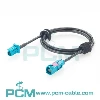
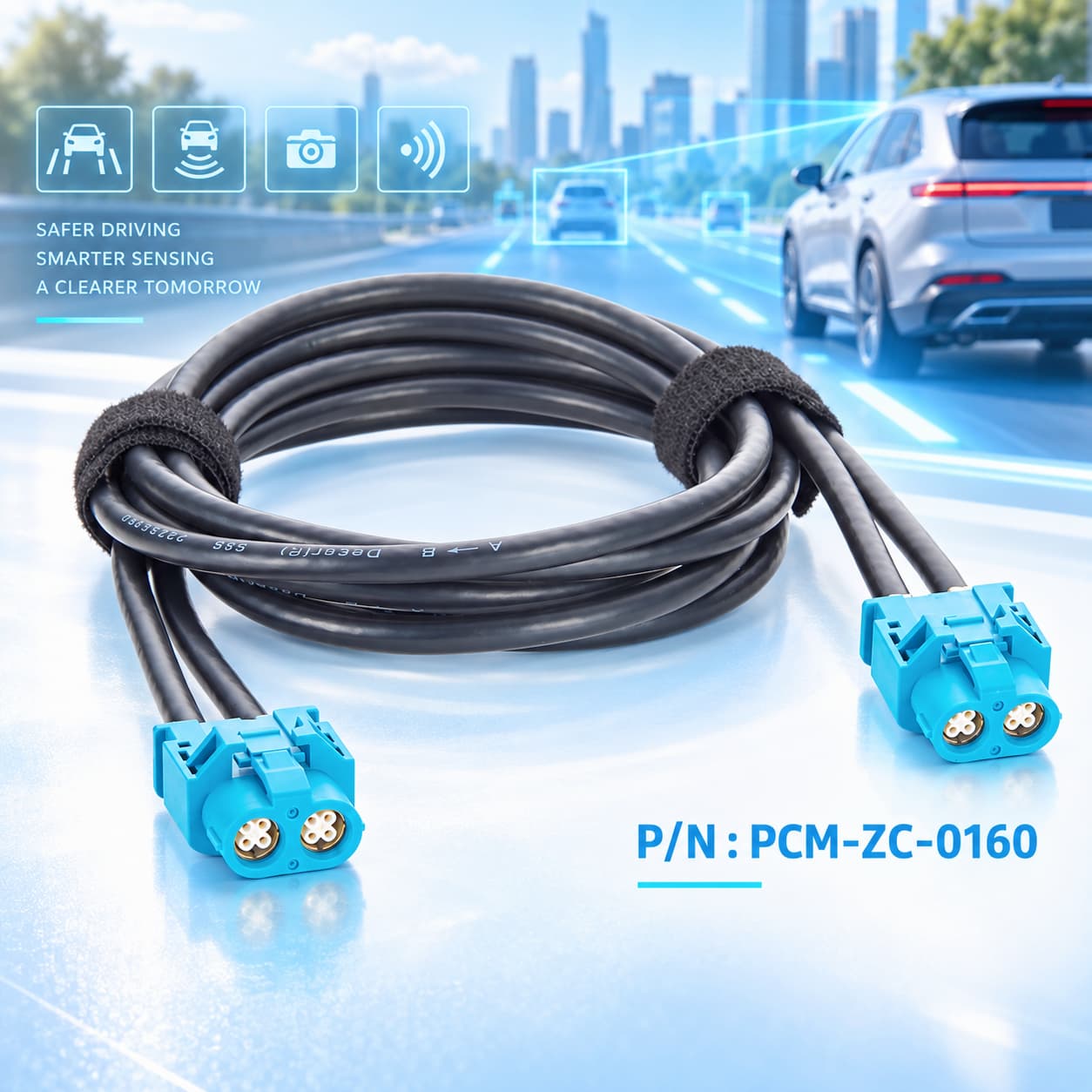
PCM-ZC-0160 uses an HSD 4+4 Pin dual-channel architecture with two 4-pin HSD Jack Z Code interfaces at each end, interconnected through Dacar 535 high-speed data cables to establish two independent high-speed differential data channels.
| Product Name | HSD 4+4 Pin Z-Code |
| Premier Cable P/N | PCM-ZC-0160 |
| Number of Channels | Two independent 4-pin HSDchannels |
| Compatible Connector | Compatible with RosenbergerD4K10C-1D5A5-Z |
| Standard Length | 1000 + 20 mm |
| Single end connector length | 25.8 + 0.15 mm |
| Packaging winding dimensions | 120 + 20 mm |
What Is an HSD 4+4 Pin Z Code Dual-Channel High Speed Data Cable?
HSD, or High-Speed Data, is a high-speed differential interconnection system widely used in automotive electronics. Its fundamental design concept is to provide impedance-controlled, shielded, high-retention high-speed signal connectivity with mechanical coding in a compact automotive connector architecture.
The "4+4 Pin" designation of PCM-ZC-0160 does not describe a conventional 8-pin single-channel interface. Instead, it consists of two independent 4-pin HSD interfaces combined into a dual-channel architecture. Each end contains two HSD interfaces, allowing two high-speed data links to be established at one consolidated connection location.
Why Do Automotive Systems Need Dual-Channel HSD Cable Assemblies ?
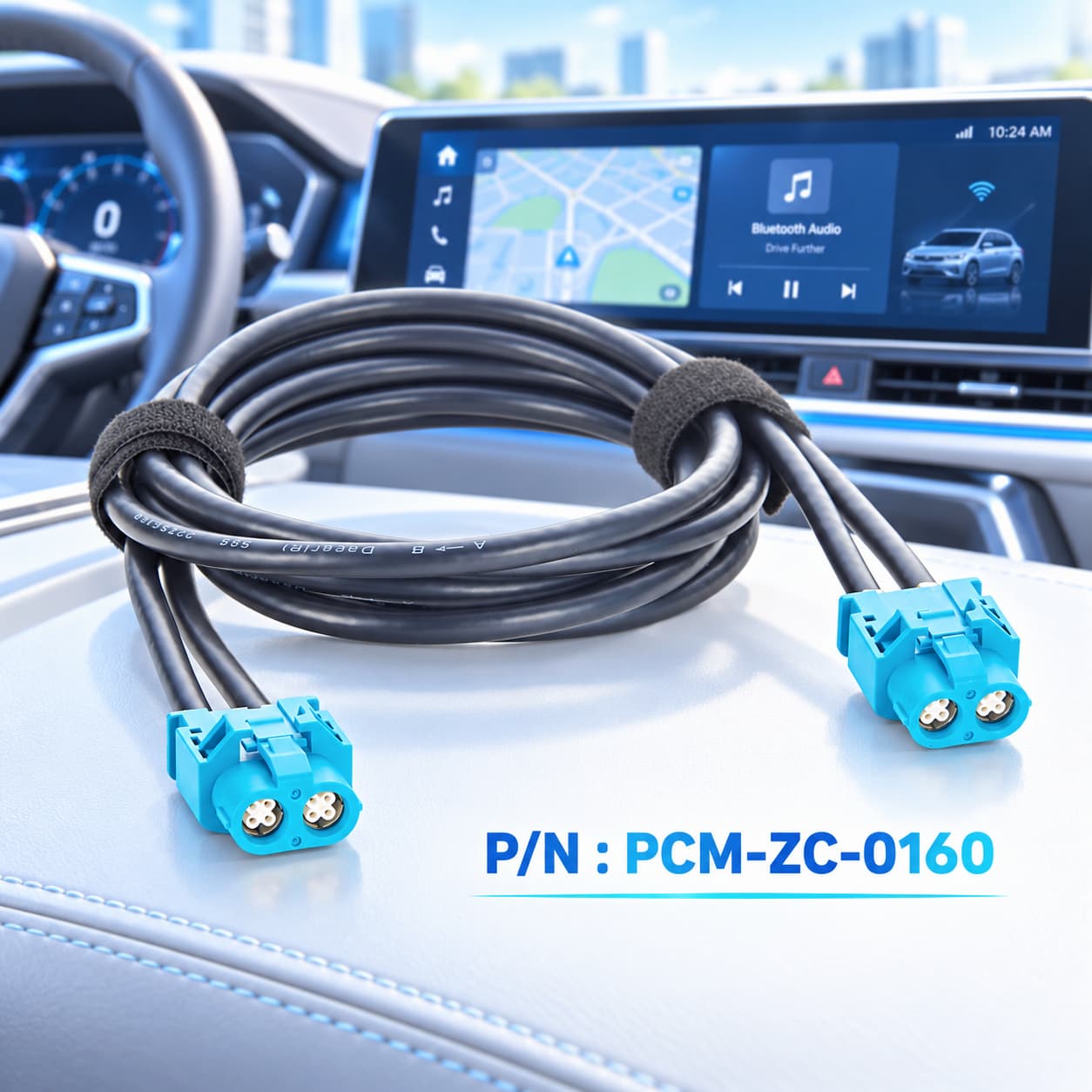
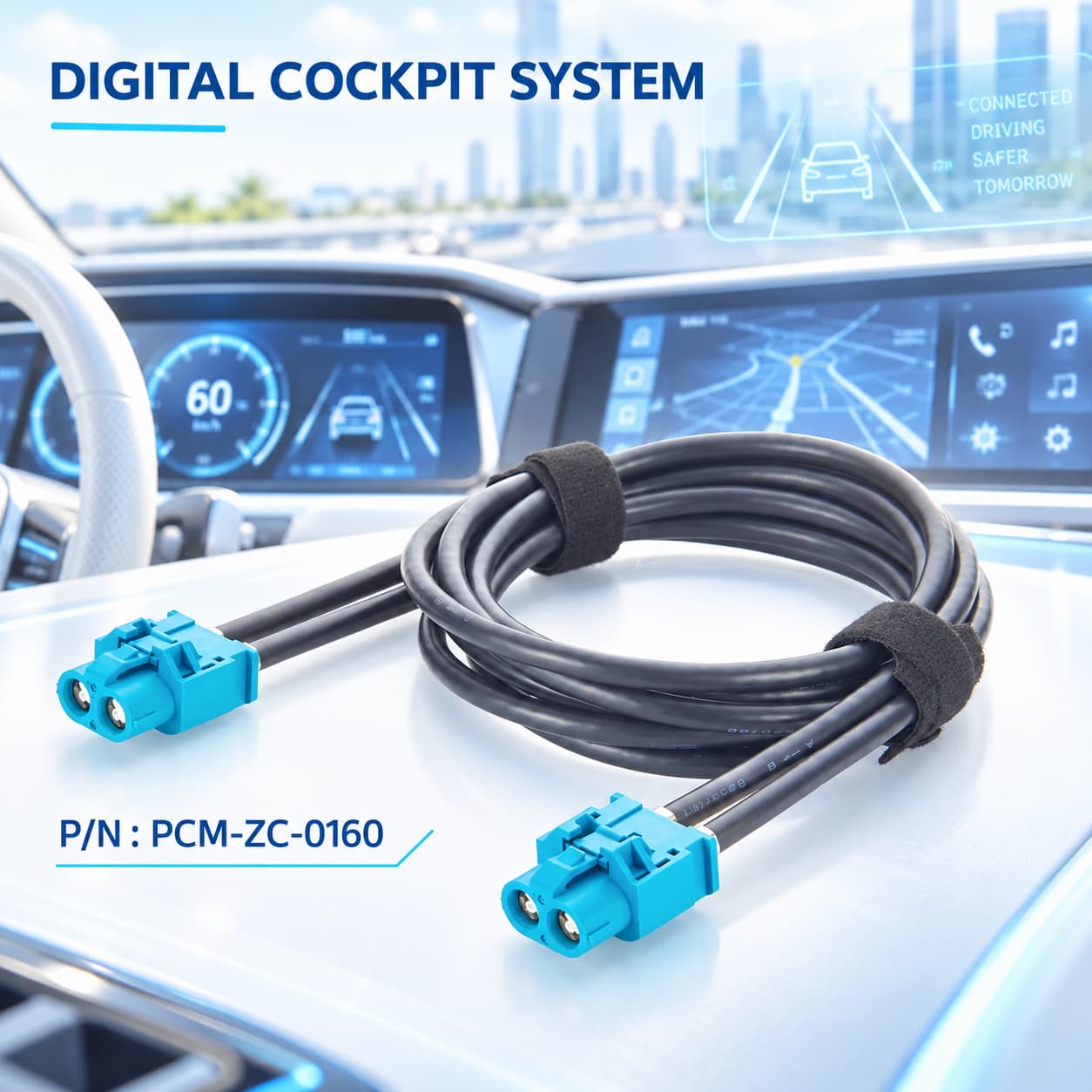
A dual-channel HSD cable assembly integrates two independent high-speed differential links into one compact connector, reducing connector quantity, harness volume, installation space and routing complexity. It is well suited for dual-camera systems, dual displays, ADAS controllers, infotainment platforms and digital cockpits.
Compared with two separate single-channel assemblies, the dual-channel design can simplify installation and improve connection density while maintaining controlled 100Ω impedance, shielding continuity and stable signal transmission. Actual compatibility must still be verified according to connector coding, pinout, cable type, data rate, PHY requirements and the complete system link budget.
Pain Points
Single Channel HSD vs. 4+4 Dual Channel HSD
| Item | Single HSD | HSD 4+4 Dual-Channel |
| High-Speed Interfaces | 1 | 2 |
| Signal Channels | Single | Dual |
| Connection Density | Standard | Higher |
| Harness Management | Independent routing | Two consolidated channels |
| Typical Use | Single camera or module | Dual-camera or multi-interface ECU |
| Selection Focus | Single interface P/N, coding and pinout | Dual interfaces, spacing, coding, pinout and channel mapping |
A dual-channel configuration does not automatically mean twice the data rate of a single-channel product. Actual performance of each channel still depends on the PHY, protocol, SerDes, cable length, connectors and complete link budget.
Products Display
Similar products
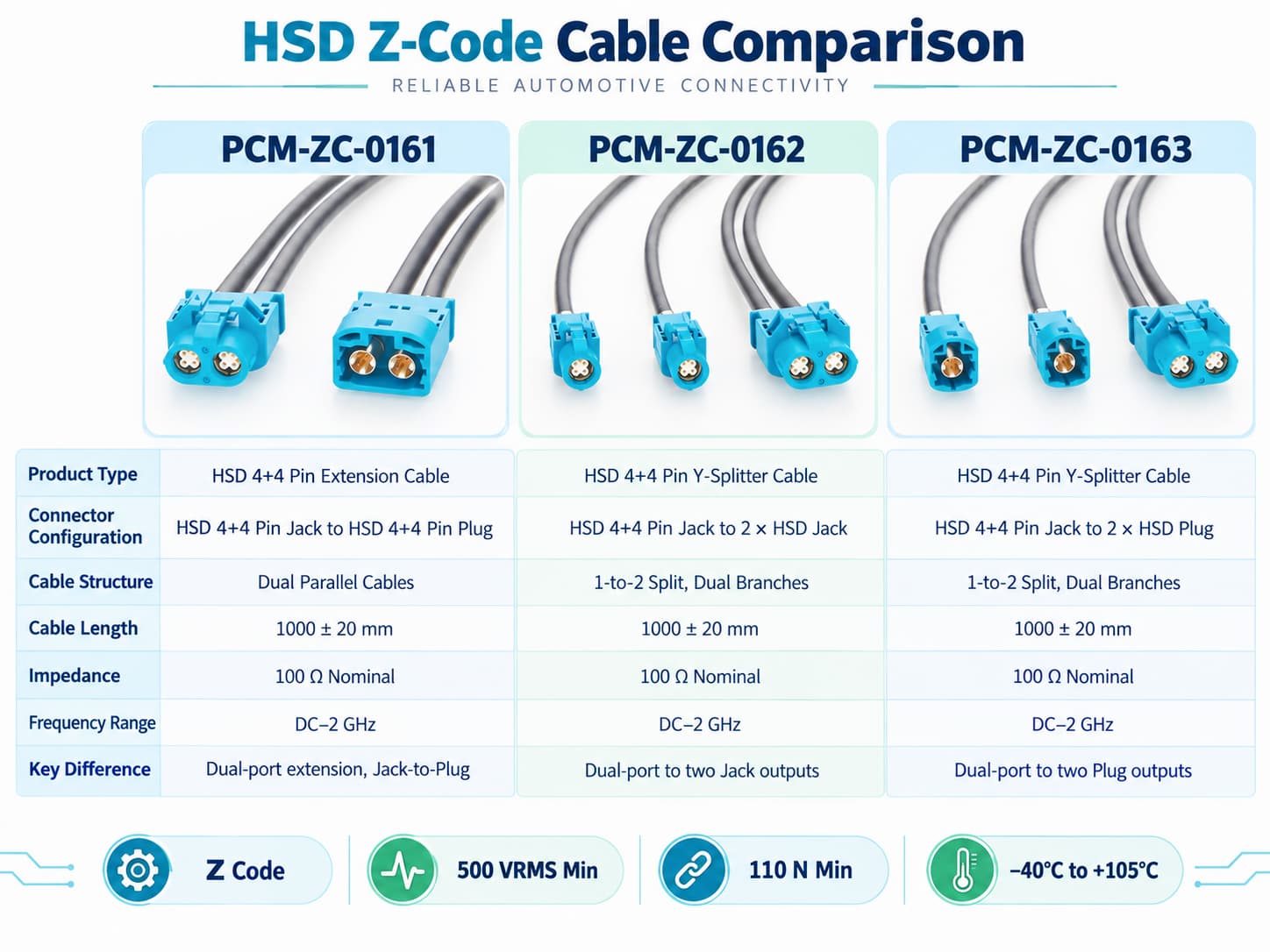
Compatibility Statement
Compatibility Verification
PCM-ZC-0160 uses an HSD Z Code interface designed for compatibility with Rosenberger D4K10C-1D5A5-Z. Before volume production, the complete connector part number, coding, gender, mechanical keying, pinout, housing configuration, cable type and device-interface drawings must be verified.
Connectors from the same HSD family or with similar appearances are not necessarily interchangeable. Differences in coding, gender, cavity arrangement or mechanical structure may prevent correct mating or cause electrical and communication problems within the target system.
Technical Compatibility Notice
Successful HSD mating does not guarantee compatibility of the complete high-speed data link. PCM-ZC-0160 is a passive cable assembly and provides no protocol, SerDes, PHY or signal-retiming conversion.
For ADAS cameras, LVDS, FPD-Link, GMSL, Automotive Ethernet and similar applications, engineers must evaluate 100Ω impedance, cable length, insertion loss, return loss, shielding, crosstalk, pinout, data rate and connector transitions. Final performance must be validated against the PHY, SerDes chipset, communication protocol, link budget and OEM requirements of the connected devices.
How to Select the Right Product ?
Verify the Complete Connector P/N, Gender and Coding First
First verify whether the equipment interface actually corresponds to the D4K10C-1D5A5-Z family and confirm jack/plug gender, Z Code, dual-interface configuration, interface spacing and mechanical keying. Do not determine compatibility solely from a "water-blue HSD connector" or visual appearance. The complete device-side P/N is the most reliable starting point for product selection.
Verify Pinout, Protocol and Device PHY
After mechanical compatibility is confirmed, verify the pin assignment and channel mapping of both channels and determine whether the system actually uses LVDS, FPD-Link, GMSL, Ethernet or another high-speed data architecture. A passive HSD cable does not automatically convert between different protocols.
Select Cable Length According to Link Performance
PCM-ZC-0160 has a standard length of 1m. When 2m, 3m, 5m or another length is required, selection should not be based only on the physical distance between devices. Insertion loss, return loss, signal integrity and the complete link budget should also be re-evaluated. In a high-speed system, identical interfaces do not automatically mean that an arbitrarily longer cable will operate correctly.
Confirm Mechanical and Environmental Requirements
Vehicle vibration, temperature, installation space, bend radius, fixing method and connector orientation all influence cable-assembly design. Straight or right-angle cable exit, harness fixing position, dynamic bending requirements, operating temperature and waterproofing requirements should be confirmed before the final configuration is selected rather than relying solely on electrical specifications.
Customization Capabilities
↕ Overall Cable Length Customization
Cable length can be customized for the actual installation distance. Longer versions require renewed evaluation of insertion loss, return loss and the complete high-speed link budget.
□ HSD Gender Customization
Multiple jack and plug combinations are available. Before customization, the complete connector part numbers and mating interfaces at both ends must be confirmed.
◉ Coding Customization
HSD coding can be customized for the device interface. Selection must follow the exact mechanical coding and complete connector part number, rather than housing color alone.
⚙ Connector Orientation and Cable-Exit Customization
Straight, right-angle and specific cable-exit orientations can be customized to optimize bend radius, installation clearance and harness routing within space-constrained equipment.
⌘ Pinout and Channel Mapping Customization
Pinout and channel mapping can be customized according to equipment definitions. Complete device pinouts or wiring tables must be provided and verified before production.
◇ Cable and Harness Structure Customization
Cable type, protection and harness construction can be customized for frequency, environmental and EMC requirements, followed by renewed verification of impedance and complete link performance.
Product FAQ
Can PCM-ZC-0160 Connect Directly to a Rosenberger D4K10C-1D5A5-Z Interface ?
PCM-ZC-0160 is designed around an interface solution compatible with this HSD Z Code configuration, but the complete device-side P/N, mating gender, coding, interface spacing and pinout must still be verified for the actual project. Belonging to the same interface family does not mean that every equipment configuration is identical.
Does 4+4 Pin Mean One 8-Pin High-Speed Interface ?
No. The 4+4 designation represents two independent 4-pin HSD interfaces forming a dual-channel architecture. Channel 1 and Channel 2 should be verified separately during product selection and wiring rather than treating the assembly as a conventional single-channel 8-pin connector.
Does the Same HSD Interface Automatically Support GMSL, FPD-Link or LVDS ?
Not necessarily. HSD is a physical interconnection system, while GMSL, FPD-Link, LVDS and other technologies involve different electrical and system architectures. PHY/SerDes, pinout, impedance, frequency range, cable loss and link budget must also be verified.
Can the 1m Cable Be Customized to 2m, 3m or 5m ?
The physical assembly can be customized, but "manufacturable" and "stable operation in the target high-speed system" are two different considerations. When cable length increases, insertion loss, return loss and complete channel performance should be re-evaluated according to the target protocol and data rate.
Does This Product Perform Protocol Conversion ?
No. PCM-ZC-0160 is a passive high-speed cable assembly whose primary function is to establish physical high-speed differential data channels between two devices. It does not contain an active SerDes, PHY, repeater or protocol converter.