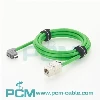
The NMEA 2000 connector is commonly referred to as the "Micro-C" connector. Developed by the National Marine Electronics Association (NMEA), the NMEA 2000 standard is a communication protocol widely used in the marine industry for connecting and integrating various electronic devices on a boat or vessel.
The Micro-C connector is a compact, robust, and reliable connector specifically designed for NMEA 2000 networks. It features a circular shape with a threaded locking mechanism that ensures a secure connection, making it suitable for the demanding marine environment.
The Micro-C connector has a 5-pin configuration, with each pin serving a specific purpose in the NMEA 2000 network. The pins are as follows:
Power (12V/24V): This pin provides power to the connected devices in the network. It typically carries either 12 volts or 24 volts, depending on the system's voltage.
Ground: This pin serves as the common ground reference for the network, ensuring proper electrical grounding.
CAN-H (Controller Area Network - High): This pin carries the high-speed data signals in the NMEA 2000 network, facilitating communication between different devices.
CAN-L (Controller Area Network - Low): This pin works in conjunction with the CAN-H pin to transmit and receive data signals, completing the data communication loop.
Shield: The shield pin is responsible for providing electromagnetic shielding and reducing interference in the network. It helps maintain signal integrity and protects against external electrical noise.
The Micro-C connector offers several advantages, including its small size, ease of installation, and compatibility with other NMEA 2000 devices. Its compact form factor allows for convenient installation in tight spaces, while the threaded locking mechanism ensures a secure connection that can withstand vibrations and harsh marine conditions.
Moreover, the NMEA 2000 standard provides a plug-and-play capability, allowing devices from different manufacturers to seamlessly connect and share data on the same network. This interoperability enables boaters to create comprehensive marine systems by integrating various components such as GPS receivers, depth sounders, chartplotters, autopilots, engine sensors, and more.
In summary, the NMEA 2000 connector, commonly known as the Micro-C connector, is a vital component in marine electronics. Its standardized design and compatibility enable the seamless integration of various devices, providing boaters with reliable and efficient data communication on their vessels.