

Gigabit Ethernet and Ethernet are both networking technologies that allow for the transfer of data between devices over a local area network (LAN). While they share similarities, there are also key differences between Gigabit Ethernet cable and Ethernet cable. Let's explore these differences in detail.
Speed:
- Ethernet cables, also known as Category 5 (Cat5) or Category 6 (Cat6) cables, typically support data transfer speeds up to 100 Mbps (Megabits per second). This is sufficient for most home and small office network applications.
- On the other hand, Gigabit Ethernet cables, also known as Category 5e (Cat5e) or Category 6a (Cat6a) cables, support data transfer speeds up to 1000 Mbps, which is equivalent to 1 Gbps (Gigabit per second). Gigabit Ethernet provides significantly faster data transmission, making it suitable for demanding applications, such as transferring large files, streaming high-definition media, or running network-intensive tasks.
Cable Construction:
- Both Ethernet and Gigabit Ethernet cables use twisted pair copper wiring to transmit data signals. However, Gigabit Ethernet cables are constructed with higher quality materials and tighter specifications to accommodate the increased speed and minimize interference.
- Cat5 and Cat6 Ethernet cables have four pairs of twisted wires, while Cat5e and Cat6a Gigabit Ethernet cables have additional insulation and improved shielding to reduce crosstalk (interference between adjacent wires) and external electromagnetic interference (EMI). These enhancements in construction allow for better signal integrity and performance at higher speeds.
Distance:
- Another significant difference lies in the maximum supported cable length. Ethernet cables typically have a maximum length of 100 meters (328 feet) before signal degradation becomes an issue. This limitation is due to the lower data transfer speeds and the higher likelihood of signal loss over longer distances.
- In contrast, Gigabit Ethernet cables can maintain their maximum data transfer rates over longer distances. Cat5e and Cat6a cables can support gigabit speeds up to 100 meters, while Cat6a cables have improved performance and can achieve 10-Gigabit Ethernet speeds up to 55 meters.
Backward Compatibility:
- Ethernet cables are compatible with both older and newer networking devices, making them versatile and widely adopted. They can be used in a variety of applications, including connecting computers, printers, routers, and switches.
- Gigabit Ethernet cables are also backward compatible with Ethernet devices. This means you can use a Gigabit Ethernet cable to connect a Gigabit Ethernet-enabled device to an Ethernet-enabled device, and they will communicate at the highest speed supported by the Ethernet device.
Cost:
Due to their superior performance and construction, Gigabit Ethernet cables tend to be more expensive than standard Ethernet cables. The cost difference arises from the higher quality materials and manufacturing processes required to meet the specifications necessary for gigabit speeds and better signal integrity.
In summary, the main differences between Gigabit Ethernet cables and Ethernet cables are the speed, cable construction, distance capabilities, and cost. Gigabit Ethernet cables provide faster data transfer rates, have better construction and shielding to reduce interference, can support longer distances without significant signal degradation, and are generally more expensive. Ethernet cables, while slower, are still widely used for various networking applications and offer backward compatibility with Gigabit Ethernet devices.

You May Also Like
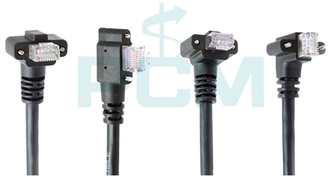
GigE Cable with Angled RJ45 Connectors

GigE Camera Cable with Screw Lock

IX Industrial Category 6A Ethernet Cable

High Flex Cat6A GigE Ethernet Cable

GigE Cable Double Shielded High Flex

USB3.0 Micro B Camera Cable High Flex


