

Control cables and motor cables are two common types of industrial cables. Although they are similar in appearance, they have significant differences in function, structure and application. Control cables are usually used in low-voltage, low-power signal transmission and control systems, while motor cables are used in high-power motor drive systems, carrying larger currents and voltages. Depending on the application requirements, they have their own characteristics in terms of voltage level, conductor cross-sectional area, insulation strength, etc. Choosing the right cable type is critical to ensuring the efficient operation and safety of your equipment.
1. Voltage level:
- Control cable: The voltage level is usually 300V/500V, which is used for lower voltage signal transmission and low power applications.
- Motor cable: The voltage level is higher, generally 600V/1000V, suitable for high power devices such as motor power supply, especially in the motor application controlled by the inverter, the voltage peak requirement is higher.
2. Insulation strength:
- The insulation strength of the motor cable is usually higher than that of the control cable because it needs to withstand higher voltage. The core insulation capacity of the motor cable is stronger to ensure that it can adapt to high voltage current transmission.
3. Conductor cross-sectional area:
- Control cable: Usually use a smaller conductor cross-sectional area (such as 0.25mm²), suitable for lower current and signal transmission applications.
- Motor cable: The conductor cross-sectional area is larger (such as 0.75mm²), used in motor drive and power supply applications that require high current. In some large systems, the motor cable can even reach 50mm² or more.
4. Number of core wires:
- Control cable: Usually has more core wires, suitable for complex control systems that require multiple signal transmission.
- Motor cable: generally has a fixed core combination, such as 3-phase power line plus 1 protective conductor (PE), commonly with four-core or single-core structure.
5. Application areas:
- Control cable: used for signal transmission and power supply of low-power equipment, suitable for industrial automation, control systems and other occasions.
- Motor cable: used for electric motors and related high-power equipment, especially large motor drive systems such as cranes and elevators.
6. Cost and thickness:
- Motor cables are usually more expensive, and because of the thick insulation layer, they are stronger and heavier. Control cables are lighter and cheaper, suitable for medium and low power applications.
7. Shielding options:
- Both cable types can be selected with or without shielding. Shielded cables can effectively avoid electromagnetic interference and are suitable for applications with high signal transmission requirements.

You may also like
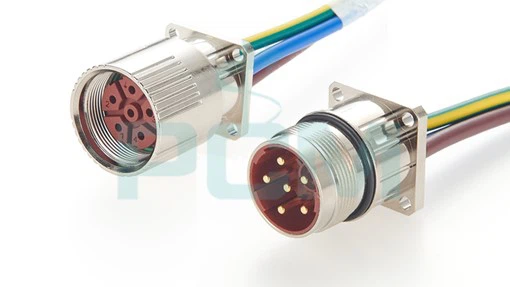
M23 Receptacle, Flange Mount

M23 Thread Power Supply Extension Cable

RJ45 to M12 cables for Servo Motors

M40 Power Cable 6SL3162-2MA00-0AC0

M16 Sensor Connector

M23 Servo Power Cable Right Angle


