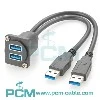
1, Standard A-type connector (USB Type-A)
The standard A-type connector, also known as USB Type-A, is the most common type of USB connector we use. It has a rectangular shape, supports hot swapping, and has wide compatibility and stability. The standard A-type connector is mainly used to connect devices such as mobile phones, wireless network cards, USB drives, portable optical drives, and small capacity portable hard drives in personal computers. Due to its high popularity, almost all electronic devices support the USB Type-A interface.
2, B-type connector (USB Type-B)
The B-type connector is square in shape and smaller than the A-type. It is usually used to connect certain types of devices, such as 3.5-inch portable hard drives, printers, and monitors. The USB Type-B interface requires a specific plug to ensure a stable connection with the device. Although its application scenarios are relatively narrow, it still plays an important role in some professional fields.
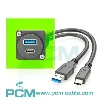
3, C-type connector (USB Type-C)
The C-type connector, also known as USB Type-C, is a popular new standard interface in recent years. It has a smaller size and can easily fit into the smallest peripheral devices, such as smartphones, Bluetooth speakers, etc. The USB Type-C interface supports forward and backward insertion and removal (both sides can be inserted), making the connection process more convenient and fast. In addition, USB Type-C also supports higher power transmission and bidirectional power transmission, integrating functions such as charging, display, and data transmission. Since USB 3.1, USB Type-C has gradually become the mainstream interface type and is widely used in devices such as smartphones, tablets, and laptops.
4, Micro USB and Mini USB connectors
Micro USB and Mini USB connectors are miniature versions of Type A and Type B USB connectors, mainly used for older portable devices such as MP3 players and digital cameras. These two types of connectors are smaller in size, making them easy to carry and use. However, due to their relatively low transmission speed and charging efficiency, they are gradually being replaced by USB Type-C interfaces in modern devices.
5, The Future Development of USB Connectors
With the continuous development of technology, USB connectors are also constantly evolving. At present, new generation USB standards such as USB 4 and USB4 Gen 3x2 have begun to emerge, which will provide higher transfer speeds and lower latency to meet the high-performance connectivity needs of future devices. In addition, with the continuous maturity of wireless charging technology, future USB connectors may be combined with wireless charging technology to achieve more convenient and flexible charging methods.

Jun 03, 2024
Leave a message
What are the four types of USB connectors?
Send Inquiry