1, USB 2.0
USB 2.0 is an early USB standard released in 2000 and an upgraded version of USB 1.1. Its maximum transfer rate is 480 Mbps, which is significantly improved compared to USB 1.1's 12 Mbps. USB 2.0 cables typically use Type-A and Type-B connectors and are widely used in low-speed devices such as printers, keyboards, and mice.
The main characteristics of USB 2.0 cable include low cost, strong compatibility, and wide applicability. However, due to the increasing demand for data transfer speed from modern devices, USB 2.0 has gradually been replaced by faster USB standards.
2, USB 3.0
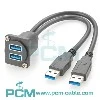
The USB 3.0 standard was released in 2008 and is a major upgrade to USB 2.0. Its maximum transmission speed reaches 5 Gbps, which is ten times faster than USB 2.0. The USB 3.0 cable also uses Type-A and Type-B connectors, but can usually be distinguished by the blue built-in logo. USB 3.0 is widely used in high-speed data transmission devices, such as external hard drives, cameras, etc.
The advantage of USB 3.0 cable lies in faster transmission speed and higher power transfer capability. This enables users to transfer large capacity files more quickly while supporting more devices that require higher power supply.
3, USB 3.1
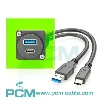
USB 3.1 is a standard further upgraded from USB 3.0 and was released in 2013. Its maximum transmission speed can reach 10 Gbps, which is twice that of USB 3.0. USB 3.1 cables often use Type-A and Type-C connectors, among which the Type-C connector can achieve forward and reverse plugging, greatly facilitating user use.
One of the notable features of USB 3.1 cable is its support for faster data transfer rates while maintaining compatibility with USB 3.0. This allows users to continue using USB 3.0 devices while owning USB 3.1 devices, achieving better device compatibility.
4, USB-C
USB-C is not a transmission rate standard, but a connector standard. The USB-C connector adopts a brand new design, which enables forward and reverse plugging and supports higher power transmission. The USB-C interface can be paired with different transfer rate standards such as USB 2.0, USB 3.0, USB 3.1, etc. Therefore, the USB-C cable itself does not limit the transfer rate.
The main features of USB-C cables include smaller interfaces, higher power transmission capabilities, higher data transmission rates, and a wide range of applications. Due to its comprehensive advantages, USB-C is gradually becoming a standard connection interface for various devices, such as the latest laptops, tablets, smartphones, etc.
5, Application field
USB 2.0 application areas:
The USB 2.0 cable is suitable for connecting low-speed devices, such as keyboards, mice, printers, etc. Due to its low cost and strong compatibility, it is still widely used in many office and home scenarios.
USB 3.0 application areas:
The USB 3.0 cable is mainly used for devices that require faster data transfer rates, such as external hard drives, cameras, high-definition cameras, etc. Its high-speed transmission capability enables users to manage large capacity files more efficiently.
USB 3.1 application areas:
The USB 3.1 cable provides faster transfer rates on the basis of USB 3.0, making it suitable for professional scenarios that require higher data transfer speeds, such as video editing, 3D modeling, and other fields. Meanwhile, the compatibility of USB 3.1 also allows users to gradually upgrade their devices without the need to replace all connecting cables.
USB-C application areas:
The USB-C cable is widely used in the latest electronic devices, including laptops, tablets, smartphones, etc., due to its forward and reverse plug design, high-power transmission, and comprehensive compatibility. Its compact interface design also makes the device more lightweight and portable.

Jan 12, 2024
Leave a message
What are the four types of USB cables?
Send Inquiry