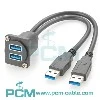
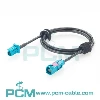
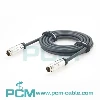
Robitic control cables are usually divided into two parts: one part is connected to the robot control cabinet, which is responsible for providing power and control signals to the robot; the other part is connected to the tools at the end of the robot (such as power tools, sensors, laser pointers, etc.), which are responsible for performing tasks. The quality of wiring directly affects the overall performance of the robot system.
1. Connection from the control cabinet to the robot
The control cabinet is the brain of the robot system, responsible for sending instructions and controlling the robot's movements. The cable extends from the control cabinet to the robot body and is usually responsible for power supply, transmission of control signals and coordination of robot movement. Such cables need to have good anti-interference ability and be able to resist external electromagnetic interference (EMI) to ensure stable transmission of control signals.
These cables often need to be sealed and protected to prevent failure in harsh industrial environments. Especially in production lines and automation systems, such cables also need to have strong mechanical durability to prevent signal failure due to bending or friction during long-term use.
2. Cable routing from robot to end tool
The robot end tool is usually a key part of the robot's mission, such as a welding gun, a robotic arm, a sensor or other auxiliary equipment. The wiring of cables must be able to meet the needs of frequent movement, so special attention should be paid to the following aspects:
Flexibility and durability: The tools at the end of the robot are often in a high-frequency moving state, so the cables must be highly flexible and able to withstand long-term bending, stretching and twisting while maintaining stable electrical performance.
Adapt to diverse movement methods: Some robots need to rotate quickly or even make complex movements when performing tasks. At this time, the cable must not only be able to adapt to large-scale bending and rotation, but also ensure that the rapid transmission of signals is not affected at high speeds.
Waterproof and oil-resistant: For some working environments, especially in industries such as automobile manufacturing or food processing, cables also need to have waterproof and oil-resistant properties to avoid short circuits or failures in humid or oily environments.
3. Space optimization in cable design
In robot systems, the rational use of space is equally important. The cables at the end of the robot usually need to be routed through the small space around the end tool. Designers need to consider the size and shape of the cables, and how to avoid affecting the robot's movement accuracy and efficiency due to cable accumulation or entanglement.
To this end, the use of highly flexible flat cables or torsion cables can effectively avoid problems such as cable entanglement and knotting in complex movements, ensuring smooth movement of the robot arm. The length of the cable also needs to be accurately calculated to reduce unnecessary dragging and stretching of the cable, thereby improving the flexibility of the robot's movement.
4. Accurately match cable and tool requirements
The requirements of each robot application are different, and the types of end tools vary greatly. Different tools may require different types of cables, such as power transmission cables for power tools, signal transmission cables for sensors, etc. Therefore, the cable wiring from the control cabinet to the tool is not only a challenge of technical requirements, but also involves how to choose the right cable type and specifications.
For example, in a laser cutting robot, in addition to the power cable, a high-speed data transmission cable may be required; in a welding robot, the cable not only needs to be resistant to high temperatures, but also has the function of anti-electromagnetic interference.
5. Safety and maintenance
During long-term operation, the cable may be worn due to mechanical friction or environmental factors. Therefore, regular inspection of the condition of the cable and replacement of damaged cables are part of maintaining the robot system. In addition, using cables with protective layers, or using cable troughs and conduits for protection, can effectively prevent the cables from being damaged during movement.

You may also like
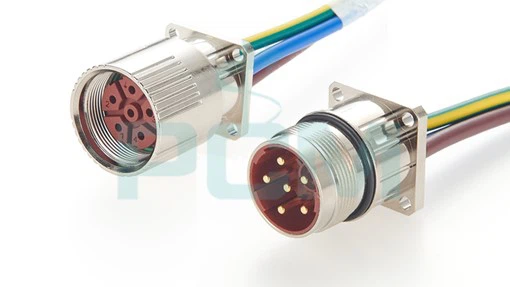
M23 Receptacle, Flange Mount

M23 Thread Power Supply Extension Cable

RJ45 to M12 cables for Servo Motors

M40 Power Cable 6SL3162-2MA00-0AC0

M16 Sensor Connector

M23 Servo Power Cable Right Angle