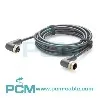
In modern industrial automation and robotics, cable selection and design is critical. Different types of cables are suitable for different application scenarios, especially in environments that require frequent movement or high-intensity mechanical operations. Several common cable types include mobile cables, robotic cables, drag chain cables, and drag chain cables. While these cables may appear similar, they have some significant differences in their application, construction, and performance.
1. Moving Cable
Moving cable is a cable designed for frequent movement, usually used in robotic arms, conveyor belts, machine tools and other equipment. Its main feature is that it can withstand constant bending, stretching and extrusion, so it has high flexibility and wear resistance. Moving cables are usually made of wear-resistant and bending-resistant materials to ensure that they will not break or degrade in environments with frequent movement.
- Application scenarios: automated production lines, robotic arms, etc.
- Features: high flexibility, wear resistance, suitable for frequently moving environments.
2. Robot Cable
Robot cable is a cable designed for robot applications, which usually needs to meet higher flexibility, durability and high temperature resistance requirements. Robot cables not only need to carry power and signals, but also need to support complex movements of robots, especially high-frequency rotation and bending. The design of robot cables takes into account the bending radius, torsion and tensile forces that may occur during the movement of the cable, so they are usually more durable and flexible than ordinary moving cables.
Application scenarios: industrial robots, automation equipment.
Features: ultra-high flexibility and durability, suitable for robot systems with high-speed movement and complex movements.
3. Towline Cable
Dragline cables are usually used in equipment that needs to move a lot, especially in the drag chain system of automated production lines. Drag chain cables need to support stable transmission of power, signal and data, and be able to slide and bend in the drag chain. Drag chain cables are usually designed to withstand long-term, high-frequency stretching and compression. Their shells are usually made of wear-resistant, oil-resistant and chemical-resistant materials to ensure that they can still maintain good performance in harsh environments.
Application scenarios: automated production lines, robotic arms, heavy equipment, etc.
Features: high durability, suitable for use in drag chains, resistant to stretching and compression.
4. Drag Chain Cable
Drag chain cables are similar to drag chain cables and are mainly used to support high-frequency and large-scale movements, but their design focuses more on more efficient cable management through drag chains. Drag chain cables are generally composed of multiple strands and have strong mechanical strength and torsion resistance. This type of cable is often used in automation equipment and robotic systems, especially in large machinery or applications that require rapid movement.
Application scenarios: automation equipment, transportation systems, robotic systems, etc.
Features: Strong mechanical strength, suitable for long-term and frequent movement in the drag chain.
| Feature | Moving Cable | Robot Cable | Towline Cable | Drag Chain Cable |
|---|---|---|---|---|
| Application Range | Robotic arms, machine tools, conveyors | Industrial robots, automation equipment | Automated production lines, heavy equipment | Automation equipment, transport systems |
| Flexibility | High | Extremely high | High | High |
| Durability | High | Extremely high | High | High |
| Abrasion/Stretch Resistance | High | High | High | High |
| Oil & Chemical Resistance | Medium | High | High | High |
| Special Features | Suitable for frequent movement | Suitable for complex movements | Suitable for use in drag chains | Suitable for efficient cable management in drag chains |

You may also like
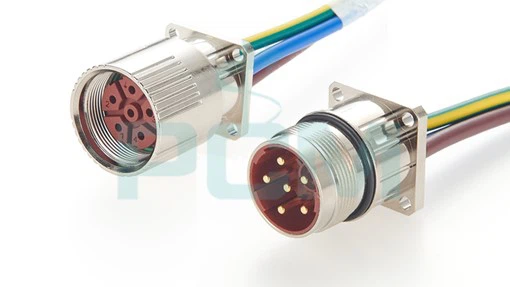
M23 Receptacle, Flange Mount

M23 Thread Power Supply Extension Cable

RJ45 to M12 cables for Servo Motors

M40 Power Cable 6SL3162-2MA00-0AC0

M16 Sensor Connector

M23 Servo Power Cable Right Angle