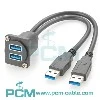
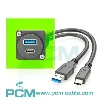
USB (Universal Serial Bus) and RS232 (Recommended Standard 232) are two different communication protocols that have essential differences in physical connections, signal transmission, and data formats. USB is a high-speed, bidirectional, and parallel communication interface designed to connect computers and various peripherals, such as keyboards, mice, printers, etc. RS232 is a low-speed, unidirectional, serial communication interface widely used in industrial control systems and old computer peripherals, such as printers and modems.
When we need to connect a USB device to an RS232 device, the USB to RS232 cable comes in handy. This type of cable contains a conversion chip inside, which is responsible for converting USB signals into RS232 signals, and vice versa. This process involves multiple steps, including physical connection adaptation, signal type conversion, and data format conversion.
Firstly, from a physical perspective, USB typically uses flat data cables, while RS232 uses circular DB9 or DB25 connectors. One end of the USB to RS232 cable is equipped with a miniature USB interface for inserting into the USB port of the computer; The other end provides an RS232 standard plug that can be connected to RS232 devices.
The next step is the process of signal conversion. USB transmits differential signals, which represent data by the positive or negative voltage difference between two lines. RS232 typically uses a single ended signal to transmit data through voltage changes relative to the ground wire. The conversion chip requires converting the differential signal into a single ended signal, or vice versa, which involves complex electronic circuit design and requires ensuring accurate and error free signal conversion.
In addition, the data format has also been changed during the conversion process. The data transmitted by USB is organized in the form of packets, including start bits, data bits, check bits, and stop bits. RS232 typically transmits data in a sequence of start bits, data bits, and stop bits. The conversion chip must reorganize and package these data bits to ensure correct transmission of data between two different communication protocols.
In addition to physical connections and signal conversion, USB to RS232 cables may also provide some additional features, such as built-in power supply. Due to the fact that many RS232 devices require an independent power supply to function, some cables are designed with power cords to provide power to these devices.
During use, users only need to plug the USB port into the computer's USB interface and connect the RS232 port to the corresponding device. Then, the computer usually automatically recognizes the newly connected device and installs the corresponding driver. Once the driver installation is completed, the device can communicate via USB to RS232 cable.
In summary, the USB to RS232 cable completes physical connection adaptation, signal type conversion, and data format conversion through an internal conversion chip, thereby achieving data transmission between two different communication protocols. The design and application of this cable simplify the connection problem between modern and traditional equipment, enabling seamless integration of cross era technologies. With the advancement of technology, we can foresee that the continuous improvement of such conversion technologies will further promote interconnection and interoperability between different devices.

Apr 23, 2024
Leave a message
How does the USB to RS232 cable work?
Send Inquiry