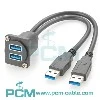
We need to understand the basic working principle of cable splitters. The main function of a cable splitter is to distribute one input signal to multiple output ports, or merge signals from multiple input ports into one output. This is usually achieved through internal signal distribution and merging circuits. These circuits accurately process and allocate signals based on their frequency, amplitude, and phase characteristics to ensure their stability and quality during transmission.
So, can cable splitters work in both directions? In theory, cable splitters have the potential for bidirectional transmission. This is because the cable itself is a bidirectional transmission medium that can simultaneously carry forward and reverse signals. However, to achieve bidirectional operation of cable splitters, certain conditions and technical requirements need to be met.
Firstly, the design of the cable splitter needs to support bidirectional signal transmission. This includes adopting appropriate circuit structures and materials in hardware to ensure effective signal transmission in both positive and negative directions. At the same time, it is necessary to optimize and adjust the software accordingly to meet the requirements of bidirectional transmission.
Secondly, bidirectional operation also requires consideration of signal isolation and interference issues. In cable communication systems, interference between signals is a common problem. If the cable splitter cannot effectively isolate and suppress interference during bidirectional operation, the transmission quality of the signal will be seriously affected. Therefore, when designing cable splitters, effective isolation techniques and interference suppression measures need to be adopted to ensure the purity and stability of the signal.
In addition, bidirectional work also needs to consider the compatibility and scalability of the system. Different cable communication systems may use different signal formats and transmission protocols, so cable splitters need to have sufficient compatibility and flexibility to meet the needs of different systems. Meanwhile, with the continuous development of technology, new communication protocols and transmission standards may emerge in the future, so cable splitters also need to have scalability in order to easily upgrade and expand their functions.
Although cable splitters theoretically have the possibility of bidirectional operation, in practical applications, they still need to be comprehensively considered based on specific needs and scenarios. In certain specific situations, such as bidirectional data transmission, bidirectional communication, etc., the bidirectional working function of cable splitters may be very useful. However, in other scenarios, only unidirectional transmission functionality may be required, and bidirectional operation is not necessary.
In summary, cable splitters can theoretically support bidirectional operation, but in practical applications, multiple factors need to be comprehensively considered. When designing cable splitters, it is necessary to fully consider the requirements and conditions of their bidirectional operation, and take effective techniques and measures to ensure the quality of signal transmission and system stability. At the same time, we also need to pay attention to the future development trends and market demands of technology, in order to continuously optimize and upgrade the functionality and performance of cable splitters.