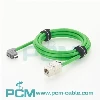
1. Basic overview of M12 connector
M12 connector is named for its thread with an outer diameter of 12 mm. It is strong, durable and reliable and is widely used in various industrial environments. These connectors are commonly used for power and signal transmission, providing stable connections. The standardized design of the M12 connector ensures a certain degree of compatibility between connectors produced by different manufacturers, but specific application and functional requirements may cause significant differences between different types of M12 connectors.
2. Design and type
1. Pin configuration
The pin configuration of the M12 connector is one of the key factors that determine its functionality and application. Common pin configurations include 3-pin, 4-pin, 5-pin, 8-pin, etc. Each configuration is suitable for different application scenarios:
3-pin M12 connector: Typically used for simple power connections.
4-pin M12 connector: commonly used to connect sensors and actuators to transmit power and signals.
5-pin and 8-pin M12 connectors: suitable for complex signal transmission and multi-function devices, supporting more data lines and control signals.
2. Encoding type
M12 connectors have different coding types, such as A coding, B coding, C coding, D coding, X coding, etc. Each coding type determines the purpose and compatibility of the connector:
A code: commonly used for the connection of sensors and actuators.
B-coding: used in Profibus and industrial networks.
C-coded: for AC power connection.
D encoding: used for Ethernet connections, supporting high-speed data transmission.
X encoding: suitable for higher speed data transmission, up to 10 Gb/s.
Different coding types ensure the correct connection of the connectors and prevent equipment damage or signal interference caused by misplugging.
3. Shell material
There are also differences in the shell materials of M12 connectors. Common materials include plastic, metal and stainless steel:
Plastic shell: light weight, low cost, suitable for general environment use.
Metal shell: Provides higher mechanical strength and anti-interference performance, suitable for harsh industrial environments.
Stainless steel housing: has the highest corrosion resistance and is suitable for special industries such as food processing and chemical industry.
4. Protection level
The protection level of the M12 connector (such as IP65, IP67, IP68) determines its applicability in different environments:
IP65: dust-proof and protected against low-pressure water spray.
IP67: dustproof and protected against short-term immersion.
IP68: dustproof and protected against long-term immersion.
Different protection levels ensure the reliability and durability of M12 connectors in various environmental conditions.
3. Differences in application fields
M12 connectors are widely used in various industries, but different application scenarios have different requirements for connectors:
1. Industrial automation
In the field of industrial automation, M12 connectors are used to connect sensors, actuators, PLCs and other equipment, requiring connectors to have high reliability and anti-interference performance. A-coded and D-coded M12 connectors are common choices for power and signal transmission and industrial Ethernet connections respectively.
2. Transportation
In the transportation industry, M12 connectors are used in rail transit, automotive electronics and aviation systems, which require connectors with high shock resistance and durability. Metal shell and high protection grade M12 connector are preferred to ensure stable connection in harsh environments.
3. Medical equipment
Medical equipment has extremely strict requirements on connectors, requiring high reliability and hygiene standards. M12 connectors with stainless steel housings and high protection levels are suitable for these applications, ensuring safe use in highly clean environments.
4. Robots and automation equipment
In robots and automation equipment, M12 connectors are used to connect power lines and signal lines to ensure reliable transmission of data and power. The variety of coding types and pin configurations meets the needs of different robots.
4. Differences in specifications and performance
1. Electrical performance
Different types of M12 connectors support different voltages and currents, usually between 12V and 250V, and currents ranging from 1A to 16A. Depending on the specific application, selecting an M12 connector with appropriate electrical performance is key to ensuring proper operation of the device.
2. Mechanical properties
The mechanical properties of M12 connectors include plugging and unplugging life, shock resistance and connection strength. High-quality M12 connectors usually have longer service life and higher mechanical strength, and are suitable for frequent plugging and unplugging and use in harsh environments.
3. Environmental adaptability
The environmental adaptability of M12 connectors includes temperature resistance, corrosion resistance and waterproof performance. Depending on the application environment, choosing M12 connectors with corresponding environmental adaptability can greatly improve the reliability and life of the equipment.
5. Differences between markets and suppliers
1. Product types and models
There are many types of M12 connectors on the market, and the products provided by different suppliers differ in design, function and performance. Users need to choose the appropriate product model based on specific needs to ensure compatibility and reliability.
2. Price difference
Due to differences in materials, designs and manufacturing processes, the price of M12 connectors varies greatly. High-quality connectors typically cost more but offer better performance and reliability. Users need to weigh costs and needs and choose the most cost-effective product.