H-MTD Z-Coded Automotive Ethernet Male-to-Female Extension Cable: Features, Applications and Selection Guide
Learn how PCM-ZC-0016 combines Rosenberger H-MTD Z-coded connectors with G&G GG 2Speed 251 cable for 100Ω differential links, DC–10GHz bandwidth and up to 10Gbps automotive Ethernet applications.
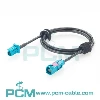
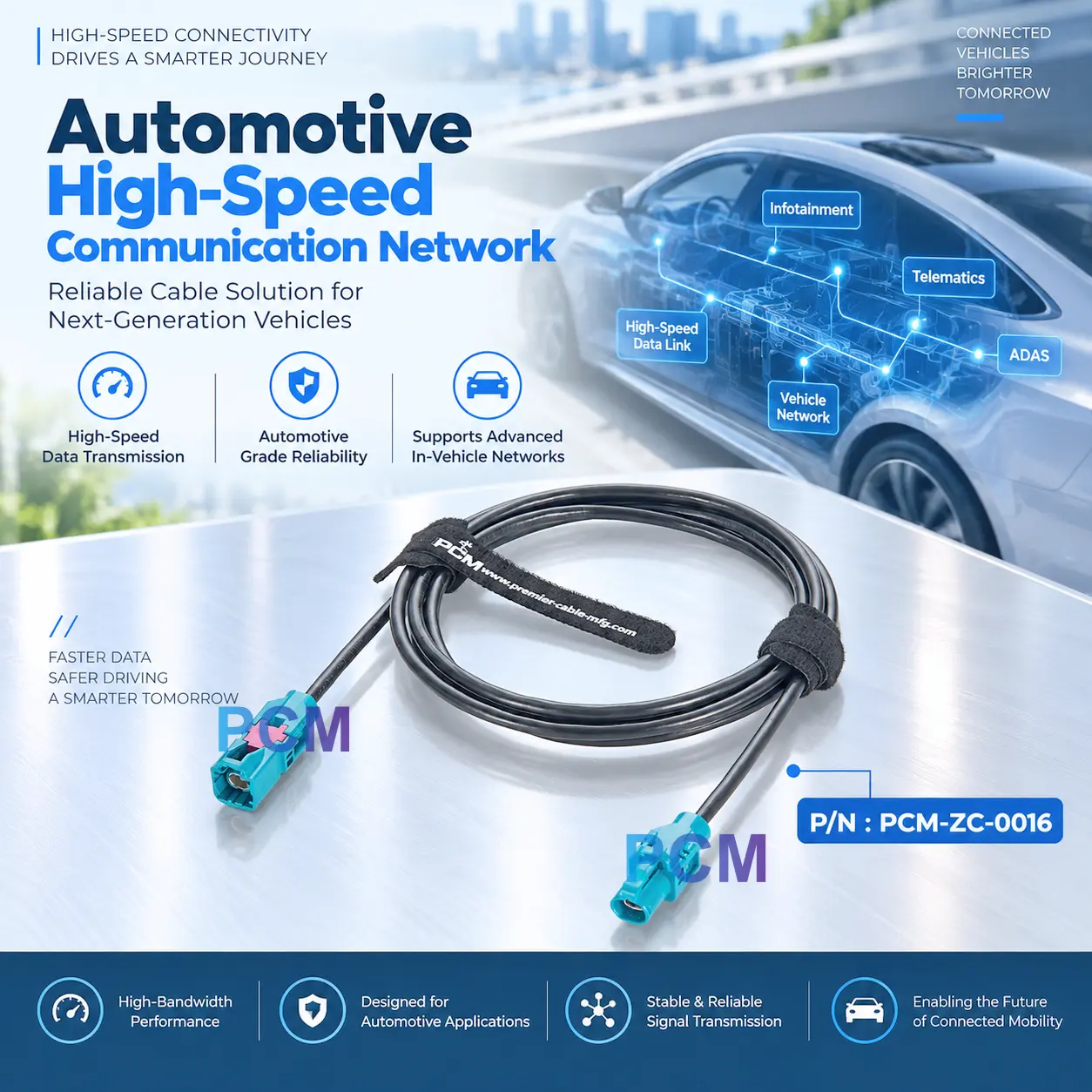
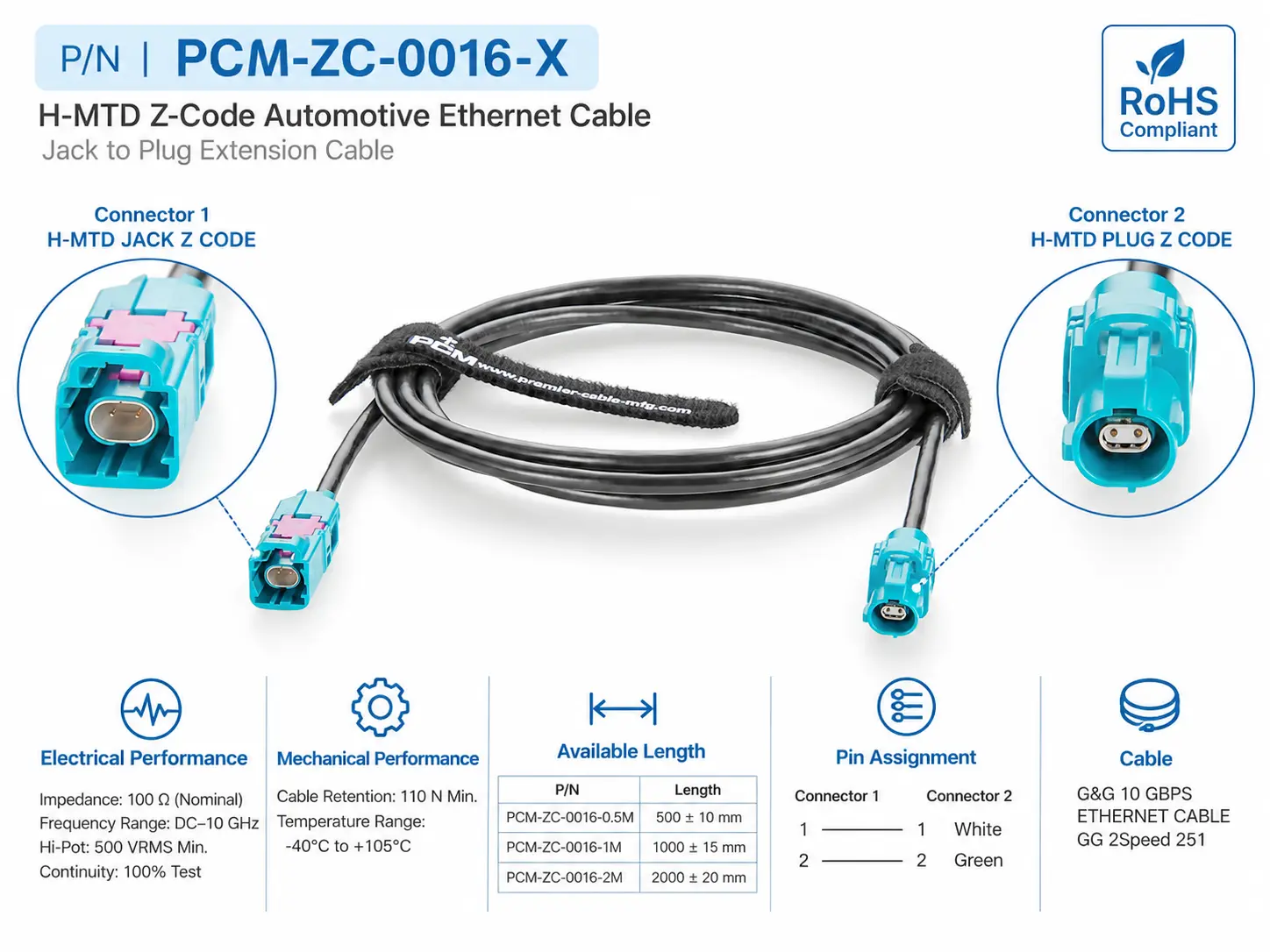
PCM-ZC-0016 is an H-MTD Z-coded male-to-female automotive Ethernet extension cable using Rosenberger E6S10A-1CAZ5-Z and E6K10A-1CAZ5-Z connectors with G&G GG 2Speed 251 cable. It provides 100Ω differential impedance, DC–10GHz frequency capability and up to 10Gbps data transmission for compatible automotive networks.
Quick Product Introduction
PCM-ZC-0016 Standard Structure:
E6S10A-1CAZ5-Z H-MTD Z-Coded Male → G&G GG 2Speed 251 → E6K10A-1CAZ5-Z H-MTD Z-Coded Female
| Product Name | H-MTD Automotive Ethernet Extension Cable |
| Premier Cable P/N | PCM-ZC-0016 |
| Connector A | Rosenberger E6S10A-1CAZ5-Z |
| Connector B | Rosenberger E6K10A-1CAZ5-Z |
| Connector Series | H-MTD |
| Coding | Z-Code |
| Cable | G&G GG 2Speed 251 |
| Length | 0.5m/1m/2m |
| Nominal Impedance | 100Ω |
PCM-ZC-0016 vs Standard H-MTD Device Cable
| Comparison | PCM-HD-0117 Panel Mount | Standard H-MTD Device Cable |
|---|---|---|
| H-MTD | Yes | Yes |
| Z Coding | Yes | Depends |
| Male-to-Female | Yes | Depends |
| Extension Function | Excellent | Limited |

What Is an H-MTD Automotive Ethernet Extension Cable?
The H-MTD Automotive Ethernet Extension Cable is a passive cable assembly designed for in-vehicle high-speed differential signal connections.
PCM-ZC-0016 uses an H-MTD Male → High-Speed Differential Cable → H-MTD Female configuration to extend an existing H-MTD connection while maintaining the original interface and communication architecture.
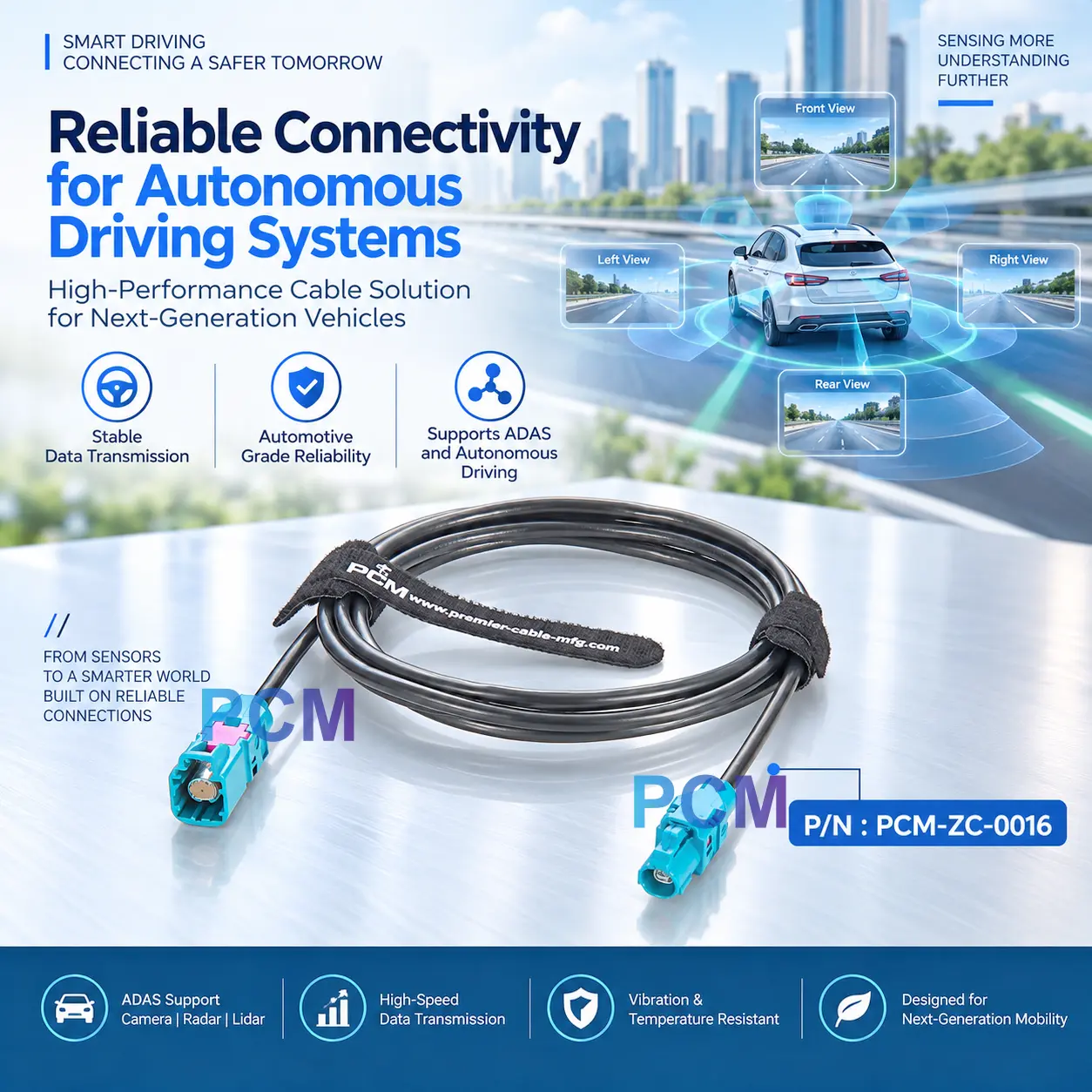
It is suitable for automotive cameras, ADAS, domain controllers and electronic modules, supporting high-speed differential transmission, modular wiring, quick connection and maintenance. It is important to note that this cable is a physical-layer extension, not an Ethernet converter; it does not convert protocols, signal formats or one PHY type into another.
PCM-ZC-0016 →What Is H-MTD ?
H-MTD --High-Speed Modular Twisted-Pair Data
It is a high-speed differential connector system developed by Rosenberger for automotive data communication. It features a compact, modular design, multiple coding options, mechanical locking and strong EMC performance.
Designed for high-frequency and high-data-rate in-vehicle networks, the H-MTD platform supports frequencies up to approximately 20GHz and is suitable for Automotive Ethernet, SerDes, ADAS cameras, domain controllers and other high-speed automotive data links.
Common Industrial Ethernet Challenges
Core Product Value

PCM-ZC-0016
The core advantages of PCM-ZC-0016 can be summarized as:
◆ Up to 10Gbps High-Speed Link
G&G GG 2Speed 251 high-speed automotive Ethernet cable features 100Ω differential impedance and a DC–10GHz frequency range, providing a reliable physical-layer foundation for compatible data links up to 10Gbps.
◆ H-MTD Z-Coded Male-to-Female ExtensionMatched H-MTD Z-coded male and female connectors provide a direct extension without changing the original interface architecture. Multiple cable lengths support flexible vehicle module layout, testing and prototype wiring.
◆ Controlled Impedance and Shielding
Controlled 100Ω differential impedance combined with cable shielding helps reduce signal reflections and external EMI, supporting improved signal integrity for ADAS, automotive cameras and high-speed ECU connections.
◆ Wide Temperature and Mechanical Reliability
A -40°C to +105°C operating range, 110N minimum cable retention, mechanical locking and 500VRMS withstand-voltage testing support robust mechanical and electrical performance in demanding automotive environments.
Products Display
Similar products

Compatibility Statement
Compatibility Verification
PCM-ZC-0016 uses Rosenberger H-MTD Z-coded male and female interfaces for physical connection and cable extension. However, mechanical mating does not automatically guarantee electrical, signal or protocol compatibility.
Before selection, verify the exact connector part number, coding, pin assignment, differential impedance, PHY type, communication protocol, target data rate and device port definition to ensure the complete link meets system requirements.
Technical Compatibility Notice
H-MTD is fundamentally a physical interconnect system for high-speed differential signals and can be used in Automotive Ethernet and high-speed SerDes links.
However, H-MTD itself is not equivalent to communication standards such as 100BASE-T1, 1000BASE-T1 or 10GBASE-T1. The up-to-10Gbps capability of PCM-ZC-0016 should be evaluated together with cable length, connected PHYs, pinout, impedance matching, frequency characteristics and complete link testing rather than determined by the connector type alone.
How to Choose an H-MTD Extension Cable ?
Verify Connector Part Number and Coding
Verify the exact H-MTD part number, Z coding, plug/jack orientation, housing and locking design instead of selecting only by appearance.
Verify Protocol, PHY and Pinout
Confirm the exact protocol, PHY and differential pin mapping because H-MTD alone does not define the transmitted signal.
Match Data Rate and Cable Length
Select cable length according to link speed and system margin, with full channel testing recommended for longer multi-gigabit links.
Verify Environmental and Mechanical Requirements
Evaluate temperature, vibration, cable routing, retention, shield grounding and connector locking for the intended vehicle environment.
Customization Capabilities
↕ H-MTD Connector and Coding Customization
H-MTD coding, plug/jack configuration and housing design can be customized according to the target vehicle interface.
□ Cable Length Customization
Custom cable lengths can be developed, with additional high-frequency validation recommended for longer links.
◉ High-Speed Cable Customization
Different 100Ω automotive high-speed cables can be selected according to data-rate, frequency and routing requirements.
⚙ Shielding and Grounding Customization
Shielding and ground-termination architectures can be optimized for demanding vehicle EMC environments.
⌘ Pinout and Protocol-Specific Development
Pin assignments and differential-pair mappings can be customized for specific automotive Ethernet or high-speed data projects.
◇ OEM/ODM Automotive High-Speed Harness Development
Complete OEM/ODM H-MTD cable assemblies can be developed with electrical, mechanical and high-frequency link validation.
Conclusion:
PCM-ZC-0016 is an H-MTD Z-coded male-to-female automotive high-speed extension cable designed around controlled 100Ω differential transmission, high-frequency cable performance, shielding, locking retention and wide-temperature operation.
Its value lies in extending a compatible H-MTD interface while maintaining the physical-layer characteristics required by high-speed in-vehicle networks.
Compatibility must ultimately be determined from the complete connector, cable, PHY, protocol and channel design.
Product FAQ
Is H-MTD an Automotive Ethernet Protocol ?
H-MTD is a connector system, not an Ethernet protocol. It can support multiple automotive Ethernet and SerDes physical-layer applications.
H-MTD Male and Female Interfaces
The male-to-female configuration extends an existing H-MTD connection without changing the device-side connector architecture.
Why Is Impedance Matching Important ?
Controlled impedance helps minimize signal reflections and preserve high-speed link integrity.
What Does 10Gbps Mean ?
Up to 10Gbps describes the intended high-speed link capability, while actual system rate depends on both endpoints and the complete channel.
Why Use Differential Signaling ?
Differential signaling improves noise immunity and supports reliable high-speed transmission in demanding automotive environments.
Why Use Shielding ?
Shielding helps reduce EMI coupling between high-speed data links and other vehicle electronics.