FAKRA Z Code to SMA Panel Mount RF Cable: Features, Applications and Selection Guide
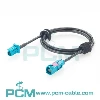
PCM-0791 is a FAKRA Z-coded male to SMA male 50-ohm RF cable assembly featuring a front panel-mount FAKRA interface with nut retention and Ø2.8mm black RG174 coax. Available in 150mm, 250mm and custom lengths, it supports RF interconnection for automotive GPS/GNSS, 4G/5G, Wi-Fi, V2X, telematics, antennas and RF test equipment.
This article focuses on the PCM-0791 FAKRA Z Code to SMA Panel-Mount RF Cable and explains the engineering relationship between FAKRA Z coding, SMA RF interfaces, 50-ohm RG174 coaxial cable, front-panel mounting and automotive RF systems.
The cable addresses a practical integration challenge: automotive electronic equipment may use SMA, PCB RF modules or other standard RF interfaces internally while the external vehicle harness uses FAKRA. A panel-mounted FAKRA interface creates a fixed external RF port on the enclosure, while a short RG174 coaxial cable connects it to the internal SMA interface.
PCM-0791 is therefore more than a FAKRA-to-SMA adapter cable. It provides an equipment-level RF interconnect solution combining RF interface adaptation, panel integration and internal cable routing.
Quick Product Introduction
PCM-0791 uses a FAKRA Z-coded male connector at one end. The interface passes through the enclosure panel and is secured using a rubber sealing ring and retaining nut. The recommended panel cutout is Ø16.35±0.05mm.
The opposite end uses an SMA male RF connector, connected through Ø2.8mm black RG174 coaxial cable with 50-ohm characteristic impedance.
Standard lengths include:
150mm;250mm;
Custom lengths can also be produced according to the position of the internal PCB, RF module or antenna interface.
This short pigtail architecture is particularly useful where equipment has limited internal space but requires a standard automotive FAKRA interface externally.
| Product Name | FAKRA Z Code Male Panel Mount to SMA PlugCoaxialCable |
| P1 Interface | FAKRA-Z Male, Panel Mount |
| P2 Interface | SMA Plug |
| Wire rod | RG174 Coaxial Cable |
| Outer Diameter | OD 2.8 mm |
| Length | 150+10 mm /250+10 mm |
| Premier Cable P/N | PCM-0791 |

What Is an SMA Interface ?
SMA is a 50-ohm coaxial interface widely used in RF modules, antennas, measurement equipment and laboratory test systems.
A FAKRA to SMA cable does not convert RF protocols; it provides physical interface adaptation between automotive FAKRA and standard SMA equipment.
PCM-0791 is suitable for routing vehicle-side FAKRA signals through an equipment panel to internal RF modules or test interfaces via SMA.
What Is RG174 50 Ohm Coaxial Cable ?
RG174 is a common small-diameter 50-ohm flexible coaxial cable with excellent flexibility and easy routing, making it suitable for short RF pigtails and space-constrained equipment.
PCM-0791 uses approximately Ø2.8mm black RG174 between the FAKRA panel interface and SMA connector. Because high-frequency attenuation increases in small-diameter coax, longer or higher-frequency applications should evaluate cable length, attenuation and frequency, with lower-loss coax considered when necessary.

Pain Points

PCM-0791
PCM-0791 uses a FAKRA Z-coded male connector as the external equipment interface and mechanically secures it through the front panel using a rubber sealing ring and retaining nut.
The recommended panel cutout is:
Ø16.35±0.05mm
Internally, the interface connects to Ø2.8mm black RG174 50-ohm coaxial cable. Standard lengths are 150mm and 250mm, with an SMA male connector at the opposite end.
The signal path can be represented as:
External FAKRA RF Interface → Panel Mount → RG174 50Ω Coax → SMA Male → Internal RF Module / Test Equipment
There is no RF protocol converter, amplifier or signal-processing IC in the assembly.
Compatibility Statement
Compatibility Verification
PCM-0791 provides a passive 50-ohm RF connection between FAKRA and SMA, but matching impedance does not guarantee device compatibility. Selection must verify FAKRA P/N, gender, coding, SMA interface, cable type, frequency and equipment RF requirements. Z Code defines mechanical coding, not a specific signal function.
Technical Compatibility Notice
FAKRA capability up to 6GHz does not automatically define PCM-0791 performance. The actual frequency range also depends on the RG174 specification, SMA interface, cable length, termination quality, insertion loss, return loss and VSWR. High-frequency applications should be verified using the actual cable P/N and finished-assembly RF testing.
How to Select the Right Product ?
Verify FAKRA Coding and Gender
Before selection, verify the required FAKRA male/female configuration and coding rather than relying on housing color alone. Providing the exact mating-connector P/N and checking mechanical keying helps reduce interface mismatch and mating risks during prototyping.
Verify the SMA Interface Configuration
Standard PCM-0791 uses SMA male, but RF modules, antennas and test equipment may use SMA male, female or other RF interfaces. Selection should follow the actual mating interface and connector type to avoid unnecessary adapters.
Select Cable by Frequency and Length
RG174 is suitable for compact 150mm or 250mm RF routing, but insertion loss increases with cable length and frequency. Longer or higher-frequency links should be evaluated for attenuation and RF link budget, with lower-loss 50-ohm coax used when necessary.
Verify Panel Cutout and Installation Clearance
PCM-0791 specifies a recommended Ø16.35±0.05mm panel cutout, but final design must also verify panel thickness, nut clearance, connector orientation and adjacent-interface spacing. Mechanical verification against the formal drawing is recommended before mass-production enclosure machining.
Customization Capabilities
↕ FAKRA Gender Customization
Panel-side FAKRA can be customized as male or female based on the exact P/N, gender and mating connector.
□ FAKRA Coding Customization
FAKRA coding can be customized to the device interface, with mechanical keying and housing color correctly matched.
◉ RF Connector Customization
The RF side can be customized with SMA, SMB, MCX, AMC, BNC or other suitable 50-ohm interfaces.
⚙ Cable Length Customization
Cable length can be customized for panel-to-module distance while considering frequency and insertion loss.
⌘ Coaxial Cable Customization
RG174 or other 50-ohm coax can be selected based on diameter, flexibility, frequency, temperature and loss.
◇ Panel-Mount Configuration Customization
Mounting orientation, nuts, seals, cable exit and panel cutout can be customized for different equipment designs.
Product FAQ
Is a FAKRA Z Code to SMA Cable a Protocol Converter ?
No. PCM-0791 is a passive RF cable assembly that provides physical coaxial interface adaptation between FAKRA and SMA. It contains no PHY, RF converter, amplifier or signal-processing IC and does not actively change GPS, 5G, Wi-Fi, V2X or other protocols.
Are FAKRA and SMA Automatically Compatible Because Both Are 50 Ohms ?
No. Fifty ohms describes nominal impedance only. Frequency, gender, coding, cable loss, VSWR, equipment ports and complete RF system requirements must also match.
What Does FAKRA Z Code Mean ?
Z Code is generally used as the FAKRA neutral coding, but it remains part of the mechanical coding system. Z Code alone does not identify the interface as GPS, camera, 5G or any other specific signal.
Can RG174 Automatically Support 6GHz ?
Not from the RG174 designation alone. Frequency rating and attenuation vary among RG174 products, while length, connectors and termination also affect complete performance. A defined cable datasheet and complete RF validation are required for a 6GHz application.
Is 150mm or 250mm Better for High-Frequency Applications ?
With all other conditions equal, a shorter coaxial cable generally produces lower insertion loss. A 150mm assembly therefore usually has a loss advantage over 250mm when the mechanical layout permits, although final performance should be confirmed by RF testing.
What Is the Advantage of a Panel Mounted FAKRA Interface ?
Panel mounting creates a fixed equipment interface so the housing and mounting structure carry more mating loads, while the internal RG174 primarily handles short RF routing. This supports modular equipment design and maintenance.