HSD 4+4 Pin Z-Code 1-to-2 Automotive Data Cable: Features, Applications and Selection Guide
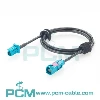
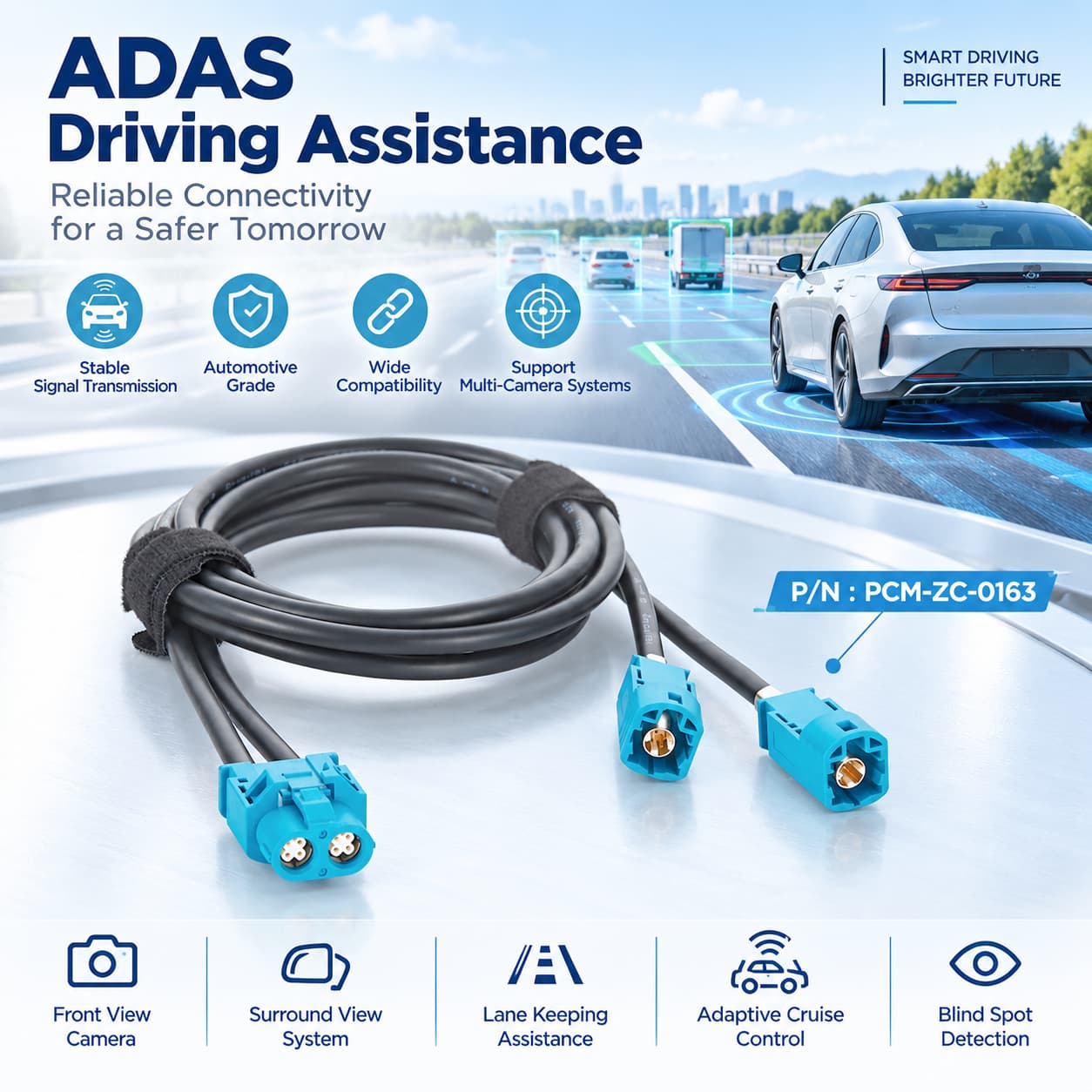
PCM-ZC-0163 is an HSD 4+4 Pin Z-Code dual-channel 1-to-2 automotive high-speed data cable featuring one dual HSD 4+4 Pin jack, two HSD Z-Code plugs and Dacar 535 100Ω high-speed cable. It provides two independent differential data channels, operates from DC to 2GHz, has a standard 1m length, and is designed for ADAS cameras, digital cockpits, displays, video processing and automotive validation, with OEM customization for interfaces, coding, length and branch configuration.
What Does This Article Cover?
As ADAS, digital cockpits, multi-camera vision systems and centralized computing architectures continue to develop, the number of high-speed data devices that must be interconnected inside a vehicle is increasing. A conventional "one interface, one separate harness" architecture can increase connector count, cable quantity, installation space and assembly complexity. Integrating multiple high-speed channels into a multi-port connector and then routing them to different devices through a breakout harness has therefore become an important architecture in automotive high-speed wiring systems.
Using the Premier Cable PCM-ZC-0163 HSD 4+4 Pin Z-Code 1-to-2 automotive high-speed data cable as an example, this article systematically explains HSD interface fundamentals, dual-channel architecture, 100Ω differential transmission, Dacar 535 cable, Z-Code mechanical error prevention, compatibility, applications, product selection and OEM customization.
Quick Product Introduction
PCM-ZC-0163 uses one dual HSD 4+4 Pin Z-Code main connector to connect two independent HSD Z-Code branch connectors.
Its basic architecture is:
1× HSD 4+4 Pin Z-Code Jack
↓
Two Independent High-Speed Data Channels
↓
2× HSD Z-Code Plugs
The main end uses a dual-port HSD architecture corresponding to Rosenberger D4K10C-1D5A5-Z, while the two branch ends use HSD Z-Code plugs corresponding to Rosenberger D4S10A-1D5A5-Z.
| Cable Configuration | 1× HSD 4×4-Pin Jack → 2× HSD 4-Pin Plug |
| Coding | Z Code |
| Main Cable Length | 1000 ± 20 mm |
| P1/P3 Connector Length | 25.8 ± 0.15 mm |
| P2/P4 Connector Length | 26.0 ± 0.15 mm |
| Temperature Range | -40°C to +105°C |
| Premier Cable P/N | PCM-ZC-0163 |

What Is an HSD 4+4 Pin Z-Code Automotive High-Speed Data Cable ?
HSD, or High-Speed Data, is a shielded connector system developed for automotive high-speed differential data transmission.A conventional single HSD connector generally provides one 4-pin high-speed data interface
The key concept of an HSD 4+4 configuration is:
two independent 4-pin HSD high-speed interfaces integrated into one housing.
Therefore, HSD 4+4 should not simply be understood as an ordinary "8-pin connector." It is more accurately described as:
2 × HSD 4Pin High-Speed Channels Integrated into One Housing
This architecture is particularly suitable for:
- camera ECUs;
- digital cockpits;
- HIL test benches;
- dual-display links;
- multi-camera systems;
- ADAS domain controllers;
- multi-channel video-processing systems.
What Is Dacar 535 High Speed Cable ?
Dacar 535 is a 100Ω cable architecture used for automotive high-speed data interconnections.
Multiple Rosenberger HSD product references explicitly identify DACAR 535/538 4-pole cable, approximately Ø4.6mm and 100Ω as a compatible HSD cable group.
PCM-ZC-0163 uses Dacar 535 to create two independent high-speed differential transmission paths.
The value of an automotive high-speed cable is not simply that "the wires are electrically continuous." Critical parameters can include:
characteristic impedance;insertion loss;return loss;differential balance;skew;crosstalk;shielding continuity;EMC performance.
For this reason, validation of a high-speed cable assembly is fundamentally different from validation of a conventional low-speed power cable.
Common Industrial Ethernet Challenges

PCM-ZC-0163
The complete architecture can therefore be represented as:
Dual HSD 4+4 Z-Code Jack
→ Channel A / Dacar 535 → HSD Z-Code Plug A
Dual HSD 4+4 Z-Code Jack
→ Channel B / Dacar 535 → HSD Z-Code Plug B
This architecture is particularly suitable for systems requiring two independent high-speed data ports while reducing connector footprint and harness complexity at the ECU side.
Compatibility Statement
Compatibility Verification
PCM-ZC-0163 is not a universal cable for all HSD Z-Code devices. Compatibility requires verification of jack/plug, housing, coding, P/N, 100Ω impedance, pin assignment, shielding, signal protocol and PHY/SerDes configuration.
Physical mating alone does not guarantee electrical or system compatibility; the complete equipment interface and link definition must be verified.
Technical Compatibility Notice
Although PCM-ZC-0163 has a 1-to-2 configuration, it does not duplicate one high-speed signal to two devices. The HSD 4+4 main interface carries two independent channels, with Channels A and B routed to separate HSD branches.
This passive breakout design simplifies harness integration; duplicating one camera or video signal typically requires an active splitter, repeater or SerDes hub.
How to Select the Right Product ?
Confirm Whether the System Requires Single HSD or Dual HSD 4+4
First determine how many independent high-speed data channels are provided by the equipment.
If only one high-speed interface is required, a conventional single HSD cable is appropriate. If the ECU provides two independent HSD channels through one dual-port interface, an HSD 4+4 to 2×HSD architecture such as PCM-ZC-0163 is more suitable.
Do not select the cable based solely on connector appearance or total pin count. Verify the complete equipment-side connector P/N and channel definition.
Confirm Gender, Z Coding and the Mating Connector
The standard PCM-ZC-0163 uses an HSD 4+4 Pin Z-Code jack as the main connector and two HSD Z-Code plugs as the branch connectors.
Before purchasing, verify whether the equipment requires a jack or plug and confirm the Z coding, housing structure and complete P/N.
HSD coding provides mechanical error prevention, so different codings should never be assumed compatible merely because they look similar.
Verify the Protocol, Pinout and Dual-Channel Mapping
Determine which device is connected to Channel A and which device is connected to Channel B, then verify the pin assignment, shield and ground definition for each channel.
For GMSL, FPD-Link, LVDS or other SerDes links, the serializer, deserializer, data rate and link budget should also be verified.
A passive cable only carries existing signals; it does not actively perform protocol conversion.
Select the Cable Version According to Length, Frequency and Environment
The standard PCM-ZC-0163 has a length of 1000±20mm, an operating frequency of DC–2GHz and an operating temperature range of -40°C to +105°C.
If the overall length or individual branch lengths are changed, insertion loss, return loss, impedance, skew and the system link budget should be re-evaluated.
The final cable configuration should also be selected according to vehicle bend radius, installation space, vibration and temperature requirements.
Customization Capabilities
↕ Overall Cable Length Customization
Overall length can be customized for ECU location and routing, with loss, signal integrity and link budget evaluated for high-speed links.
□ Individual Branch Length Customization
Branches A and B can use equal or different lengths, with each high-speed link evaluated separately for transmission performance.
◉ HSD Gender Customization
HSD jack/plug combinations can be customized for ECU and device interfaces after confirming the exact P/N and mating interface.
⚙ HSD Coding Customization
HSD coding can be customized for the equipment interface while matching the mechanical key, housing and mating connector.
⌘ Channel Mapping and Pinout Customization
Channel A/B and pin mapping can be customized based on verified connector drawings, pinouts and signal definitions.
◇ Cable and Mechanical Structure Customization
High-speed cable, shielding, branch position and strain relief can be customized, with transmission performance validated for the application.
Product FAQ
Does PCM-ZC-0163 Actually Split One Signal into Two ?
No. PCM-ZC-0163 is a passive dual-channel breakout cable. The HSD 4+4 main connector contains two independent high-speed channels that are routed separately to the two HSD branch connectors. It does not actively duplicate, amplify or regenerate a signal.
Is HSD 4+4 the Same as a Conventional 8-Pin Connector ?
It should not be treated that way. HSD 4+4 integrates two independent 4-pin high-speed HSD interfaces into one dual-port housing. Each channel should be evaluated separately during system design rather than treating the connector merely as a generic "8-pin" interface.
Does DC–2GHz Mean a Data Rate of 2Gbps ?
No. Frequency and data rate are not directly interchangeable parameters. The actual supported data rate also depends on the protocol, encoding method, SerDes architecture, cable length, insertion loss, return loss and complete link budget. System-level validation is therefore required rather than simply interpreting 2GHz as 2Gbps.
Can Z Code Be Changed to Another Coding ?
Other coding options can be evaluated for a specific project, but the mechanical key and complete connector P/N for the main connector, branch connectors and equipment interfaces must all be verified. Coding is not simply a housing-color customization.
Can the Two HSD Branches Have Different Lengths ?
Yes. Branch A and Branch B can have different lengths according to the locations of the two connected devices. However, changes in high-speed link length affect insertion loss, skew and link margin, so each channel should be evaluated according to its actual configuration.
What Information Is Required Before OEM Customization ?
At minimum, provide the following information:
exact connector P/N, jack/plug configuration, coding, Channel A/B definitions, pin assignment, target protocol, SerDes model, data rate, overall cable length, individual branch lengths, equipment installation locations, operating temperature, EMC requirements and any required link budget.
The more complete this information is, the easier it is to identify compatibility risks during the prototype stage.