USB 2.0 Type A to HSD 4Pin Z Code Automotive Data Cable: Features, Applications and Selection Guide
PCM-0840 is a USB 2.0 Type-A male to HSD 4Pin Z-Code jack automotive data cable featuring a 28AWG×1P + 24AWG×2C + AEB shielded construction, black UL2725 PVC jacket and standard 1m length. Designed for automotive infotainment, displays, diagnostics and related high-speed data connections, it can be customized according to the equipment interface, pin mapping, protocol, cable length and installation requirements.
What Does This Article Cover?
As automotive electronic architectures continue to evolve toward digitalization, centralized computing and high-speed data transmission, an increasing number of high-speed connections are required between head units, displays, camera modules, diagnostic equipment and other electronic modules. Reliable interconnection between conventional consumer-electronics interfaces and automotive high-speed interfaces has therefore become an important consideration in harness design and system integration.
Using the Premier Cable PCM-0840 USB 2.0 Type-A male to HSD 4Pin Z-Code jack cable as an example, this article systematically explains USB and HSD interface fundamentals, product construction, shielding design, compatibility boundaries, applications, product selection and OEM customization considerations, helping engineers, buyers and system integrators correctly understand USB-to-HSD cable assemblies.
Quick Product Introduction
PCM-0840 features a standard USB 2.0 Type-A male connector on one end and an HSD 4Pin Z-Code jack commonly used in automotive electronics on the other. The two interfaces are connected through a 28AWG×1P + 24AWG×2C + AEB composite shielded cable.
| Premier Cable P/N | PCM-0840 |
| P1 Interface | USB 2.0 Type-A Male |
| P2 Interface | HSD Z-Code 4-Pin Female |
| Standard Length | 1000 + 25 mm |
| Wire rod | UL2725 |
| Wire Gauge | 28AWGx1P +24AWGx2C + AEB |
| Wire outer diameter | 4.5 mm OD |
| Molding | Black PVC 45P Overmold |

What Is a USB Type A to HSD Cable?
A USB Type-A to HSD cable is an interface-adaptation high-speed data cable assembly designed to establish a predefined physical and electrical connection between a USB interface and an automotive HSD high-speed data interface.
It is generally not a protocol converter.
In other words, PCM-0840 does not contain an active chipset that converts USB into LVDS, Ethernet or another protocol. Instead, conductors, terminals, shielding and a specified pin mapping carry the corresponding signals from one interface to the other.
For USB 2.0 applications, a typical link requires the D+/D− differential data pair together with power and ground. Rosenberger also provides HSD USB 2.0 configurations incorporating differential data and power connections.
What Is HSD 4Pin Z Code ?
HSD, or High-Speed Data, is a high-speed differential connection system widely used in automotive electronics.
Its core characteristics include:
a 100-ohm differential interconnect architecture, fully shielded construction, mechanical keying, locking mechanisms and multiple coding options.
One major purpose of the different codings is interface error prevention, reducing the possibility of incorrectly mating ports intended for different functions. Rosenberger specifically states that HSD provides different mechanical and color codings together with mechanical keying and locking features for reliable connectivity.

Pain Points

Which Protocols Can HSD Support ?
According to Rosenberger, the HSD high-speed differential connection system can be used for USB, LVDS, Ethernet, FireWire, APIX, CAN, PCIe, FPD-Link and GMSL applications. However, HSD defines physical connectivity rather than universal protocol compatibility.
Actual compatibility depends on pin assignment, impedance, cable construction, frequency, shielding and device-side protocol configuration, so one cable assembly should not be assumed to support every protocol.
Why Can USB and HSD Be Used in the Same Cable Assembly?
USB describes an interface and communication architecture, while HSD primarily provides a high-speed physical interconnect suitable for automotive environments.
In an automotive system, a device may use USB data communication internally while its external harness interface does not necessarily use a conventional USB connector. Automotive environments place greater emphasis on locking, vibration resistance, installation space, EMC performance and mating-error prevention, making HSD a practical vehicle-side interconnect.
Rosenberger explicitly lists USB connections as a typical HSD application.
This is an important technical reason why USB-to-HSD cable assemblies are used.

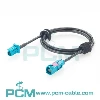
Products Display

Similar products
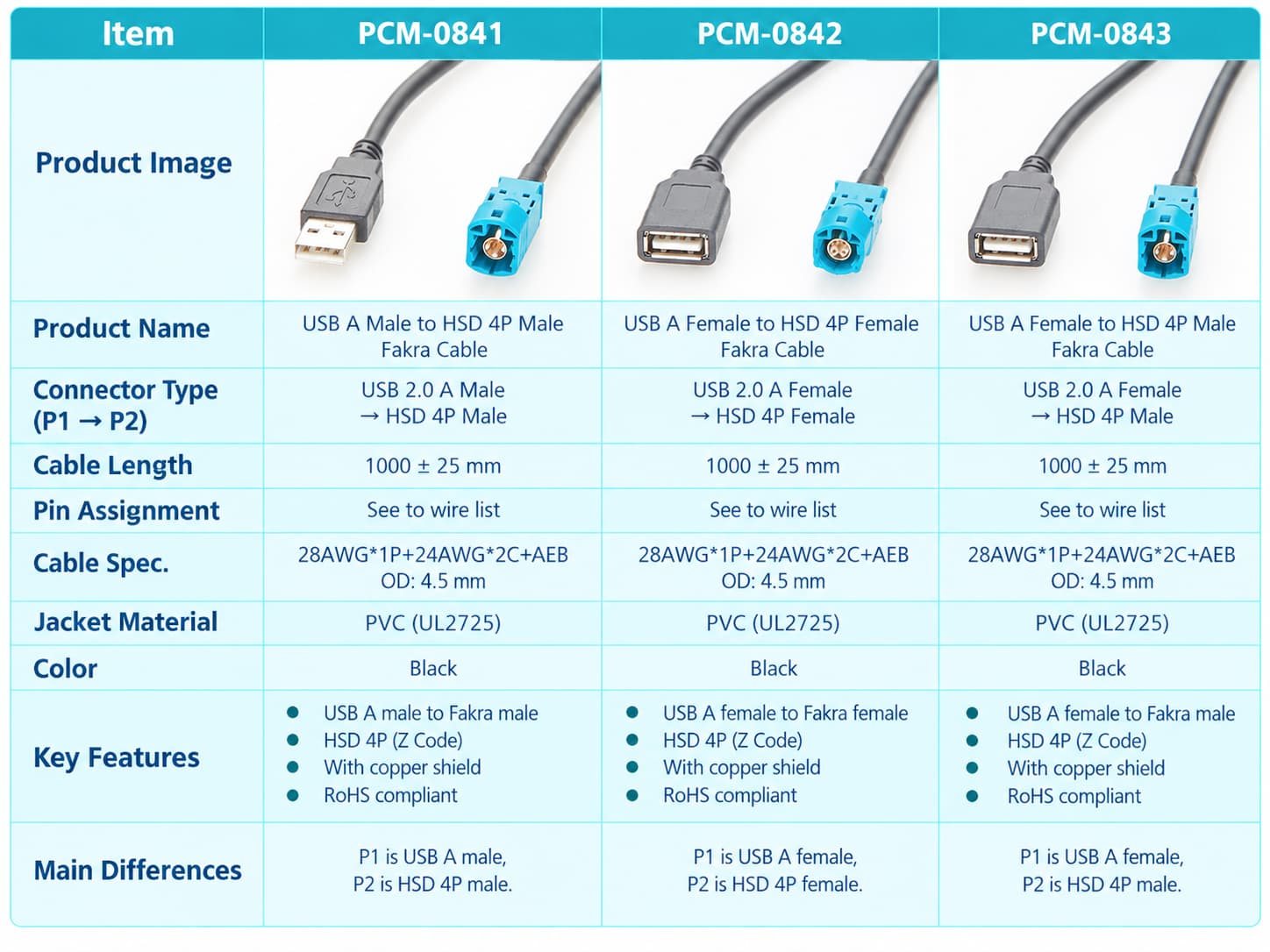
Compatibility Statement
Compatibility Verification
PCM-0840 connects USB Type-A and HSD through predefined pin mapping but does not perform protocol conversion.
Compatibility requires verification of HSD gender, Z coding, pinout, target protocol, PHY, impedance and equipment-side P/N. Reliable communication requires matching mechanical, electrical and protocol definitions.
Technical Compatibility Notice
HSD is a 100-ohm shielded high-speed connection system used for USB, LVDS, Ethernet and other applications, but connector capability does not determine protocol speed.
For USB 2.0, PCM-0840 should be evaluated up to 480Mbps; other signals require verification of pin mapping, PHY, impedance, electrical parameters and the complete link budget.
How to Select the Right Product ?
Confirm HSD Coding, Gender and Exact Interface First
Do not select the product based only on "4Pin HSD." First confirm the complete equipment-side connector P/N, male/female configuration, Z coding and mating interface. Different codings use different mechanical keying structures, so visually similar connectors are not necessarily mateable.
Verify the Protocol and Pin Mapping
For USB 2.0 applications, verify the corresponding D+, D−, VBUS and GND connections. If the equipment uses LVDS, Ethernet or another signal type, the pin assignment must be verified according to the target system. Mechanical mating does not guarantee electrical or protocol compatibility.
Evaluate Cable Performance According to Protocol and Length
High-speed data cables should not be evaluated only by continuity. As cable length increases, impedance, insertion loss, return loss, skew, EMI and power-voltage drop must also be considered. High-speed video and differential-data applications should be evaluated according to the complete link budget.
Select Standard or Customized Versions According to Installation Requirements
PCM-0840 has a standard length of 1m, but different vehicles and devices have different installation spaces, bend-radius requirements, routing paths and connector orientations. Before mass production, cable length, cable-exit direction, overmold dimensions and cable requirements should be determined according to the actual 3D installation environment to reduce installation stress and excess cable.
Customization Capabilities
↕ Cable Length Customization
Cable length can be customized for ECU location and routing, with signal integrity and voltage drop evaluated for high-speed links.
□ HSD Coding Customization
HSD coding can be customized to match the equipment interface, housing, mechanical keying and mating connector.
◉ HSD Gender Customization
HSD jack or plug configurations are available, with complete P/N, gender and mating direction confirmed before production.
⚙ Pin Mapping Customization
Pin mapping can be customized for USB, LVDS and other systems based on an accurate equipment-side pinout.
⌘ Cable Construction Customization
AWG, shielding, OD and jacket construction can be customized, with signal integrity verified for high-speed protocols.
◇ Overmolding and Mechanical Customization
Overmold size, shape, cable-exit direction and strain relief can be customized for different installation and routing requirements.
Product FAQ
Does USB 2.0 to HSD Perform Protocol Conversion ?
No. PCM-0840 is a passive cable assembly that primarily provides physical interface adaptation and corresponding pin mapping between USB Type-A and HSD. It does not contain an active protocol-conversion chipset.
Can USB 2.0 Reach 6Gbps Through HSD ?
The two specifications should not be treated as equivalent. Standard USB 2.0 Hi-Speed operates at 480Mbps. The HSD interconnect system can support various higher-speed applications, but the actual data rate is determined by the protocol and complete link architecture.
Which Protocols Can HSD Support ?
According to Rosenberger, HSD can be used for USB, LVDS, Ethernet, FireWire, APIX, CAN, PCIe, FPD-Link, GMSL and other systems. However, support for these applications does not mean that one unchanged cable assembly can be universally used for every protocol.
Can HSD Z Code Mate with Other Codings ?
They should generally not be treated as universally interchangeable interfaces. Coding is part of the HSD mechanical error-prevention system, so the mating connector should be selected according to the actual equipment-side coding rather than pin count alone.
Can HSD Connect Directly to an LVDS Camera ?
HSD can be used in LVDS camera applications, but direct compatibility depends on the camera and ECU pinout, SerDes architecture, electrical definition and cable design. HSD is a physical interconnect system and does not automatically convert signal protocols.
Can a USB Female or Other USB Interface Be Customized ?
USB Type-A male/female and other applicable interface configurations can be developed according to project requirements. However, changing the USB interface requires re-verification of the pinout, protocol, power definition, mechanical structure and target-device compatibility.