In most robotic systems, Ethernet issues rarely come from the network switch or controller. The weak point is usually much simpler: the cable itself.
If you talk to maintenance engineers in automated factories, you will hear the same complaint again and again-connections start fine during commissioning, but after a few weeks or months of operation, intermittent signal loss begins to appear. In robotic arms, this problem shows up even faster.
So why does this happen?
1. Continuous motion is more damaging than people expect
A robotic arm doesn't move in a single direction. It rotates, accelerates, stops, and reverses thousands of times per day. Even if the cable looks "securely fixed," it is constantly being bent at the same stress points.
Standard Ethernet cables are not designed for this kind of mechanical life. The copper conductors inside slowly fatigue, and shielding layers start to break down. The result is not an immediate failure-it's unstable communication that comes and goes.
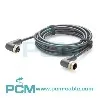
This is exactly where a drag chain Ethernet cable becomes necessary. Unlike standard patch cables, it is built specifically for continuous flexing inside cable carriers and robotic joints.

2. Small bends turn into big signal problems
One of the most common failure patterns is not a complete break, but data instability. A robotic system may run normally for hours, then suddenly drop connection for a few seconds before recovering.
In most cases, the root cause is internal conductor stress caused by repeated bending beyond the cable's intended radius.
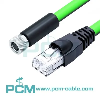
This is why many engineers now move away from generic "industrial-looking" cables and switch to a properly designed Cat6A RJ45 cable for robotic arm applications, where controlled flexibility is part of the design-not an afterthought.
3. EMI in robotic environments is often underestimated
Robotic cells are electrically noisy environments. Servo motors, drives, and switching power systems all operate in close proximity to data lines.
Without proper shielding, Ethernet signals can easily pick up interference. This is especially noticeable in high-speed communication systems where Cat6A bandwidth is being used near its limits.
A properly constructed industrial waterproof RJ45 Ethernet cable with shielded twisted pairs helps maintain signal stability under these conditions. In many real installations, shielding is what separates a stable production line from one with unpredictable downtime.

4. Motion + environment = dual stress failure
In advanced automation systems, cables are not only moving-they are also exposed to oil mist, dust, or occasional moisture. Over time, this combination of mechanical and environmental stress leads to connector degradation.
This is where sealed connection systems become important.
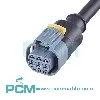
In many robotic installations, engineers are now using IP67 RJ45 panel mount cable solutions to move the Ethernet interface out of the moving enclosure and onto a protected, sealed external panel. This reduces stress on internal ports and improves long-term serviceability.
For higher-speed applications, an IP67 RJ45 Cat6A panel mount cable provides both sealing and gigabit-level stability in one assembly.
5. The real issue is usually cable selection, not system design
When robotic communication fails, the first reaction is often to check software, switches, or PLC configuration. But in many cases, the problem is physical: the cable was never designed for motion.
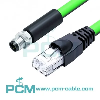
A proper robotic RJ45 cable is not just a standard Ethernet cable with a label-it is engineered for flex life, shielding integrity, and stable impedance under movement.
Once this is addressed, many "random network issues" simply disappear.

Final thoughts
Ethernet failure in robotic arms is rarely random. It usually comes down to three things: motion stress, electrical noise, and environmental exposure.
This is why more automation engineers are standardizing on dedicated motion-rated and sealed solutions instead of general-purpose networking cables.
In practical deployments, switching to a purpose-built drag chain Ethernet cable or an integrated IP67 RJ45 panel mount cable is often the difference between repeated maintenance calls and a stable, predictable production system.