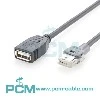
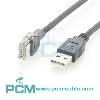
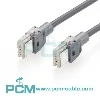
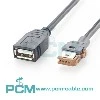
A USB to TTL serial cable is a type of cable that allows communication between a computer and devices that use serial communication protocols. It provides a way to connect devices that use TTL (Transistor-Transistor Logic) level signals to a computer's USB port.
TTL is a logic level standard used for digital circuits, where logic 0 is represented by a low voltage level (usually 0 volts) and logic 1 is represented by a high voltage level (usually 3.3 volts or 5 volts). Many microcontrollers, development boards, and other embedded systems use TTL-level serial communication to exchange data and commands with a computer.
The USB to TTL serial cable acts as a bridge between the USB port of a computer and the TTL-level signals of the target device. It typically consists of a USB connector on one end and a set of wires or a connector with multiple pins on the other end. The pinout of the TTL end of the cable varies depending on the specific cable, but it commonly includes connections for transmitting data (TX), receiving data (RX), ground (GND), and sometimes additional control signals.
The cable incorporates an integrated circuit (IC) called a USB-to-serial converter or UART (Universal Asynchronous Receiver-Transmitter). This IC handles the conversion of data between USB and TTL-level signals. It takes the data received from the computer via USB and converts it into TTL-level signals that can be understood by the target device. Similarly, it converts TTL-level signals from the target device into USB data that can be transmitted back to the computer.
USB to TTL serial cables are commonly used for various purposes, including:
Programming and debugging microcontrollers: Many microcontrollers, such as Arduino boards, Raspberry Pi, and ESP8266/ESP32 modules, use TTL-level serial communication for programming and debugging. The USB to TTL serial cable allows these devices to be connected to a computer for uploading firmware, monitoring output, and troubleshooting.
Communication with embedded systems: The cable enables communication with embedded systems that use TTL-level serial interfaces, such as sensors, motor controllers, and other peripheral devices. It allows data exchange and control commands to be sent between the computer and the embedded system.
Serial console access: Some devices, like network routers, switches, and embedded Linux systems, provide a serial console interface for configuration and troubleshooting. The USB to TTL serial cable can be used to connect to the serial console and access the device's command line interface.
DIY electronics projects: Hobbyists and electronics enthusiasts often use USB to TTL serial cables for their DIY projects. They can interface their custom-built circuits or devices with a computer for data exchange, control, and monitoring.
To use a USB to TTL serial cable, you typically need to install the appropriate drivers for the USB-to-serial converter IC on your computer. Once the drivers are installed, the cable will appear as a virtual serial port in the operating system, and you can use serial communication software or programming libraries to communicate with the connected device.
Overall, USB to TTL serial cables provide a convenient and widely used method for connecting computers with TTL-level serial devices. They are versatile tools for programming, debugging, and communicating with a variety of embedded systems, making them popular among developers, engineers, and hobbyists in the electronics field.