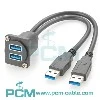
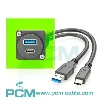
USB (Universal Serial Bus) is a common computer interface standard used to transfer data and power between computer systems and external devices. It is widely used in various devices, such as personal computers, laptops, mobile phones, tablets, printers, scanners, cameras, audio devices, and other external devices. The design goal of the USB interface is to provide a universal and easy-to-use standard that can connect multiple devices and achieve high-speed data transmission and plug and play functionality.
The development of USB began in the 1990s, initially to solve the problem of connecting computers and external devices. Its design goal is to replace traditional serial and parallel interfaces and provide higher data transmission rates and simpler connection methods. The USB interface adopts a point-to-point topology, where a host (usually a computer) can connect multiple external devices. The USB interface has a hot swap function, which means that users can insert or remove devices while the system is running without the need to restart the computer.
There are different versions of USB interfaces, each introducing new features and improvements. The initial USB 1.0 version provided two modes with a maximum transfer rate of 1.5 Mbps and 12 Mbps. Later, the USB 2.0 version was introduced, increasing the transfer rate to 480 Mbps. The subsequent USB 3.0 and USB 3.1 versions further improved the transmission speed, reaching 5 Gbps and 10 Gbps, respectively. USB 3.1 also introduces new connector types, such as USB Type-C, which has the characteristic of reversible insertion, making connections more convenient.
In addition to data transmission, the USB interface also provides power transmission function. Through the USB interface, external devices can obtain power from computers or other power supply devices without the need for additional power adapters. This makes the USB interface an integrated solution for power supply and data transmission, making the device more portable and simplified.
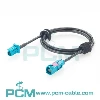
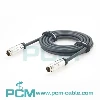
CAN (Controller Area Network) bus is a communication protocol widely used in automobile and Industrial control system. It was first developed by Bosch in Germany in the 1980s to address the communication needs between automotive electronic systems. The design goal of CAN bus is to provide a reliable, real-time, and efficient communication method suitable for complex automotive electronic systems.
The CAN bus adopts a distributed communication structure, where multiple nodes communicate through sharing the same bus. Each node can send and receive messages, which can include control commands, sensor data, diagnostic information, etc. The CAN bus supports multiple nodes to send messages in parallel, which enables it to have low latency and high reliability in real-time systems.
The CAN bus has some unique characteristics that make it widely used in the automotive and industrial fields. One important feature is the conflict detection and resolution mechanism. When two or more nodes simultaneously send messages, the CAN bus can detect

Jun 15, 2023
Leave a message
What is USB and CANbus?
Send Inquiry