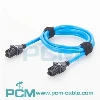
USB-C, as a new universal serial bus interface standard, has been warmly welcomed by consumers since its launch. The USB-C interface not only has many advantages such as fast transmission speed, strong power supply capability, and support for bidirectional transmission, but also has a thinner design and is more convenient to use. However, the USB-C interface is divided into two types: master and public, which have significant differences in appearance, purpose, and usage.
Firstly, from an appearance perspective, the USB-C master and public versions have significantly different forms. The USB-C public version is usually a connector with a Type-C interface on one end, designed to be compact and suitable for connecting various devices, such as smartphones, tablets, laptops, etc. It supports full functionality and omnidirectional connection, without worrying about the direction of the plug, and can be inserted into the Type-C interface in any direction, greatly improving the convenience of connection. The USB-C master, on the other hand, is an interface typically used within a device to connect to the USB-C master or other USB-C devices.
Secondly, in terms of usage, there are significant differences between the USB-C public and master versions. The main purpose of the USB-C public version is data transmission and charging. Due to its support for USB 3.1 specifications, it has high-speed data transfer capabilities and can easily transfer large files and high-definition videos. In addition, the USB-C public version also has a fast charging function, which can provide faster charging speed for mobile devices. The main function of the USB-C master is to provide a stable interface for devices to connect with other USB-C devices or connectors, enabling data transmission or charging.
Again, in terms of usage, the USB-C public version and the master version are also different. The USB-C public version can be directly plugged into the USB-C interface of the device for data transmission or charging. The USB-C master, on the other hand, needs to be connected to the USB-C public or other USB-C devices for data transmission or charging. In addition, due to the smaller design of the USB-C public version, it is more convenient to carry and use.
In addition, although the USB-C master and public versions differ in appearance, purpose, and usage, they both share some common advantages of the USB-C interface. For example, they all support forward and reverse insertion, eliminating the hassle of reverse insertion and improving the user experience. Meanwhile, their transmission speeds are all very fast, with a maximum data transfer speed of 10Gbit/second, far exceeding traditional USB interfaces. In addition, the USB-C interface also supports bidirectional transmission and fast charging, further enhancing its convenience of use.
However, although both the USB-C master and public versions have many advantages, there are also some issues that need to be noted during use. For example, due to the small distance between the PIN and PIN of the USB-C master, if there is dust or debris inside the device, it may cause a micro short circuit between the vbus and GND at the charging terminal, affecting the normal use of the device. In addition, the structure of the USB-C master is relatively complex, and issues with machining accuracy may also lead to unstable contact resistance, affecting data transmission and charging efficiency.