USB 3.0, as a high-speed data transfer standard, performs well over short distances. However, its transmission distance limitations may pose challenges for certain applications. By using methods such as USB extension cables, signal amplifiers, fiber optic USB, or wireless USB extenders, these limitations can be effectively overcome, enabling USB 3.0 to play a greater role in various applications. In the future, with the continuous development of technology, we can look forward to more solutions to further expand the transmission distance of USB 3.0 to meet the growing data transmission needs.
Performance characteristics of USB 3.0
Faster data transfer speed: USB 3.0 provides significant data transfer speed improvement compared to USB 2.0. The maximum transfer speed of USB 2.0 is 480 Mbps, while USB 3.0 can reach 5 Gbps, which means it can transfer large files and high-definition videos faster.
Full duplex communication: USB 3.0 introduces full duplex communication, allowing devices to simultaneously send and receive data, improving the efficiency of data transmission.
Greater current output: USB 3.0 ports typically provide greater current output, which allows charging devices to charge faster while providing more power to external devices.
Backward compatibility: USB 3.0 is compatible with USB 2.0, which means you can connect USB 3.0 devices to USB 2.0 ports and they will run at USB 2.0 speed.
Transmission distance limit for USB 3.0
However, although USB 3.0 has made significant progress in performance, it is still limited by transmission distance. The standard USB 3.0 transmission distance limit is about 3 meters (10 feet), which means that if data needs to be transmitted over longer distances, additional measures need to be taken.
Signal attenuation: As the distance of USB 3.0 signal propagation increases, signal attenuation becomes more pronounced, leading to a decrease in data transmission speed and possibly even connection interruption.
Interference and noise: USB 3.0 is very sensitive to electromagnetic interference and noise during high-speed transmission, which may introduce issues in long-distance transmission.
Method for Extending USB 3.0 Transmission Distance
Although USB 3.0 has its transmission distance limitations, there are multiple ways to extend the transmission distance to meet different needs.
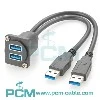
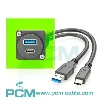
Using a USB extension cable: The simplest method is to use a USB 3.0 extension cable. These extension cables can connect USB devices to longer distances without compromising performance. They typically provide an additional transmission distance of 5 meters (16 feet) to 10 meters (32 feet).
Signal amplifier: A USB signal amplifier is a device that can amplify USB signals to overcome signal attenuation issues during long-distance transmission. These devices can further expand the transmission distance of USB 3.0.
Fiber optic USB: Fiber optic USB is an advanced solution that can significantly expand the transmission distance of USB 3.0, even reaching hundreds of meters, by using fiber optic to transmit data. This technology is suitable for applications that require extremely long-distance transmission, such as industrial automation and medical equipment.
Wireless USB Extender: A wireless USB extender allows you to connect USB devices to a computer through a wireless connection without the need for a physical connection. This method is suitable for situations where USB devices need to be used in different rooms or locations.
Application Cases
Medical devices: In the medical field, the long-distance transmission capability of USB 3.0 is crucial for remote monitoring devices and medical image transmission. By using fiber optic USB or wireless USB extenders, medical professionals can remotely access and analyze patient data.
Industrial automation: Industrial automation systems typically require the transmission of large amounts of data on production lines, and the high-speed transmission capability of USB 3.0 makes it an ideal choice. By using signal amplifiers or fiber optic USB, industrial automation systems can achieve reliable data transmission.
Audio and video production: During the audio and video production process, high-definition video and audio data need to be transmitted, and USB 3.0 can provide the required bandwidth. Extension cables and signal amplifiers ensure high-quality data transmission between different devices.