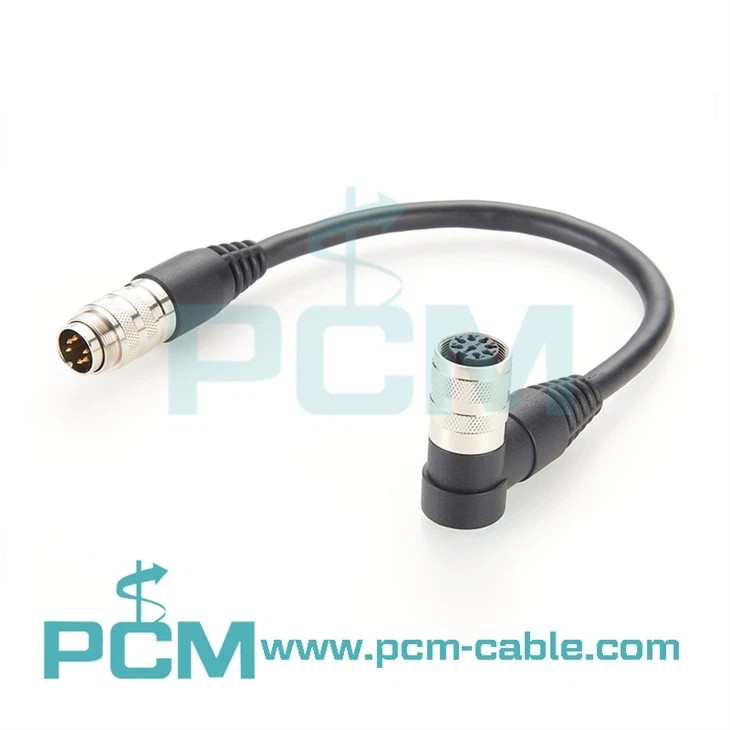
Firstly, structurally speaking, there are significant differences between AISG cables and traditional RF cables. AISG cable is a specialized connecting cable mainly used to connect mobile communication devices and antennas. It usually consists of two or more wires, with one wire used to transmit power signals and the other wire or wires used to transmit data signals. These wires are usually wrapped with insulation material on the outside to ensure the stability and reliability of signal transmission. In addition, AISG cables also adopt special shielding design to resist electromagnetic interference and further ensure the quality of signal transmission.
In contrast, traditional RF cables focus more on signal transmission efficiency and stability. The internal structure of RF cables usually consists of an outer conductor, an insulator, an inner conductor, and another layer of insulator. This structure enables RF cables to transmit high-speed data and high-frequency signals within a frequency range of several GHz. In order to ensure the transmission quality of high-frequency signals, RF cables need to meet very high standards, and precise testing and quality control are required during the manufacturing process.
Function and Application Fields
There are also significant differences between AISG cables and traditional RF cables in terms of functionality and application areas. The main function of AISG cable is to connect mobile communication devices and antennas, and to achieve remote control and monitoring of antennas through the transmission of control and data signals. This has led to the widespread use of AISG cables in mobile communication base stations and antenna systems. Through AISG cables, mobile operators can remotely control the direction of antennas, adjust the tilt angle of antennas, monitor antenna parameters, and detect antenna fault states, thereby optimizing network coverage and improving communication quality.
Traditional RF cables are more commonly used in fields such as radio spectrum, microwave communication, satellite communication, and radar. Due to its higher anti-interference ability and transmission stability, RF cables can maintain stable signal transmission in complex and changing communication environments. This makes RF cables an indispensable component in various wireless communication systems and electronic devices. RF cables play an important role in wireless communication, broadcasting, television, radar, navigation, computers, and instrumentation.
Performance comparison
In terms of performance, AISG cables and traditional RF cables also have their own advantages. AISG cables perform well in mobile communication base stations and antenna systems due to their high anti-interference, reliability, and waterproof characteristics. It can maintain stable signal transmission under strong interference conditions and has a long service life. This makes AISG cables an indispensable part of mobile communication networks.
Traditional RF cables are known for their high transmission efficiency, wide frequency range, and good stability. RF cables can transmit high-speed data and high-frequency signals with a frequency range of up to several GHz, and have uniform twisting and winding, precise impedance control, and low noise performance. These characteristics make RF cables have broad application prospects in fields such as radio spectrum, microwave communication, satellite communication, and radar.
Selection and Installation
When selecting and installing cables, it is necessary to choose the appropriate cable type based on different application scenarios and operating frequencies. For mobile communication base stations and antenna systems, AISG cables are an ideal choice. It can achieve effective connection between mobile communication devices and antennas, and remotely control and monitor antennas through transmission of control and data signals. This makes AISG cables play an important role in optimizing network coverage and improving communication quality.
For fields such as radio spectrum, microwave communication, satellite communication, and radar, traditional RF cables are a better choice. It can transmit high-frequency signals and maintain stable signal transmission quality, which makes RF cables have broad application prospects in these fields.