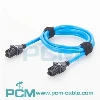
1, Temperature adaptability of AISG cables
Temperature is one of the important factors affecting cable performance. Extreme high or low temperature environments can have adverse effects on the insulation materials, conductors, and overall structure of cables, thereby affecting the quality of signal transmission and system stability.
Challenges in High Temperature Environments
In high-temperature environments, the insulation material of cables may soften or age due to heat, leading to a decrease in insulation performance and an increased risk of leakage and short circuits. In addition, high temperatures can accelerate the thermal expansion of metal conductors inside cables, which may increase the gap between conductors and affect the transmission efficiency of signals. The adaptability of AISG cables in high temperature environments mainly depends on the heat resistance of their insulation materials. High quality insulation materials should have a high heat resistance level and be able to maintain stable physical and chemical properties at high temperatures.
Challenges in Low Temperature Environments
In low-temperature environments, cable materials may become hard and brittle due to cold, and are prone to fracture when bent or stretched. In addition, low temperatures may also increase the insulation resistance inside the cable, affecting the quality of signal transmission. In order to improve the adaptability of AISG cables in low-temperature environments, materials with low-temperature elasticity and toughness should be selected to ensure that the cables can still maintain good flexibility and mechanical strength at low temperatures.
2, Humidity adaptability of AISG cables
Humidity is another important factor that affects cable performance. High humidity environments can easily cause moisture to penetrate into the insulation layer of cables, leading to a decrease in insulation resistance and thus affecting electrical performance. Cables that are exposed to humid environments for a long time may also experience corrosion and mold growth, further damaging their structure and performance.
The influence of humidity on insulation performance
An increase in humidity can lead to an increase in moisture content in the insulation layer of the cable, thereby reducing the insulation resistance. The decrease in insulation resistance will increase leakage current and affect the quality of signal transmission. In addition, moisture may also promote chemical reactions inside the cable, leading to aging and decomposition of insulation materials.
Moisture prevention measures
In order to improve the humidity adaptability of AISG cables, effective moisture-proof measures should be taken. On the one hand, insulation materials and sheath materials with moisture-proof properties can be selected to reduce the penetration of moisture into the cable. On the other hand, measures such as sealing and waterproofing can be taken during the installation and maintenance of cables to ensure that they can maintain good insulation performance in humid environments.
3, Strategies for addressing temperature and humidity challenges
Select high-quality materials
The selection of insulation and sheath materials with excellent heat resistance, cold resistance, and moisture resistance is the key to improving the temperature and humidity adaptability of AISG cables. These materials should be able to maintain stable physical and chemical properties in extreme environments, ensuring the performance and reliability of the cable.
Optimize cable design
By optimizing the structural design of cables, their adaptability to temperature and humidity can be improved. For example, using a multi-layer insulation structure can effectively improve the insulation and moisture resistance of cables; The use of reinforced sheath material can enhance the mechanical strength and weather resistance of the cable.
Strengthen monitoring and maintenance
Regular monitoring and maintenance of AISG cables to promptly identify and address potential issues is an important means of improving their temperature and humidity adaptability. By monitoring the temperature, humidity, and electrical performance parameters of the cable in real-time, abnormal changes in the cable can be detected in a timely manner, and corresponding measures can be taken to ensure the stable operation of the cable.
Improve installation process
When installing AISG cables, the influence of temperature and humidity factors should be fully considered. For example, when installing cables in humid environments, measures such as sealing and waterproofing should be taken; When installing cables in high-temperature environments, it is important to ensure that the cables have good heat dissipation conditions to avoid overheating and performance degradation.

Jan 13, 2025
Leave a message
Temperature and humidity adaptability of AISG cables
Send Inquiry