Introduction :
TE Connectivity offers two sealed MATEnet connector versions for different automotive Ethernet cabling requirements: 1802105-9 (UTP) and 1802113-9 (STP). Both are single port, Z code MATEnet receptacle housings with a 180° cable exit, but they are designed for different twisted-pair cable constructions.
Understanding the difference between Unshielded Twisted Pair (UTP) and Shielded Twisted Pair (STP) helps engineers select the correct connector for automotive Ethernet networks. The choice mainly depends on electromagnetic compatibility (EMC) requirements, cable construction, and the vehicle's wiring architecture.
Overview of TE 1802105-9 and 1802113-9
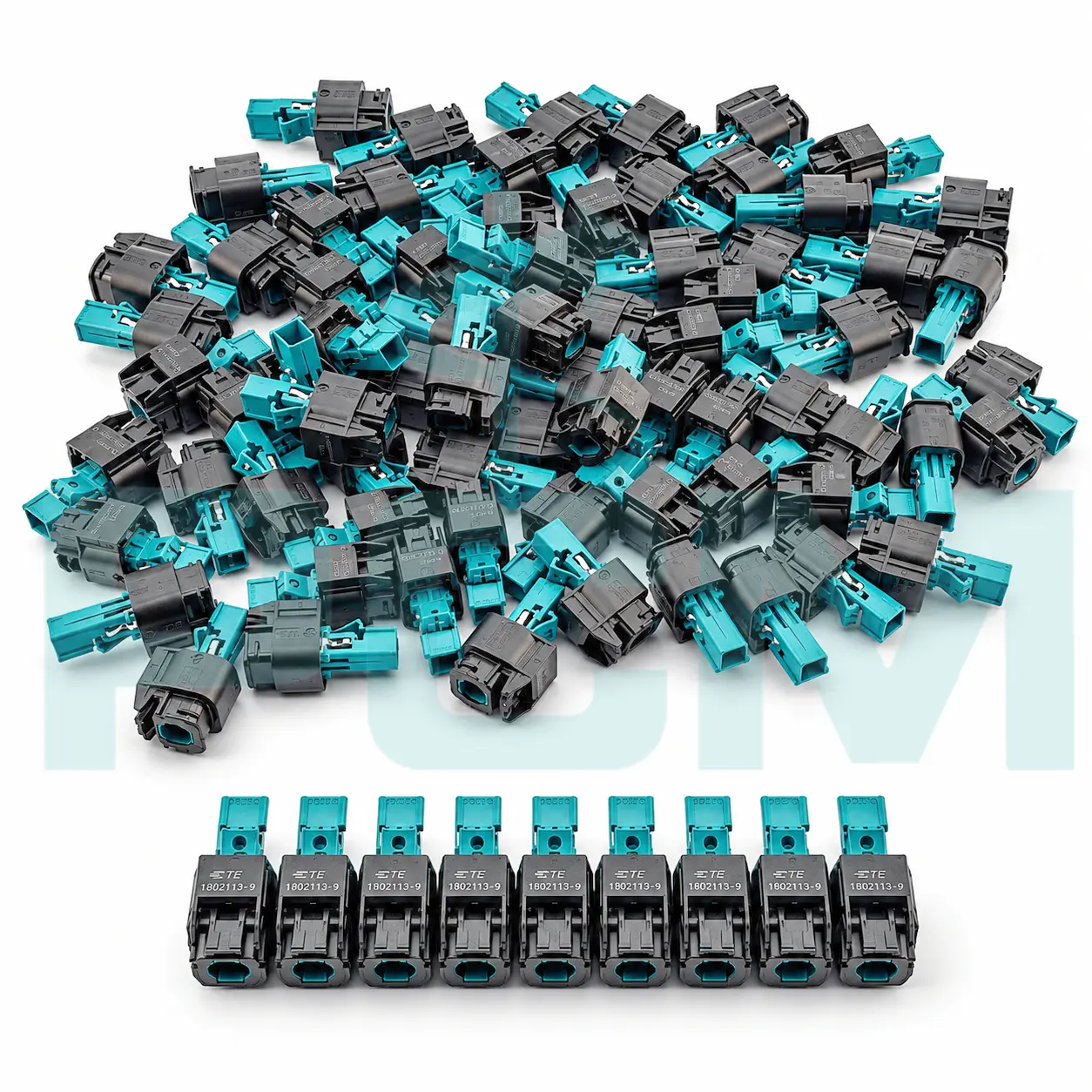
The TE 1802105-9 and 1802113-9 belong to the MATEnet automotive Ethernet connector family. They provide compact, sealed connection interfaces for transmitting data between electronic control units (ECUs), cameras, sensors, and other in vehicle electronic devices.
The main difference is their supported cable type:
TE 1802105-9: A sealed MATEnet receptacle housing designed for Unshielded Twisted Pair (UTP) cable.
TE 1802113-9: A sealed MATEnet receptacle housing designed for Shielded Twisted Pair (STP) cable.
Key Differences: UTP vs STP
The main difference is cable shielding.
TE 1802105-9 is designed for UTP cable, with twisted conductors and no additional shield. Its simpler, lighter construction can reduce material and assembly costs where vehicle EMC requirements allow.
TE 1802113-9 is designed for STP cable, which adds a conductive shield to help reduce external electromagnetic interference. It suits automotive Ethernet networks with stricter EMC requirements. Proper shield termination and grounding are essential.
The following table summarizes the main differences and shared specifications of TE 1802105-9 and 1802113-9:
| Specification | 1802105-9 | 1802113-9 |
| products |
|
|
| Product Series | MATEnet | MATEnet |
| Cable Type | UTP | STP |
| Cable Construction | Unshielded Twisted Pair | Shielded Twisted Pair |
| Connector Type |
Receptacle Housing |
Receptacle Housing |
| Coding | Z Code | Z Code |
| Sealing |
Sealable |
Sealable |
| Temperature Range | -40°C to +105°C | -40°C to +105°C |


Which MATEnet Connector Should You Choose ?
Choose TE 1802105-9 (UTP) when the OEM specifies unshielded twisted-pair cable, EMC requirements can be met without additional shielding, or a lighter, simpler wiring harness is preferred.
Choose TE 1802113-9 (STP) when shielded cabling is required, the installation has stricter EMC requirements, or the vehicle design specifies shield grounding and termination.
Before selecting a replacement, verify the Z coding, mating interface, cable construction, termination structure, and sealing requirements against the OEM specifications.

Custom MATEnet Cable Assembly Solutions
Premier Cable provides custom automotive Ethernet cable assemblies using TE 1802105-9 and 1802113-9 MATEnet connectors, supporting both UTP and STP configurations.Available customization options include:
- Cable Length: Customized lengths for different vehicle wiring layouts.
- Cable Type: UTP or STP construction based on OEM requirements.
- Connector Configuration: MATEnet connectors matched to mating interfaces.
- Shield Termination: Shielding and grounding solutions for STP assemblies.
- Cable Construction: Customized conductors, insulation, shielding, and jacket materials.
- Assembly Details: Custom routing, branching, and cable identification.
Customers can provide TE part numbers, connector drawings, cable specifications, pin assignments, required lengths, and application details for development.
Our custom solutions support automotive Ethernet connections in ADAS, vehicle cameras, ECUs, infotainment systems, and in-vehicle communication networks.
You Might Also Like

Waterproof MATEnet Cable

MATEnet Automotive Ethernet Waterproof Cable

Automotive Adapter MATEnet Cable