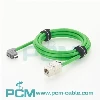
The Hirose IX connector series has become one of the most trusted interconnect systems for modern automation, offering compact size, high performance, and strong vibration resistance.
However, engineers often face one key question: Should I choose the A key or the B key type?
Understanding their differences is essential for designing reliable and efficient communication networks in industrial environments.
1. The IX A Key – Optimized for Ethernet Communication
The IX A key version is designed primarily for Ethernet-based networks.
It supports Cat6A 10 Gbps transmission and complies with the IEC 61076-3-124 standard, making it a preferred choice for:
- High-speed data links between PLCs and switches
- Machine vision and industrial camera connections
- Communication between controllers and industrial PCs
Common assemblies include the IX40G-A-10S-CV(7.0) plug and IX40G-A-10P-JC, offering reliable EMI shielding and secure mechanical retention.
In short, A key connectors handle data - fast, shielded, and network-based communication.

2. The IX B Key – Designed for Control and Signal Lines
The B key type is physically keyed differently to avoid accidental mating with the A key version.
It is used for non-Ethernet communication, such as control signals, low-voltage synchronization, or I/O feedback.
Assemblies like IX40G-B-10S-CV(7.0) and IX40G-B-10P-JC ensure stable, shielded connections between:
- PLCs and distributed I/O modules
- Sensor or actuator interfaces
- HMI and embedded control boards
Where A key cables carry large volumes of data, B key cables carry the control signals that make automation systems move.
3. Key Differences at a Glance
| Feature | IX A Key | IX B Key |
|---|---|---|
| Function | Ethernet / data communication | Control / signal transmission |
| Key Orientation | Type A (Ethernet) | Type B (control / non-Ethernet) |
| Typical Cable | IX40G-A-10S-CV | IX40G-B-10S-CV |
| Bandwidth | Up to 10 Gbps | Low-voltage signal level |
| Application | Cameras, switches, PLCs, IPCs | PLC I/O, sensors, HMIs, motion systems |
This clear distinction prevents mismating and helps engineers organize hybrid networks where both Ethernet and control lines coexist.

4. Choosing the Right Connector for Your System
When selecting between A key and B key:
- Choose A key for data-intensive Ethernet links (networking, vision, or edge computing).
- Choose B key for control and signal transmission (motion control, sensors, PLC I/O).
For many OEMs and integrators, combining both types in a single system creates a hybrid communication architecture - high-speed data plus precise control in one unified platform.
5. Built for Industrial Reliability
At Premier Cable, our IX cable assemblies use original Hirose components to ensure signal integrity, shielding, and durability.
Whether your system depends on high-speed Ethernet or synchronized control, IX A key and B key cables deliver compact, modular, and vibration-resistant connectivity for next-generation automation networks.
Related Products

IX B Key To RJ45 Jack Cat6A Ethernet Cable

IX In-Line Jack to IX Plug Cable 10Gbps

IX B Key to M12 X-Code Female Cable

IX Industrial Category 6A Serial Cable

IX B Key To IX B Key Cat6A Serial Cable

IX Industrial Cable IX B Key to M12 X-Code