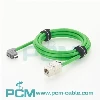
CAN (Controller Area Network) bus is an advanced and reliable communication protocol used in many modern vehicles and industrial applications. It enables the transmission of data between electronic control units (ECU) in real-time, making it an essential aspect of modern-day communication systems.
In a CAN bus, data is sent in a series of messages. Each message contains a message identifier and data payload. The message identifier identifies the source and destination of the message, while the data payload contains the actual data being transmitted. The CAN bus uses a broadcast-type communication approach, meaning that all ECUs on the network receive and process every message transmitted on the bus, however, only the intended recipient(s) act on the messages.
At the core of the CAN bus are two data wires: CAN High (CANH) and CAN Low (CANL). These wires transmit the differential signal between them, which changes depending on the state of the message being sent. For example, if a '0' bit is being transmitted, the CANH wire will be in a higher voltage state than the CANL wire. Conversely, if a '1' bit is being transmitted, the CANL wire will be at a higher voltage than the CANH wire. This differential signal is used to eliminate noise and interference, making the CAN bus a robust and reliable communication protocol.
Transmission of messages on the CAN bus is performed through a prioritization process, ensuring that messages with higher priority are transmitted before messages with a lower priority. During communication, each ECU on the network continuously monitors the CAN bus and waits for a time when there is no traffic on the bus before transmitting its message. This ensures that each message is transmitted without any conflict or data collision.

Oct 31, 2023
Leave a message
How data is transferred in CAN bus?
Send Inquiry