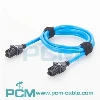
Common industrial camera cable interface
1. USB interface
A USB interface camera is a digital camera that directly outputs digital image signals. The full name of USB is Universal Serial Bus (Universal Serial Bus). The USB interface is 4 "pins", of which 2 are power lines and 2 are signal lines. USB is a serial interface, which is hot-swappable and easy to connect. The early USB2.0 interface is easy to connect, and almost all computers are equipped with a USB interface without a capture card. But the USB2.0 interface transmission rate is slow, the transmission speed is 480Mbps, the communication distance is 5m, and 80% of the bandwidth is used for image transmission. The transmission process requires the CPU to participate in management, which occupies and consumes a lot of resources. In addition, the USB2.0 interface generally does not have fixing screws, the interface is unstable, and there is a risk of loosening on sports equipment. Later, it was upgraded to USB3.0. USB3.0 added two new data lines on the basis of 2.0, which is backward compatible and solved the problem of slow transmission speed. The transmission speed has reached 4.8Gbps, but the transmission distance is still relatively short, and the communication distance 10m, 80% of the bandwidth is used for image transmission. Because the USB interface camera is easy to use and has a wide range of interfaces, it is currently widely used in microscopes, scientific research experiments, portable equipment and other industries.
2. 1394 interface
1394 interface, IEEE1394 bus is a high-speed serial bus, also known as "FireWire" (FireWire), which supports hot swap, real-time data transmission, using bus structure, plug and play. It is used to connect digital products with computers and other machines. It is widely used in the industrial field. The protocols and encoding methods are very good, and the transmission speed is stable. The highest transmission speed of 1394a is 400Mbps, and the highest transmission speed of 1394b is 800Mbps, such as 3.2Gb, but it is relatively rare, the interface penetration rate is low, and it was monopolized by Apple in the early days. Need to pay attention to its PacketSize packet size setting. Packet Size is the bandwidth of the entire 1394 bus. It uses less CPU resources and can be used by multiple units at the same time. However, due to the low penetration rate of the interface, it has been gradually eliminated by the market. The 1394 interface is divided into 4 cores and 6 cores. There are two pairs of data lines in the 4 cores, and the 6 cores exclude data. Outline also includes a set of power cords to power external devices. The IEEE 1394 interface does not require a controller, and can achieve peer-to-peer transmission. The maximum transmission distance of 1394a is 4.5 meters, and the transmission distance of 1394b is usually 10 meters. It can be extended to 100 meters (100Mbps) under the condition of reduced data rate. Relay equipment is used. Support can further increase the transmission distance.
3. Cameralink interface
The digital image signal communication interface protocol introduced by the AIA Association is a serial communication protocol. Adopt LVDS interface standard (differential technology: LVDS (low voltage differential signal)), with fast speed, strong anti-interference ability and low power consumption. Developed from Channel link technology, some transmission control signals are added on the basis of Channel link technology, and some related transmission standards are defined. The protocol adopts MDR-26-pin connector or SDR-26-pin connector, which has the characteristics of high speed, bandwidth up to 6400Mbps, strong anti-interference ability and low power consumption.
4. Gige Gigabit Ethernet interface
Created and promoted by AIA (Automatde Imaging Association), it is a camera interface standard developed based on the Gigabit Ethernet communication protocol. Suitable for industrial imaging applications, it transmits uncompressed video signals over a network and is a standard for transmitting images over long distances using inexpensive cables. The Gigabit Ethernet protocol is stable and easy to use. It can work when connected to a Gigabit Ethernet card. In the properties of the Gigabit Ethernet card, there are also giant frames similar to the Packet Size in 1394. Set this parameter well, you can achieve a more ideal effect. Long transmission distance, can transmit 100 meters. Multiple units can be used at the same time, and the CPU usage rate is small.
5. CoaXPress interface
CoaXPress is an asymmetric high-speed point-to-point serial communication digital interface standard with a transmission speed of up to 6.25Gbps and a transmission distance of more than 100m. The data transmission volume is large, the transmission distance is long, and the transmission distance and transmission volume can be selected: from 50m@6.25Gbps to 170m@1.25Gbps, the price is low, it is easy to integrate, and it supports hot plugging. The CoaXPress standard can support the growing bandwidth demands over the next decade, while also meeting many additional requirements such as: larger cables, higher cable reliability and flexibility, instant behavior, and cost-effectiveness. The availability of standard coaxial cables and bandwidth makes CoaXPress not only of interest in machine vision applications, but also highly suitable for applications in the medical and security markets where coaxial cables are widely used. By using the same coaxial cable, CoaXPress is able to smoothly upgrade analog video to digital video. CoaXPress uses IEC standardized cables and connectors suitable for most industrial environments. There are two types of connectors for cameras and frame grabbers - 75Ω DIN 1.0/2.3 type or 75Ω BNC type, both suitable for high vibration industrial environments.
The content described above is the common type of industrial camera cable interface, and its different types of industrial camera cables are suitable for different product application scenarios. With the rapid development of electronic information technology and the wide application of various cameras, the global image and video data has exploded, and human society is entering the era of big data of visual information. Industrial cameras can be said to be the window of the soul of industrial automation systems. From object/barcode identification, product inspection, appearance dimension measurement to robotic arm/transmission equipment positioning, industrial camera technology can be used as a stage. With the widening range of applications, in order to increase the application flexibility or form a more complex automation system with industrial computers, the development trend of industrial camera specifications is gradually moving closer to personal computers, and some products have even evolved into a small sparrow with five internal organs. All-in-one mini industrial computer. Compared with the human eye, industrial cameras have the advantages of fast detection speed, and the control standards are not subject to human subjective influence. Moreover, the resolution of industrial cameras is much higher than that of the human eye. When detecting subtle parts or circuits, it is better than the human eye. . The application of industrial cameras in manufacturing is becoming more and more extensive, and products such as industrial cameras have also appeared in new development directions. But no matter what kind of industrial camera system, except for a few special applications, the industrial cameras used are more and more closer to personal computers, and even smart cameras are essentially a built-in CPU and memory, which can perform various visual tasks. Algorithms of industrial computers.
Premier Cable makes a lot of camera link cables.
You can see the details of the product from the below link: https://www.pcm-cable.com/industrial-camera-cables/
MDR SDR Camera Link Cable;
USB Camera Link Cable;
GigE Cable;
IEEE 1394 Cable;
Hirose Connector Cable;
...