

PROFINET Overview
PROFINET is an industrial Ethernet communication protocol based on the standard Ethernet IEEE 802.3. It not only inherits the high-speed, efficient, and low-cost characteristics of Ethernet, but also has been specifically optimized for industrial automation environments. PROFINET supports multiple transmission media, including copper Ethernet cables, fiber optic (FO) cables, power over Ethernet (PoE) cables, and wireless communication technologies. This enables PROFINET to work stably in various environments, from the front office to the control room and even the factory workshop.
Compatibility between ordinary Ethernet cables and PROFINET
From a technical perspective, PROFINET is fully compatible with regular Ethernet technology. PROFINET networks can use standard Ethernet cables and interfaces, with the common interface type being RJ45 connectors. This means that in theory, ordinary Ethernet cables can be applied to PROFINET networks.
However, in practical applications, we still need to consider more factors. PROFINET networks typically need to operate in various complex environments, such as control rooms and factory workshops, which often have adverse factors such as electromagnetic interference (EMC), crosstalk, mechanical stress, and vibration. These factors may all have a negative impact on network stability.
Limitations of ordinary Ethernet cables
Although ordinary Ethernet cables can work normally in most cases, their limitations become particularly evident in industrial automation environments. Ordinary Ethernet cables are usually designed for simple office environments, and their anti-interference ability and durability may not meet the needs of industrial environments.
For example, standard Cat-5e cables are capable of installing PROFINET networks in office environments, but their performance may be greatly compromised in more harsh factory environments. This is because electromagnetic interference and mechanical stress in the factory environment may cause damage to cables, leading to unstable signal transmission.
Advantages of PROFINET cables
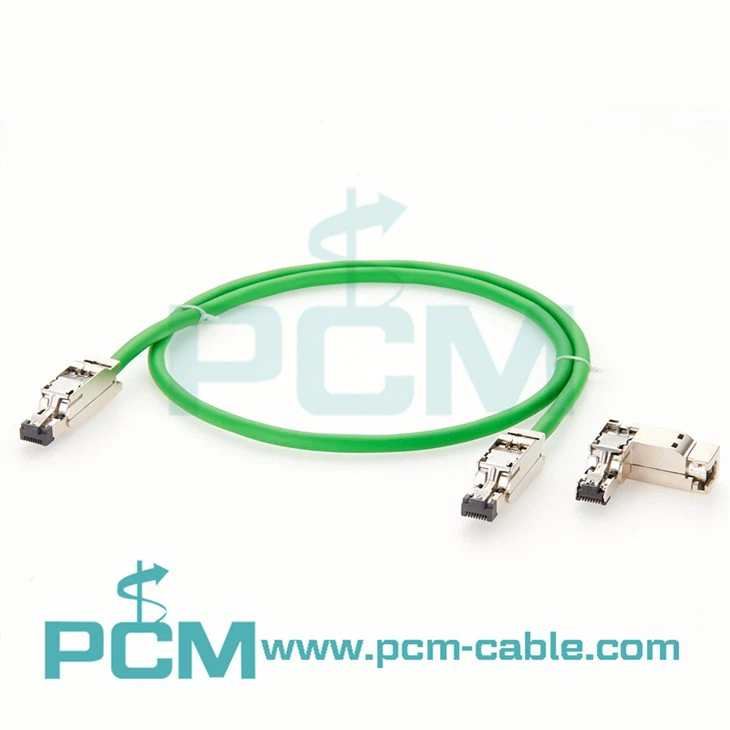
In contrast, dedicated PROFINET cables fully consider the characteristics of industrial environments in the design and manufacturing process. They typically use higher quality materials and more advanced processes to ensure stability and durability in harsh environments. In addition, PROFINET cables have been reinforced for EMC, such as adding aluminum foil shielding layers and braided shielding layers to minimize interference.
Wiring standards and practical applications
In PROFINET networks, common wiring standards are based on Ethernet standards. This includes two wiring standards, T568A and T568B. Regardless of which standard is used, the key is to maintain consistency throughout the network to ensure correct signal transmission and communication connections.
However, it should be noted that the specific wiring standards may vary depending on the region, application requirements, and equipment manufacturer. In practical applications, it is recommended to refer to relevant technical documents, equipment manuals, or manufacturer's guides to understand the wiring requirements of specific equipment or systems, and follow corresponding standards and best practices for wiring.
Application of industrial grade connectors and network cables
In industrial sites, it is strongly recommended to use industrial grade connectors and network cables. These products have been specially designed and tested to ensure stability and durability in harsh environments. Although their prices may be slightly higher than regular products, considering the high requirements for stability and reliability in industrial automation environments, these investments are completely worth it.
Oct 17, 2024
Leave a message
Can I use a regular Ethernet cable for PROFINET?
Send Inquiry


