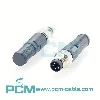
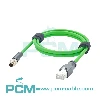
M12 L-code plugs and sockets from different brands are usually interoperable, but only if they follow the unified international standard IEC 61076-2-111. Big brands like Phoenix Contact and Turck design their M12 L-code products according to this standard, so they are compatible in most cases.
Reasons for interoperability
1. Unified mechanical interface:
The size of the plug and socket, the male and female interface form, the locking thread (M12x1), etc. have clear standards to ensure consistent mechanical connections.
2. Consistent coding method (L-code):
L-code defines the number of pins, arrangement, and electrical functions (such as +V, –V, PE), which must be followed by all brands.
3. The same electrical performance indicators:
For example, voltage ≤ 63V DC, current ≤ 16A, and compliance with industrial protection levels such as IP67/IP68.

Notes
- The number of pins must match: for example, if one is 3+PE and the other is 4+PE, they cannot be directly plugged in.
- Differences in grounding methods: Some brands may have different grounding layouts for PE or FE, which needs to be confirmed according to the system grounding requirements.
- Foolproof design: Although compatible in most cases, some brands may have made fine adjustments to the shell structure, resulting in loose insertion or unsmooth assembly.
As long as the M12 L-code plugs and sockets are manufactured strictly in accordance with the IEC 61076-2-111 standard, different brands (such as Phoenix Contact and Turck) are generally interoperable.
However, in actual engineering applications, it is still recommended to do an actual matching test to ensure that the mechanical, electrical and environmental adaptation is correct.
You May Also Like

M12 L-code Connector h-Splitter

M12 L-code Connector T-Splitter

M12 L-code Connector T-Splitter with Cable

M12 L-coded Receptacles


High-flex M12 L-code Right Angle Cable