What Does This Article Cover?
As vehicles integrate more ADAS functions, surround-view cameras, radar sensors, intelligent cockpits, infotainment systems and telematics modules, the amount of data transmitted inside the vehicle continues to increase.
Conventional low-speed harnesses are suitable for basic control and power circuits, but cameras, radar systems and high-speed electronic modules often require compact, shielded and vibration-resistant interconnects.
Using Premier Cable PCM-0802 HSC 4Pin Automotive High-Speed Data Cable as an example, this guide explains HSC 4-pin connectors, A coding, differential transmission, shielded cable construction, combined power and data architecture, EMI considerations and automotive selection guidelines.
Quick Product Introduction
PCM-0802 uses the following architecture:
HSC 4Pin Female A-Code → 1000±30 mm Cable → HSC 4Pin Female A-Code
The cable construction is:
28AWG × 1P + 24AWG × 2C + AEB
The 28AWG twisted pair carries high-speed differential data, while the two 24AWG conductors support power or auxiliary circuits.
This makes PCM-0802 a compact high-speed data + power hybrid automotive harness.
| Product Name | HSC4Pin Automotive High-Speed Data Cable |
| Premier Cable P/N | PCM-0802 |
| Connector Type | HSC Automotive Connector |
| P1 Connector | HSC 4Pin Straight Female |
| P2 Connector | HSC 4Pin Straight Female |
| Coding | A-Code |
| Cable Length | 1000+30 mm |
| Cable Type | UL2725 |
| Cable OD | Approx. 4.5 mm |
Compatibility Statement
PCM-0802 uses an HSC 4Pin A-coded interface, but identical connector appearance, pin count and coding do not automatically guarantee interoperability between different vehicles or electronic modules.
Compatibility also depends on pin assignment, protocol, differential-pair definition, power polarity, voltage, current, shielding and transceiver requirements.
Always verify the target equipment documentation before installation.


Technical Compatibility Notice
It does not convert CAN to Ethernet, convert LVDS into another protocol, amplify data signals, increase ECU processing performance or automatically adapt different equipment pinouts.
The stated approximately 1Gb/s or higher capability should therefore be interpreted as system-dependent high-speed application capability, not as a guaranteed data rate for every connected device.
Basic Product Knowledge
What Is an HSC 4Pin Automotive High-Speed Cable ?
An HSC 4Pin automotive high-speed cable is a compact automotive interconnect designed to carry high-speed differential data together with power or auxiliary circuits between electronic modules.
PCM-0802 combines:
High-Speed Differential Data + Power/Auxiliary Conductors
within one harness.
Why Do Vehicles Need High-Speed Data Cables ?
Modern vehicles exchange much more data than traditional electrical systems.
Cameras continuously transmit image data, ADAS controllers receive information from multiple sensors, infotainment systems handle audio and video streams, and telematics modules communicate with other vehicle electronics.
As a result, automotive wiring must consider not only electrical continuity but also bandwidth, impedance, crosstalk, EMI, shielding and signal integrity.
Pain Points and Product Value
Challenge 1:
Higher Data Rates Increase Signal-Integrity Requirements
High-speed links are significantly more sensitive to impedance, pair symmetry, crosstalk and termination than basic low-speed wiring.
PCM-0802 uses a dedicated differential pair and shielded interconnect structure for high-speed automotive applications.
Challenge 2:
Separate Power and Data Harnesses Consume More Space
Vehicle installation space is limited.
A device requiring both data and power may otherwise need separate connectors and cables.
PCM-0802 integrates both functions into one compact 4-pin harness.
Challenge 3:
Similar Connectors Can Be Mis-Mated
Modern vehicles use many similar-looking connectors.
A-coded mechanical keying helps reduce accidental mating with differently coded interfaces.
PCM-0667 XLR 3-Pin Male to PH5.0 Screw Terminal
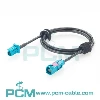
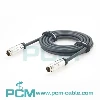
PCM-0802 uses straight HSC 4-pin female A-coded connectors on both ends with a standard length of 1000±30 mm.
The UL2725 cable contains a 28AWG differential pair plus two 24AWG conductors in a fully shielded 4.5 mm OD construction.
It is suitable for compatible ADAS, radar, cameras, IVI, telematics and automotive electronic module connections.
Applications:
Applicable to compatible interfaces and pin assignments:
ADAS modules, millimeter-wave radar, vehicle sensors, surround-view cameras, vision systems, IVI, smart cockpit, telematics, and automotive electronic control units.

Similar products

Products Display

Hybrid High-Speed Harness vs. Conventional Cable
| Item | PCM-0667 Screw Terminal | Traditional Welding XLR | |
| High-Speed Differential Data | Supported | Not necessarily | |
| Data + Power Integration | Yes | Usually separated | |
| Shielding Design | Full Shielding | Depends on product | |
| Anti-misinsertion Code | A-Code | Not necessarily | |
| Connection Locking | Yes | Depends on connector | |
| Line diameter | OD approx. 4.5 mm | Depends on design | |
| High-speed SI Requirements | High | Usually lower | |
| Typical Applications | ADAS/Camera/Radar/IVI | ower/Low-Speed Control |
How to Select an HSC 4Pin Automotive Cable ?
Verify the Connector Series
Verify the exact connector series and gender rather than relying only on appearance.
PCM-0802 uses HSC 4Pin straight female connectors on both ends.
Verify Connector Coding
PCM-0802 uses A coding.
A connector with a different coding may not mate even if it looks similar.
Verify the Pin Assignment
Pin assignment is one of the most important compatibility parameters.
Confirm the differential data pair, power, ground or auxiliary assignments at both ends before use.
Verify the Power Current Requirement
Although PCM-0802 uses 24AWG conductors for power or auxiliary circuits, the maximum load should not be determined from AWG alone.
Voltage, current, temperature and connector performance should be validated at system level.
Customization Capabilities
HSC Connector and Coding Customization
HSC connector gender, straight or angled orientation and coding/keying can be customized to match specific automotive modules.
Custom Pin Assignment
Pin assignments can be customized for differential data, power, ground and auxiliary functions according to the target ECU, camera, radar or sensor.
Custom Cable Length
Cable lengths other than the standard 1000±30 mm can be developed according to module location and routing requirements.
Conductor Construction Customization
Data-pair and power-conductor gauges can be adjusted according to system requirements, subject to connector and electrical validation.
Shielding and EMI Customization
Foil, braid, drain-wire and connector shield-termination structures can be optimized for automotive EMC requirements.
OEM/ODM Automotive Harness Development
Custom HSC automotive harnesses can be developed from drawings, pinouts, BOMs, connector part numbers or samples, including labels, protective materials, retention hardware and testing requirements.
Frequently Asked Questions
01.What Is Differential Signal Transmission ?
PCM-0802 uses a twisted 28AWG pair for high-speed differential transmission.
Instead of referencing a single signal conductor directly to ground, differential transmission uses the voltage relationship between two conductors.
This helps improve noise immunity when external interference couples similarly into both conductors.
02.Why Is a Twisted Pair Used ?
Twisting keeps the two differential conductors exposed to a more similar electromagnetic environment.
This can reduce unbalanced interference, help limit radiated emissions and maintain more consistent differential geometry.
However, twisted-pair construction alone does not guarantee a specific data rate.
03.What Is a Fully Shielded Automotive Cable Structure ?
Vehicles contain many potential EMI sources, including DC/DC converters, motor drives, wireless modules, displays and high-speed digital electronics.
PCM-0802 uses a fully shielded interconnect structure to improve electromagnetic compatibility and high-speed signal integrity.
Actual shielding performance also depends on connector shield continuity, cable construction, termination and vehicle grounding design.
04.Why Is Connector Locking Important ?
Automotive connectors are continuously exposed to road vibration, shock, thermal changes and harness forces.
A locking mechanism helps maintain mechanical retention after mating and reduces the risk of accidental disconnection.
Final vehicle applications should still be validated for vibration, retention and environmental requirements.
Get In Touch