

Hey there! As a serial cable supplier, I often get asked about the mechanical stress tolerance of serial cables. It's a super important topic, especially for those who rely on these cables in their daily operations. So, let's dive right in and explore what mechanical stress tolerance means for serial cables.
First off, what exactly is mechanical stress? Well, it's basically the force that's applied to an object, in this case, a serial cable. This force can come in many forms. For example, bending the cable too sharply, pulling it too hard, or even just the normal wear and tear that happens when you move or adjust the cable. And if a cable can't handle this stress, it can lead to all sorts of problems, like signal loss, intermittent connections, or even complete cable failure.
When it comes to serial cables, mechanical stress tolerance depends on several factors. One of the most important is the cable's construction. The materials used in making the cable play a huge role. For instance, cables with high - quality insulation and strong conductors are generally more resistant to mechanical stress. The insulation not only protects the conductors from damage but also helps maintain the cable's flexibility. A cable with a flexible yet durable insulation can withstand repeated bending without breaking.
The design of the cable also matters. Some serial cables are designed with extra reinforcement in areas that are more likely to experience stress, like the ends where the connectors are attached. These reinforced areas can prevent the cable from fraying or the conductors from getting damaged when you plug or unplug the cable.
Let's talk about different types of mechanical stress and how serial cables handle them. Bending stress is one of the most common types. You might need to bend a cable to fit it into a tight space or to route it around obstacles. But if you bend it too much, it can cause the conductors inside to break. Good serial cables are rated for a certain minimum bend radius. This is the smallest radius that the cable can be bent around without causing damage. For example, a well - made cable might have a minimum bend radius of 10 times the outer diameter of the cable. This means that if the cable has an outer diameter of 5mm, you shouldn't bend it around a radius smaller than 50mm.
Tensile stress is another type. This is the stress that occurs when you pull on the cable. If you pull too hard, you can stretch the conductors, which can lead to a change in their electrical properties and eventually to failure. High - quality serial cables are designed to withstand a certain amount of tensile force. They often have internal strength members, like Kevlar fibers, that help distribute the pulling force and prevent the conductors from being over - stretched.
Now, let's take a look at some of the serial cables we offer. Our PCI Express Card Serial Cable is a great example of a cable that has good mechanical stress tolerance. It's built with high - quality materials and a robust design. The connectors are firmly attached, and the cable has a flexible insulation that can handle bending without issues. Whether you're using it in a computer system or for other applications, you can trust it to withstand normal mechanical stress.
Our USB To DB37 PCIe Card Cable is also designed with mechanical stress in mind. It's suitable for applications where you need to connect a USB device to a DB37 PCIe card. The cable is reinforced at the ends to prevent damage when you're plugging and unplugging it. And the internal conductors are well - protected by the insulation, so they can handle bending and pulling without getting damaged easily.
The USB To DB44 Serial PCIe Card Octopus Cable is a more complex cable, but it's equally tough. With multiple connections, it might seem more prone to stress, but we've designed it to be as durable as possible. The cable's construction ensures that each individual conductor is protected, and the overall design can handle the mechanical stress that comes with its use.
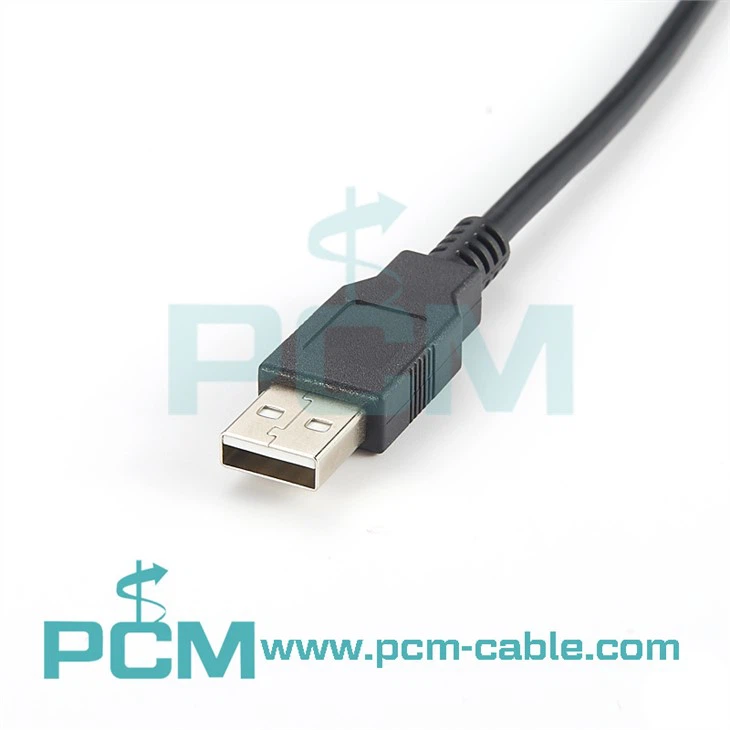

So, how can you test the mechanical stress tolerance of a serial cable? Well, there are some simple tests you can do at home or in a basic lab setting. For bending stress, you can slowly bend the cable around different radii and check if the signal is still being transmitted properly. You can use a continuity tester or a device that can measure the electrical properties of the cable. For tensile stress, you can attach a known weight to the end of the cable and see if it can hold up without any visible damage or change in performance.
In a professional setting, more advanced testing equipment is used. These machines can simulate different types of mechanical stress, like cyclic bending and high - force pulling, and measure the cable's performance over time. This helps manufacturers ensure that their cables meet the required standards for mechanical stress tolerance.
If you're in the market for serial cables, it's crucial to consider the mechanical stress tolerance. A cable that can't handle the stress in your application is going to cause you headaches down the line. You might have to replace the cable frequently, which can be costly and time - consuming. And in some cases, a failed cable can even lead to system downtime, which can be a real problem for businesses.
As a serial cable supplier, we understand the importance of providing high - quality cables with good mechanical stress tolerance. We've spent a lot of time researching and developing our products to make sure they can withstand the rigors of different applications. Whether you're using serial cables in a home office, a factory, or a data center, we have the right cable for you.
If you're interested in learning more about our serial cables or want to discuss your specific requirements, we'd love to hear from you. You can reach out to us to start a conversation about your needs. We can help you choose the right cable based on the mechanical stress it will face in your application. Don't hesitate to get in touch and let's work together to find the perfect serial cable solution for you.
References
- "Cable Engineering Handbook"
- "Electrical and Electronic Wiring Practices"





