USB 3.1 Type-C Male-to-Male Waterproof Cable: Features, Applications and Selection Guide
Learn how the PCM-KW-560 USB 3.1 Type-C male-to-male waterproof cable combines 10Gbps USB data, up to 100W USB PD, IP67 protection, a locking connector and EMI shielding for industrial, outdoor and test equipment.
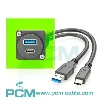
PCM-KW-560 is a 1.5m USB 3.1 Gen 2 Type-C male-to-male waterproof cable supporting up to 10Gbps data and 100W USB PD in compatible systems. It combines IP67 protection, EMI shielding, a locking USB-C structure, UL2725 cable and industrial overmolding for demanding equipment connections.
Quick Product Introduction
PCM-KW-560 is a 1.5m USB 3.1 Gen 2 Type-C male-to-male cable designed for compatible high-speed, high-power and environmentally protected industrial connections.
| Product Name | USB 3.1 Type-C Male-to-Male Waterproof Cable |
| Premier Cable P/N | PCM-KW-560 |
| Connector A | Waterproof USB Type-C Male |
| Connector B | USB Type-C Male |
| Length | 1500+25mm |
| USB Version | USB 3.1 Gen 2 |
| Protection | IP67 |
| Locking | Lock Structure |
| Cable | UL2725 |
PCM-HD-0117 vs IX to RJ45 Male Cable
| Comparison Items | PCM-KW-560 | Ordinary USB-C Cable |
|---|---|---|
| USB-C Male-to-Male | Yes | Yes |
| USB 3.1 Gen 2 | Yes | View Products |
| IP67 | Yes | Usually No |
| Lock Structure | Yes | Usually No |

What Is a USB 3.1 Type-C Male-to-Male Waterproof Cable ?
The USB 3.1 Type -C male-to-male waterproof cable is a type of USB connection line that uses both ends with USB Type-C male connectorsand combines high-speed data lines, power lines, shielding structures, and environmental sealing components.
PCM-KW-560 can be represented as:
Industrial Device → Waterproof USB-C Male → USB 3.1 Gen 2 Cable → USB-C Male → Host / Peripheral/ Power Source
Its main purpose is to achieve simultaneously in compatible USB-C systems:
Data + Power
And enhance connection reliability in industrial applications through waterproof, locking, and shielding structures.
Does a USB-C Male-to-Male Cable Have a Fixed Direction ?
A standard passive USB-C male-to-male cable normally has no fixed A-to-B data transmission direction. Communication depends on the connected devices' Host / Device (DFP / UFP) roles and supported USB protocols, while the CC lines participate in connection and role detection.
Therefore, data direction cannot be determined simply from connector A or B. In USB PD applications, power flow also depends on the negotiated Source / Sink roles. Actual data and power behavior should be verified according to both devices, protocol support, and cable capabilities.

Common Industrial USB Challenges
USB-C can combine high-speed data and power in a single compatible connection.
Core Product Value

PCM-KW-560
The value of PCM-KW-560 can be summarized as follows:
◆ High-Speed USB-C Connectivity
PCM-KW-560 features a USB Type-C male-to-male configuration designed for USB 3.1 Gen 2 data rates up to 10Gbps. Its 1.5 m length balances installation flexibility with high-speed link requirements, making it suitable for industrial computers, control equipment, test instruments, and other USB-C devices.
◆ High-Power USB PD CapabilityIn addition to high-speed data transmission, PCM-KW-560 provides a power path for up to 100W USB PD with compatible equipment. This allows a single USB-C cable to support both data and power connections, reducing separate power wiring and interfaces. Actual power delivery depends on the source, sink device, PD negotiation, and cable current capability.
◆ IP67 Protection & Locking Structure
PCM-KW-560 combines an IP67 protection design with a locking structure for demanding industrial installations. When properly mated, locked, and sealed under specified conditions, the interface provides improved protection against dust and water while reducing the risk of accidental disconnection caused by vibration, movement, or long-term operation.
◆ Industrial Cable & Shielding Design
The cable incorporates UL2725 cable construction, EMI shielding, and UL94V-0-rated materials where applicable, balancing high-speed signal integrity, electromagnetic interference resistance, and industrial material requirements. The shielding helps protect high-speed differential signals in electrically noisy environments, while durable cable construction supports industrial control, testing, and automation applications.

Products Display

Similar products

Compatibility Statement
Compatibility Verification
- PCM-KW-560 uses a USB Type-C male-to-male configuration, but identical USB-C connector shapes do not guarantee identical data, power, or locking capabilities.
- Before selection, verify USB 3.1 Gen 2 / 10Gbps support, Host/Device roles, USB PD compatibility, required power level, operating voltage and current, as well as the corresponding locking interface on both devices. Full compatibility requires the mechanical interface, electrical capabilities, and USB protocol requirements to match.
Passive Transmission & Link Performance
- The specified 10Gbps data rate and up to 100W power capability are system-level performance characteristics, not features determined solely by the USB-C connector or cable construction.
- Actual performance depends on device controllers, USB protocol support, PD negotiation, voltage/current profiles, high-speed differential-pair integrity, cable length, and applicable E-Marker requirements. In addition, IP67 protection generally depends on the connector being properly mated, locked, and sealed under the specified installation conditions; it should not be assumed to apply equally when the interface is unmated.
How to choose USB 3.1 Type-C waterproof cable ?
How Do I Verify USB Speed Compatibility ?
Verify that both the host and peripheral support USB 3.1 Gen 2 and the required high-speed lanes. The slowest device in the link limits actual performance.
How Do I Verify 100W USB PD ?
Confirm the source, sink, USB PD profile, cable current rating and applicable e-marker support before specifying 100W operation.
How Do I Verify Waterproofing and Lock Compatibility ?
Verify the mating receptacle, sealing geometry and locking mechanism. Waterproof and locking performance depend on the complete assembled interface.
How Do I Match the Cable to the Environment ?
For continuous-flex, oil, chemical, temperature or UV exposure, verify the specific cable-material and flex-life requirements separately.
Customization Capabilities
↕ Custom USB-C Connector
Standard, waterproof and locking USB-C connector structures can be customized for equipment integration.
□ Custom Locking Structure
Locking geometry and mechanical retention can be customized to match the mating equipment.
◉ Custom Cable Length
Cable length can be customized, with high-speed validation recommended for changed configurations.
⚙ USB Data Configuration
USB data configurations can be developed according to required USB generation and signal routing.
⌘ USB PD Power Customization
Power capability can be customized according to USB PD, current, conductor size, e-marker and thermal requirements.
◇ Waterproof Structure
Waterproof caps, sealing rings and connector mating structures can be customized for environmental protection.
Conclusion:
PCM-KW-560 integrates USB 3.1 Gen 2 data, high-power USB PD, IP67 protection, locking retention and EMI shielding into one industrial USB-C male-to-male cable assembly.
Its performance should always be evaluated as part of the complete USB system. USB-C connector shape alone does not establish data speed, power level, waterproof performance or device compatibility.
Product FAQ
What Does the Locking Structure Do ?
The lock improves connector retention in vibration or movement-prone environments.
Does the Lock Work with Every USB-C Receptacle ?
The USB-C interface may mate, but the locking function requires a compatible mechanical receptacle design.
What Is the Purpose of EMI Shielding ?
EMI shielding helps protect high-speed USB signals from external electrical noise.
Can the Cable Length Be Customized ?
Yes. Cable length can be customized with high-speed validation recommended for each configuration.
How Do I Confirm Compatibility ?
Provide the device model, USB specification, data rate, USB PD requirement, cable length, locking geometry and environmental conditions for engineering verification.