What Does This Article Cover?
In broadcast systems, recording studios, stage productions, professional AV installations and lighting-control environments, RJ45 8P8C interfaces are often used as compact multi-conductor signal interfaces, while XLR 3-pin connectors are widely used for balanced audio, DMX and selected control equipment.
When two devices use different physical connectors but compatible signal definitions, a properly engineered RJ45-to-XLR adapter with a defined pin mapping is required.
Using the Premier Cable PCM-KW-674 RJ45 Female to XLR 3-Pin Male Audio Adapter Cable as an example, this article explains RJ45 and XLR fundamentals, the use of structured cabling for audio or control signal transport, shielding, compatibility limitations, product selection, applications and OEM/ODM customization.
Quick Product Introduction
PCM-KW-674 uses the following configuration:
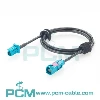
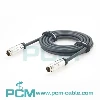
RJ45 8P8C Female → 21 cm Shielded Cable → XLR 3-Pin Male
One end uses an RJ45 8P8C female receptacle that can connect to standard CAT5, CAT5e or CAT6-type cabling. The other end uses a nickel-plated XLR 3-pin male connector for equipment with a compatible audio or control pin assignment.
The cable uses 24AWG red/white signal conductors with tinned-copper braided shielding, an approximate 6.0 mm outer diameter and a light-green PVC 90P jacket.
| Product Name | RJ45 FemaletoXLR3-PinMale Audio Adapter Cable |
| Premier Cable P/N | PCM-KW-674 |
| Connector A | XLR 3-Pin Male |
| Connector B | RJ45 8P8C Female |
| Cable Length | 210+10 mm |
| Typical Cabling | CAT5/CAT5e/CAT6 |
| Conductors | 24AWG Dual Conductors |
| Shielding | Tinned-Copper Braid |
| Cable OD | 6.0 mm |
Compatibility Statement
PCM-KW-674 uses standard RJ45 8P8C and XLR 3-pin physical connectors, but it should not be treated as a universal RJ45-to-XLR converter.
Proper operation requires all of the following:
● the RJ45 equipment uses the same pin mapping as the adapter;
● the XLR equipment uses a compatible 3-conductor signal definition;
● the signal type and electrical level are appropriate;
● the CAT5/CAT5e/CAT6 cable is wired according to the system requirements.
Therefore:
Physical mating does not automatically guarantee system compatibility.


Technical Compatibility Notice:
PCM-KW-674 is intended for physical interface adaptation and signal extension. It does not perform Ethernet protocol conversion, analog-to-digital conversion, impedance conversion or signal amplification.
In this application, RJ45 is simply used as an 8P8C multi-conductor connector.
In other words:
An RJ45 connector does not necessarily mean Ethernet.
When RJ45 is used in audio or control equipment, each pin may be assigned by the equipment manufacturer to analog audio, digital audio, DMX, GPIO or other low-voltage signals.
The equipment manufacturer's pin assignment should therefore always be verified before connection.
Basic Product Knowledge
What Is an RJ45 Female to XLR 3-Pin Male Adapter Cable ?
An RJ45 female to XLR 3-pin male adapter cable is a passive cable assembly that maps selected conductors from an RJ45 8P8C interface to an XLR 3-pin interface.
It typically consists of an RJ45 receptacle, XLR male connector, internal conductors, shielding and an outer jacket.
Its purpose is not to convert Ethernet data into audio. Instead, it routes compatible signals from defined RJ45 pins to corresponding XLR pins according to a specified pin mapping.
Why Use Braided Shielding ?
Broadcast rooms, stages, consoles and equipment racks often contain power cables, lighting-control lines, digital equipment and other electronic systems, resulting in a relatively complex electromagnetic environment.
PCM-KW-674 uses tinned-copper braided shielding to help reduce unwanted electromagnetic coupling into the signal conductors when combined with proper grounding and system design.
However:
Shielding does not replace correct balanced wiring, grounding or pin mapping.
Why Can CAT5/CAT5e/CAT6 Cable Carry Audio or Control Signals ?
CAT5, CAT5e and CAT6 cables contain multiple twisted conductor pairs.
The twisted-pair geometry helps reduce common-mode interference, which is why structured cabling is used not only for Ethernet but also by some professional equipment manufacturers for low-level balanced signals and control lines.
The RJ45 female interface on PCM-KW-674 allows compatible signals to be extended through existing structured cabling, reducing the need for dedicated new cable runs.
Pain Points and Product Value
Challenge 1:
Different Equipment Uses Different Connectors
Broadcast, audio and lighting equipment may use a centralized RJ45 interface on one side while maintaining conventional XLR connectivity on the other.
PCM-KW-674 provides a compact physical adapter between these connector formats for compatible equipment.
Challenge 2:
Rewiring with Dedicated Audio Cable Can Be Expensive
Broadcast facilities, equipment rooms and AV installations often already contain extensive CAT5/CAT6 structured cabling.
If the connected equipment supports compatible signal transport over RJ45, the existing cabling can be reused for extension, reducing the need for additional dedicated audio wiring.
Challenge 3:
Unshielded Adapters May Increase Noise Risk
Industrial equipment often contains power supplies, control boards, PLCs, relays and multiple cable harnesses in a limited space.
Overly long Ethernet patch cables can create unnecessary cable accumulation.
The standard 300±15 mm length of PCM-0164 is well suited for short internal connections between an Ethernet port and a nearby equipment panel.
RJ45-to-XLR Adapter vs. Standard XLR Audio Cable
A conventional XLR cable is intended for direct connection between standard XLR interfaces, while an RJ45-to-XLR adapter is better suited to systems that already use RJ45 distribution, patch panels or CAT cabling infrastructure.
The two solutions are designed for different wiring architectures rather than being direct substitutes.
| Item | RJ45-to-XLR Adapter | StandardXLR Cable | |
| Interface | RJ45 Female to XLR Male | XLR to XLR | |
| Purpose | Interface Adaptation, Structured Cabling Adapter | Direct audio device connection | |
| PinMapping Dependency | High | Lower | |
| Structured CableExtension | Supported incompatible systems | Not directly | |
| Cable Length | Short adapter | Various lengths | |
| Installation | Cabinet, console, Patch interface | Stage, equipment room direct connection |
PCM-KW-674 RJ45 Female to XLR 3-Pin Male
PCM-KW-674 is designed for professional interconnection applications requiring an RJ45 female interface to an XLR male connector.Its architecture is:
RJ45 8P8C Female → 24AWG 2C Shielded Cable → XLR 3-Pin Male
The 21 cm length reduces cable congestion around equipment and racks, while the tinned-copper braid helps with interference control. The nickel-plated XLR male connector provides mechanical durability, and the PVC 90P jacket supports flexible routing and cable protection.
Applications:
Suitable for broadcast stations, recording studios, professional mixers, audio distribution equipment, stage sound systems, DMX lighting equipment, AV racks and other systems using compatible RJ45/XLR signal definitions.

Products Display

How to Select an RJ45-to-XLR Audio Adapter Cable ?
First Priority: Verify the Pin Mapping
Pin mapping is the most important selection criterion for an RJ45-to-XLR adapter.
Different equipment manufacturers may use completely different assignments on the same RJ45 8P8C connector.
If the pinout is incompatible, physical mating may still be possible but the result may be no signal, incorrect routing or potential equipment problems.
Determine Whether Shielding Is Required
Shielded construction is generally preferred in broadcast rooms, stages, equipment racks, dense AV systems and electrically noisy environments.
However, overall shielding effectiveness also depends on equipment grounding, CAT-cable shield continuity and the complete system design.
Confirm the Signal Type
Determine whether the equipment carries balanced analog audio, AES digital audio, DMX or another control signal.
Different signal types have different requirements for pinout, impedance, cable construction and topology, so identical connectors do not imply interchangeability.
Confirm CAT Cable Type and Wiring
CAT5, CAT5e and CAT6 can all serve as multi-pair structured cabling, but suitability depends on the equipment manufacturer's specification.
For longer runs, verify cable category, shielding, wiring scheme, total length and the system's recommended distance.
Customization Capabilities
1.Custom Pin Mapping
RJ45 8P8C-to-XLR 3-pin wiring can be customized according to the customer's equipment pin assignment.
This is one of the most important OEM/ODM customization items for this type of adapter.
2.XLR Gender Customization
XLR 3-pin male or female configurations can be selected according to the mating equipment and required signal connection direction.
3.Custom Cable Length
The standard PCM-KW-674 length is 210±10 mm, with alternative lengths available for rack, equipment rear-panel and console layouts.
4.Conductor and Shielding Customization
Different conductor gauges, shielding structures and cable constructions can be evaluated according to the audio or control signal and installation environment.
5.Jacket Color and Material Customization
PVC jacket color, material and identification can be customized for channel management, system recognition and OEM branding.
The light-green jacket can also help technicians distinguish a specific signal path inside dense equipment racks.
6.Labeling and Packaging Customization
Custom P/N labels, channel identifiers, direction markings, equipment names, packaging and BOM requirements can be supported for broadcast, AV and systems-integration projects.
Frequently Asked Questions
01.Can It Convert Ethernet Data into XLR Audio ?
No.
PCM-KW-674 contains no protocol-conversion electronics, ADC, DAC or network-audio decoding circuitry.
It only provides conductor routing according to a defined pin mapping and therefore cannot directly convert standard Ethernet data into analog XLR audio.
02.Why Can an RJ45 Connector Carry Audio ?
RJ45 8P8C is fundamentally an eight-contact connector.
Equipment manufacturers can assign those contacts to Ethernet, analog audio, digital audio, DMX or other signals.
Whether it carries audio therefore depends on the equipment pinout, not the physical RJ45 form alone.
03.Can Standard CAT5e Cable Be Used for Extension ?
Yes, when the equipment manufacturer supports it and the required pin mapping is correctly maintained.
Cable length, shielding, wiring scheme and installation environment should also be considered.
An RJ45 connector alone does not mean that every CAT5e cable is suitable for every system.
04.Will CAT6 Automatically Provide Better Audio Than CAT5e ?
Not necessarily.In this type of application, actual performance depends mainly on signal type, twisted-pair construction, shielding, cable length, connected equipment and pin mapping.
CAT6 has a higher Ethernet category rating, but that does not automatically mean audible improvement in every analog audio or control application.
Get In Touch