Why does LiDAR need professional cable assemblies ?
speed thenet coimicat on sensor data ran ssoneupmeneynronizaton mecnnaaonon e oeieiabily uinder
complex environments.
Especially in automotive applications, radar is typically installed on the roof, bumper,.front compartment, or other space-constrained areas,the harness must pass through complex internal vehicle paths to connect to the domain controller or central computing platform.
Therefore, selecting the appropriate LiDAR Cable Assembly based on the specific radar model helpsreduce intermediate nodes and makes device interfaces and harness layouts clearer.
Premier Cable can provide customized LiDAR Cable Assemblies with different cable lengths, interface configurations, and wire structures based on
actual project requirements,establishing reliable connections between radar, ADAS controllers, data acquisition devices, and robot computingplatforms.
What Are The Differences Between Three Lidar Harnesses ?
| Comparison Item | PCM-ZC-0129 | PCM-ZC-0200 | PCM-XQD-0002 |
| Corresponding Brand | Hesai Hesai | Hesai Hesai | RoboSense Speedtong Juchuang |
| Corresponding Radar | AT128 | OT128 | E1R |
| Radar Positioning | Vehide-grade forward long-range LiDAR | 360° Automotive Grade Long-Range LiDAR | Fully Solid-State Robot LiDAR |
| Main Perception Features | 120 Forward High Resolution Perception | 360 degrees of environmentalperception | 120°x90° ultra-wide field of view |
| Typical System | ADAS, Advanced Driving Assistance Systems | Robotaxi, Robotruck, L4platform | AMR, Unmanned Delivery, Robots |
Features
-
High-Speed Data Transmission & EMI Protection
Designed for continuous transmission of high-density LiDAR point-cloud and perception data, the cable assembly supports Automotive Ethernet architectures with optimized impedance control, twisted-pair construction, shielding, and grounding. These features help maintain signal integrity and EMI resistance between LiDAR sensors and ADAS computing platforms in electrically complex vehicle environments.
-
Integrated Power, Data & Model-Specific Connectivity
Power, Ethernet data, control, and required signals can be integrated into one LiDAR cable assembly according to the sensor interface. Model-specific connectivity for Hesai AT128, Hesai OT128, RoboSense E1R, and other platforms reduces unnecessary adapters, simplifies system architecture, and improves LiDAR installation, commissioning, and integration efficiency.
-
Compact Routing & Reliable Mechanical Connection
Optimized cable lengths, exit directions, connector structures, and breakout configurations support compact routing in vehicle roofs, bumpers, body areas, and robotic platforms. Secure connector locking, strain relief, and cable retention help reduce connection failures caused by vibration, mechanical shock, movement, cable bending, and installation stress.
-
Environmental Durability & Flexible Customization
Connector, cable, and jacket materials can be selected for automotive and robotic environments involving temperature variation, abrasion, and other operating challenges. Custom cable lengths, connector combinations, wire specifications, breakout structures, and labeling are available for OEM, Tier 1, HIL testing, autonomous-driving R&D, robotics, and production integration.
Products Description
Hesai AT128 LiDAR Sensor Cable
◆ Premier Cable P/N: PCM-ZC-0129
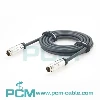
PCM-ZC-0129 is a dedicated Hesai AT128 LiDAR Sensor Cable developed for connectivity between the AT128 LiDAR and associated vehicle control, power or data infrastructure.
Hesai AT128 is an automotive-grade, high-resolution long-range LiDAR featuring a wide horizontal field of view and designed for ADAS and intelligent vehicle perception applications.
Because automotive LiDAR sensors are often installed in restricted spaces and exposed to vehicle vibration, an AT128 LiDAR cable assembly needs to consider connector compatibility, cable routing, installation layout and long-term connection reliability.
Premier Cable can customize the Hesai AT128 LiDAR Cable according to equipment interfaces, installation positions and required cable lengths for autonomous driving development vehicles, ADAS test systems and LiDAR data acquisition platforms.

Hesai OT128 LiDAR Sensor Cable
◆ Premier Cable P/N: PCM-ZC-0200
PCM-ZC-0200 is developed for Hesai OT128 LiDAR connectivity and can be used between the LiDAR sensor and autonomous driving computing platforms, control systems or related data equipment.
The OT128 is a 360-degree automotive-grade high-performance long-range LiDAR designed for applications such as Robotaxi, Robotruck and autonomous driving development platforms.
Its communication architecture includes Automotive Ethernet, making connector compatibility, Ethernet connectivity and vehicle cable routing important considerations when configuring a Hesai OT128 LiDAR Cable.
Premier Cable can provide application-specific OT128 cable assemblies to establish a practical physical connection between the LiDAR sensor, domain controller, central computing unit or test equipment for prototype development, laboratory testing and vehicle integration.

RoboSense E1R LiDAR Ethernet Power Cable
◆ Premier Cable P/N: PCM-XQD-0002
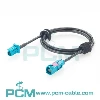
PCM-XQD-0002 is a dedicated RoboSense E1R LiDAR Ethernet Power Cable designed to provide network and power connectivity between the E1R LiDAR and robotic computing or control platforms.
Compared with conventional automotive long-range forward-facing LiDAR sensors, the RoboSense E1R is primarily designed around robotic perception applications, including obstacle avoidance, environmental mapping, autonomous navigation, AMRs and autonomous delivery equipment.
Within compact robotic platforms, LiDAR sensors, power systems, network equipment and controllers are often installed within limited internal space. A properly configured RoboSense E1R Cable can simplify Ethernet communication, power connectivity and internal cable routing.
Premier Cable can provide E1R LiDAR cable assemblies with different cable lengths and connector configurations according to robotic system requirements.

Products Display


Product advantages
Stable High-Speed Transmission
Optimized impedance control, shielding, twisted-pair construction, and termination help maintain LiDAR Ethernet signal integrity, resist EMI, and provide stable point-cloud data transmission for ADAS and robotic computing platforms.
Direct Connection & Integration
Model-specific interfaces for Hesai AT128, OT128, RoboSense E1R, and other LiDAR platforms enable direct sensor connectivity while integrating data, power, and required signals to reduce adapters and simplify system integration.


Reliable & Efficient Installation
Secure locking, strain relief, optimized cable routing, and custom lengths support vibration, movement, bending, and restricted installation spaces while improving wiring efficiency in ADAS, Robotaxi, and AMR platforms.
Customization & Multi-Platform Support
Custom connector combinations, cable lengths, and constructions support multiple LiDAR platforms from R&D and HIL testing to autonomous vehicle, Robotaxi, AMR, and production integration, providing scalable LiDAR cable assembly solutions.
Core Application Scenarios

ADAS & Advanced Autonomous Driving
Designed to connect LiDAR sensors such as Hesai AT128 with ADAS domain controllers, central computing platforms, and vehicle perception systems. It supports high-speed point-cloud data, power, and related signals for L2+ to L4 autonomous vehicles, intelligent passenger cars, and Robotaxi platforms, with customizable connectors and cable lengths for vehicle integration.

Autonomous Driving R&D & HIL Testing
Suitable for LiDAR prototyping, HIL testing, laboratory validation, point-cloud data acquisition, and autonomous vehicle road testing. The cable assembly can connect LiDAR sensors with DAQ equipment, simulation platforms, and central computers, with customizable lengths, connectors, breakouts, and power/data configurations for validation, debugging, and system integration.

Autonomous Heavy Trucks & Smart Logistics
Suitable for autonomous heavy trucks, port tractors, mining vehicles, and smart logistics platforms, linking Hesai OT128 LiDAR sensors mounted on cab roofs, front structures, or vehicle perimeters to onboard computing systems. The dedicated LiDAR harness simplifies power and data routing in long-duration, vibration-prone vehicle environments while supporting easier assembly, troubleshooting, sensor servicing, and cable management.
Frequently Asked Questions
01.Are Hesai AT128 and OT128 LiDAR cables interchangeable?
02.What information should I provide when ordering a Hesai or RoboSense LiDAR cable?
03.Can LiDAR cable length and connector configurations be customized?
04.Can these LiDAR cable assemblies be used for Robotaxi and autonomous vehicle development?
Get In Touch